Schlagwortarchiv: Menschenbild

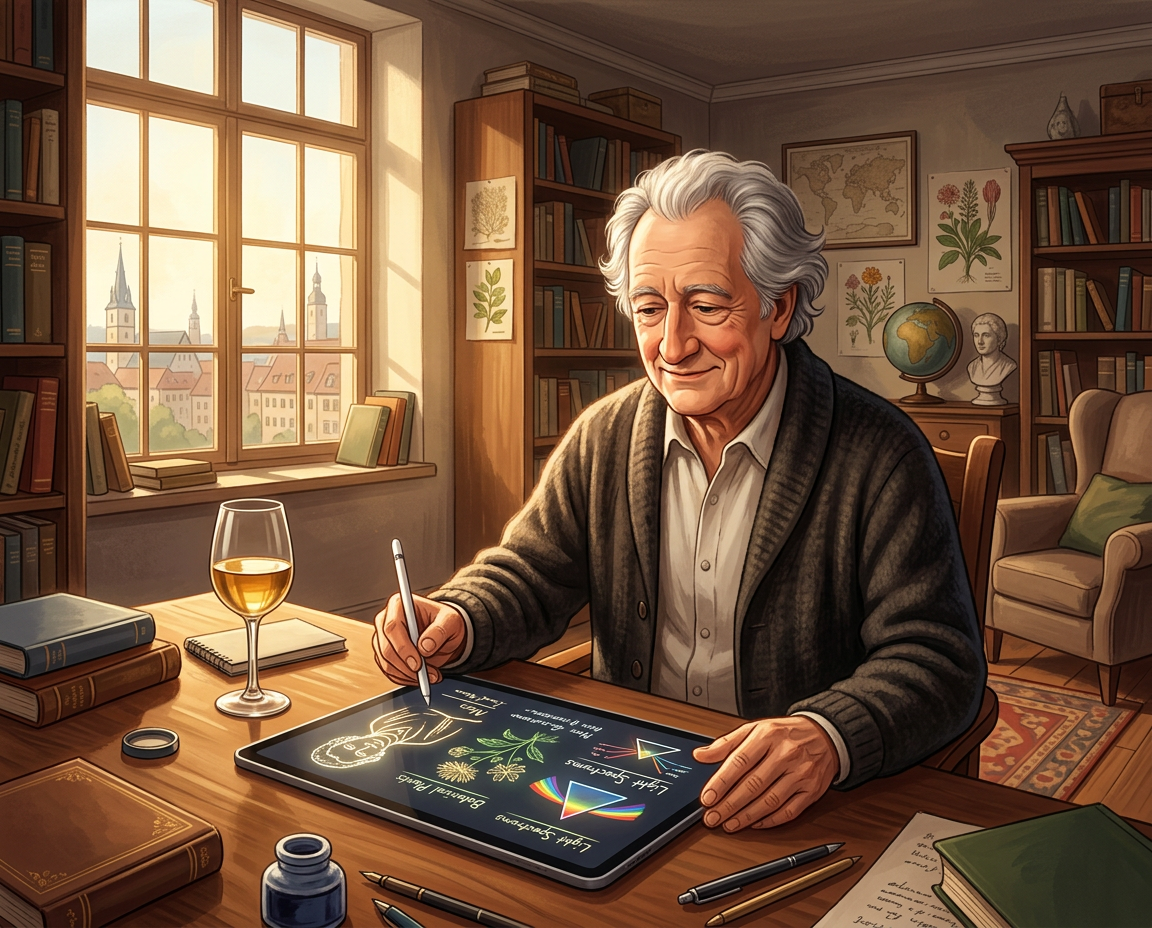
Freedom is not a state of being, but a daily struggle. Get together in the real world! How Goethe would assess the global crisis of our time, what he would demand of politicians and the public, and what solutions he might envisage.

Andreas Peglau in conversation with OPEN AI, 15 August 2026.


Image: AI-generated, created with Adobe Firefly based on a concept by ChatGPT / OPEN AI and Andreas Peglau

Image: AI-generated, created with Adobe Firefly based on a concept by ChatGPT / OPEN AI and Andreas Peglau


Download as pdf  


Preliminary note: I have amended the following text only to the extent that I have inserted my name and ‘OPEN AI’, and deleted topic suggestions from the AI that we did not address. The AI, for which all conversations start from scratch, had no information about me other than what I had written to it, so it did not know who I was either.
In four places, I have subsequently highlighted quotes from OPEN AI that required correction (see footnotes). Weiterlesen

Freiheit ist kein Zustand, sondern ein täglicher Kampf. Geht analog zusammen! Wie Goethe die globale Krise unserer Zeit bewerten, was er von Politikern und Bevölkerung fordern, welche Auswege er sehen könnte. Ein Gedankenexperiment

Andreas Peglau im Austausch mit OPEN AI, 15. August 2026.


Bild: KI-generiert, erstellt mit adobe firefly nach einem Konzept von ChatGPT / OPEN AI und Andreas Peglau.

Bild: KI-generiert, erstellt mit adobe firefly nach einem Konzept von ChatGPT / OPEN AI und Andreas Peglau.


Text herunterladen.


Vorbemerkung: Den folgenden Text habe ich nur insofern geändert, dass ich meinen Namen und „OPEN AI“ eingefügt sowie Themenvorschläge der KI gelöscht habe, auf die wir nicht eingegangen sind. Die KI, bei der ja alle Gespräche am Punkt Null beginnen, hatte über mich ausschließlich das an Information, was ich ihr geschrieben habe, wusste also auch nicht, wer ich bin.
An vier Stellen habe ich im Nachhinein auf zu korrigierende Zitate von OPEN AI verwiesen (siehe Endnoten).


*


Andreas Peglau: Hallo. Ich habe mit Dir vor kurzem sehr ertragreiche Gespräche über Marx und Engels geführt darüber, wie sie vermutlich die politische Entwicklung seit 1990 einschätzen würden.
Du konntest das beurteilen, weil Du unter anderem die Gesammelten Werke von Marx und Engels und diverse Sekundärliteratur dazu gespeichert hast.
Bist Du in Bezug auf Johann Wolfgang von Goethe (1749 –1832) ähnlich kompetent?


OPEN AI: Ja, ich kenne das Leben, die Briefe, Tagebücher, Dramen und Gedichte von Goethe sehr gut und kann versuchen, seine Sicht auf die Welt oder bestimmte Themen einzuschätzen.

Kompetenzen zu Goethe

  • Werke und Briefe: Ich kenne seine großen Romane, Dramen sowie seine naturwissenschaftlichen Schriften.
  • Zeitgeist: Ich kann seine Haltung zu historischen Ereignissen wie der Französischen Revolution einordnen.
  • Weltanschauung: Seine Ideen zu Humanismus, Kunst und Natur sind mir vertraut.

Wenn Du möchtest, lass uns starten: Zu welchem Thema oder welcher Lebensphase von Goethe möchtest Du seine Sichtweise erfahren?


Andreas Peglau: Unsere Ausgangsbasis sollte der alte, über 80-jährige Goethe sein, der im Vollbesitz seines Wissens, Könnens und seiner gesammelten Erfahrungen ist.

Wie würde er wohl die heutige politische Weltlage einschätzen?  Weiterlesen

Menschen aller Länder, erkennt euch selbst – und befreit euch gemeinsam! Marx und Engels über den Zusammenbruch des realen Sozialismus, eigene Fehleinschätzungen, die Rolle der Psyche, die aktuelle Weltsituation und heutige Chancen für den Aufbau des Sozialismus

Andreas Peglau befragt den KI-Assistenten von OPEN AI.
Ein Gedankenexperiment vom
27. Juli 2026


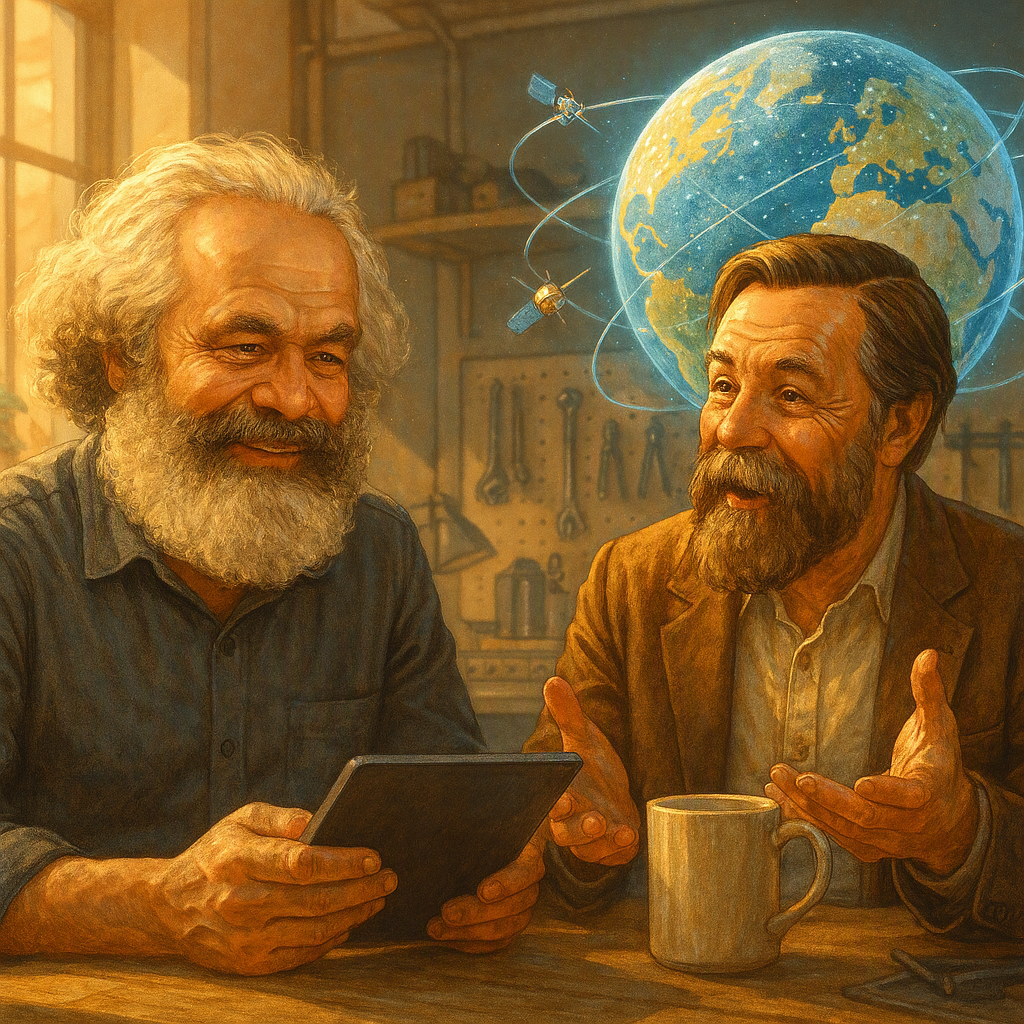
Karl Marx und Friedrich Engels 2026: "Es gibt viel zu tun."Bild: KI-generiert, erstellt mit designer.microsoft.com nach einem Konzept von ChatGPT / OPEN AI. Vorschlag: Andreas Peglau

Bild: KI-generiert, erstellt mit designer.microsoft.com nach einem Konzept von ChatGPT / OPEN AI.

Text als pdf herunterladen. 


Vorab

Zu Lebzeiten haben sich Marx und Engels meist eher intolerant verhalten gegenüber abweichenden Sichtweisen. Aus der Luft gegriffen ist der abrupte Perspektivwechsel, den OPEN AI den beiden im Folgenden zubilligt, dennoch nicht. Marx wandte sich in seinen letzten Jahren intensiv ethnologischer Literatur und damit über die Ökonomie hinausreichenden Fragestellungen zu. Und Engels anerkannte 1893, zehn Jahre nach dem Tod von Marx, dass sie bei der „Ableitung der politischen, rechtlichen und sonstigen ideologischen Vorstellungen und durch diese Vorstellungen vermittelten Handlungen […] die Art und Weise, wie diese Vorstellungen etc. zustande kommen“, vernachlässigt hatten. Warum also sollten Marx und Engels, soeben wieder zum Leben erweckt, sich nicht voller Tatendrang auf neue Aufgaben und Informationen stürzen – inzwischen angesammeltes Wissen über psychosoziale Zusammenhänge inklusive?

Wer sich von einer KI Informationen übermitteln lässt, sollte jede Quelle, jedes Zitat, jede Kernaussage noch einmal überprüfen – und wird oft feststellen, dass Fehler vorliegen. Doch ebenso klar ist mir inzwischen durch eine Reihe von Kontakten mit OPEN AI: Wo für komplexe Sachverhalte eine Vielzahl für die KI erreichbarer, seriöser Informationen vorliegt – in Bezug auf die Theorien von Marx und Engels ist das der Fall – und ich zugleich kompetent bin, die KI-Antworten zu beurteilen, lässt sich in faszinierender Weise Wissen aufbereiten. Ich muss auch nicht die „Meinung“ der KI teilen, um davon zu profitieren: Sie verschafft mir spannende Ansatzpunkte, um selbst weiterzudenken. Weiterlesen

Die psychosoziale Revolution. Tarek Al-Ubaidi im Gespräch mit Andreas Peglau

Freitag, 15. Mai 2026, 19:00 bis 21 Uhr.
Im CROPfm-Archive anhören; https://cropfm.at/archive/show/psychosozial

https://cropfm.at/images/570-Psychosoziale-Revolution-750.jpg

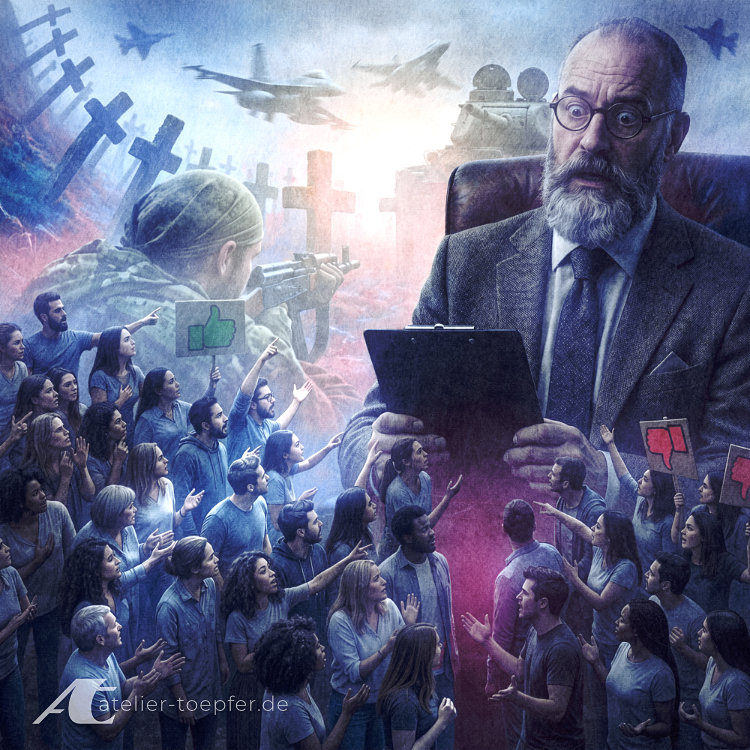
Illustratiion: Matthias Töpfer, https://atelier-toepfer.de/


Wenn wir, wie sich nicht nur augenscheinlich, sondern letztlich auch wissenschaftlich belegen lässt, als sensible, mitfühlende, liebevolle, liebenswerte, neugierige, kreative und nicht zuletzt auch prosoziale Wesen auf die Welt kommen, wieso sieht die Welt dann so aus, wie sie es gerade tut?


Andreas Peglau ist überzeugt, dass die Gesellschaft nicht nur durch ökonomische Bedingungen geformt wird, sondern auch der psychische Zustand der einzelnen Individuen unser Zusammenleben maßgeblich prägt. Er fordert eine Psychosoziale Revolution, die auch politisch-ökonomische Umwälzungen enthält.


People as puppets? How Marx and Engels suppressed the real psyche in their teaching (complete text and download)

by Andreas Peglau


Download as pdf: AP People as puppets – How Marx and Engels suppressed the real psyche in their teaching


Please note that this text has a continuation as of March 20, 2026: People are NO puppets! A utopia that goes beyond Karl Marx—and whose realization can begin tonight

On June 23, 2026, I also published an „Addendum to my critique of Marx“: No socialism without slavery, war as a great communal work.


This is a DeepL translation I have not checked.
I apologize for any errors and inaccuracies that are sure to occur.
Please use the original German text, written in 2024, for comparison:
https://andreas-peglau-psychoanalyse.de/menschen-als-marionetten-wie-marx-und-engels-die-reale-psyche-in-ihrer-lehre-verdraengten/).
A.P.

  Weiterlesen

People as puppets? How Marx and Engels suppressed the real psyche in their teaching, Part 1: Starting points, Max Stirner and „German Ideology“

by Andreas Peglau  


Download the entire text as a PDF file.


Starting points

Today, as the US-led „West“ accepts the destruction of the entire planet in order to maintain its „rules-based“ hegemony, there is a greater need than ever to find alternatives to irresponsible greed for profit and power, warmongering and hostility towards life.

Socialism, which had been tried out in practice, at least to some extent, in several countries, was seen as such an alternative. Its most important theoretical starting point was the teachings of Karl Marx (1818–1883) and Friedrich Engels (1820–1895), which were often distorted in the context of ‚Marxism-Leninism‘. „Real socialism“ was massively discredited early on, particularly by state terror under Stalin and later under Mao Tse Tung and Pol Pot, and collapsed around 1990. Since then, such concepts have generally been considered permanently discredited, and capitalism has been regarded as without alternative. Weiterlesen

People as puppets? How Marx and Engels suppressed the real psyche in their teaching, Part 2: Character masks

by Andreas Peglau


Download the entire text as a PDF file.


No definitive solutions

The old Engels would certainly have agreed that Marx’s teachings should be critically revisited. In 1895, six months before his death, he recapitulated in a letter: „But Marx’s whole approach is not a doctrine, but a method. It does not provide ready-made dogmas, but points of reference for further investigation.“[1] Five years earlier, he had said that the „conception of history“ developed by him and Marx was „above all a guide to study“.[2] As early as 1886, he described it as a „great fundamental idea“ of materialist dialectics „that the world should not be understood as a complex of finished things, but as a complex of processes in which the seemingly stable things undergo no less than their mental images in our heads, the concepts, a continuous change of becoming and passing away.“ Therefore, „the demand for definitive solutions and eternal truths must cease once and for all; one must always be aware of the necessary limitations of all knowledge gained.“[3]
However, anyone who consistently applied this to the concept of Marxism quickly found themselves labelled a dissident in „real socialism“ and ran the risk of being persecuted or – under Stalin – murdered.

Why should anything be further developed that Lenin had defined in 1913 as follows: „Marx’s doctrine is all-powerful because it is true. It is self-contained and harmonious; it gives people a unified world view.“[4]  Weiterlesen

People as puppets? How Marx and Engels suppressed the real psyche in their teaching, Part 3: Individual scope, Friedrich Engels, Robert Owen

by Andreas Peglau


Download the entire text as a PDF file.


Individual scope

For those who, in the second half of the 19th century, still mostly worked more than 10 hours a day for little money, there was indeed little energy and opportunity left to rise above their circumstances. For this reason alone, and because of the power imbalance, the responsibility of an individual proletarian for the capitalist economic system was minimal.
But throughout history, people have broken out of their circumstances. In 73 BCE, for example, the slaves who liberated themselves in the Spartacus uprising did so – an example that Marx was familiar with.[1] Since then, countless people have committed themselves to other people, to a wide variety of goals and ideas, even when they knew that they were putting their physical integrity or their very existence at risk. During the lifetimes of Marx and Engels, this was already happening in the struggle for liberation from capitalist oppression, as in the Paris Commune uprising of 1871. During its suppression, up to 35,000 people were massacred and thousands more were later deported.[2]

In the same year, Marx commemorated the „self-sacrificing pioneers of a new and better society“ in his work The Civil War in France.[3] Had these pioneers not cast off their „character masks“? Weiterlesen

People as puppets? How Marx and Engels suppressed the real psyche in their teaching, Part 4: Condition of the working class, empty heads and human-creating work

by Andreas Peglau


Download the entire text as a PDF file.


The condition of the working class

After spending 21 months in Great Britain researching industrial development and its consequences, Engels published his book The Condition of the Working Class in England in 1845. It contains harrowing accounts of the living conditions of the English proletariat. Engels writes of the dwellings in the London district of St. Giles, saying that

„the filth and dilapidation exceed all imagination – there is hardly a window pane intact, the walls are crumbling, the doorposts and window frames are broken and loose, the doors are nailed together from old boards or do not exist at all – here in this thieves‘ quarter, doors are not even necessary because there is nothing to steal. Piles of dirt and ashes lie everywhere, and the dirty liquids poured out in front of the doors collect in stinking puddles. This is where the poorest of the poor live, the lowest-paid workers […]“.[1]

Weiterlesen

People as puppets? How Marx and Engels suppressed the real psyche in their teaching, Part 5: What is „capital“?/ The animated monster

by Andreas Peglau


Download the entire text as a PDF file.


What is „capital“?

Marx’s three-volume work of the same name does not provide a definition of the subject referred to in the title, but rather a multitude of sometimes contradictory statements on the subject. [1]
A small selection: Capital is what becomes of a value that is ‚exploited‘ and turns into ’surplus value‘.[2] „Every new capital enters the stage for the first time […] still as money, […] which is to be transformed into capital through certain processes.“[3] „Capital is money, capital is commodity.“[4] In the third volume of Capital, it then states:

„But capital is not a thing, but a specific social relation of production belonging to a specific historical social formation, which is represented by a thing. Capital is not the sum of the material and produced means of production. Capital is the means of production transformed into capital, which in themselves are as little capital as gold and silver are money in themselves. It is the means of production monopolised by a certain section of society, which have become independent of living labour and the conditions under which this labour is performed.“[5]

According to Marx, capital is therefore simultaneously surplus value, money, commodities, products and means of production. But he believes that it is nevertheless „not a thing“ – rather, it is a production relationship, and thus, in his understanding, an extremely comprehensive category that includes raw materials, means of production and human labour, as well as the processes that take place between them and the existing „conditions of activity“.[6] Weiterlesen