Archiv der Kategorie: English section (translated articles and other)

No socialism without slavery, war as a great communal work. Addendum to my critique of Marx

by Andreas Peglau


Download as pdf


*

In “People as puppets? How Marx and Engels suppressed the real psyche in their teaching“ I demonstrated, using his endorsement of child labor as an example, that Marx’s belief in progress could lead to inhumane conclusions.[1] In the “Instructions for the Delegates of the Provisional Central Council” of the International Workingmen’s Association, written by Marx in 1866, it was stated:

“We regard the tendency of modern industry to enlist children and adolescents of both sexes in the great work of social production as a progressive, healthy, and justified tendency, although the manner in which this tendency is realized under the rule of capital is abhorrent.”[2]

As Marx knew and had documented himself on several occasions, every month of child labor cost thousands of children their health or their lives. Nevertheless, as late as 1875, he still considered a “general ban on child labor” to be

“incompatible with the existence of large-scale industry and therefore nothing more than a pious wish. Its implementation—if possible—would be reactionary, since, with strict regulation of working hours according to different age groups and other precautionary measures to protect children, the early combination of productive work with education is one of the most powerful means of transforming today’s society.”[3]

Marx must have known how futile adequate child protection was in the capitalism of 1875, especially within “large-scale industry.” Yet he gave priority to the future social transformation he hoped for over the real child poverty of his time.

The fact that a fundamental stance on the part of Marx and Engels came into play here is evident in their treatment of other, no less controversial topics. Weiterlesen

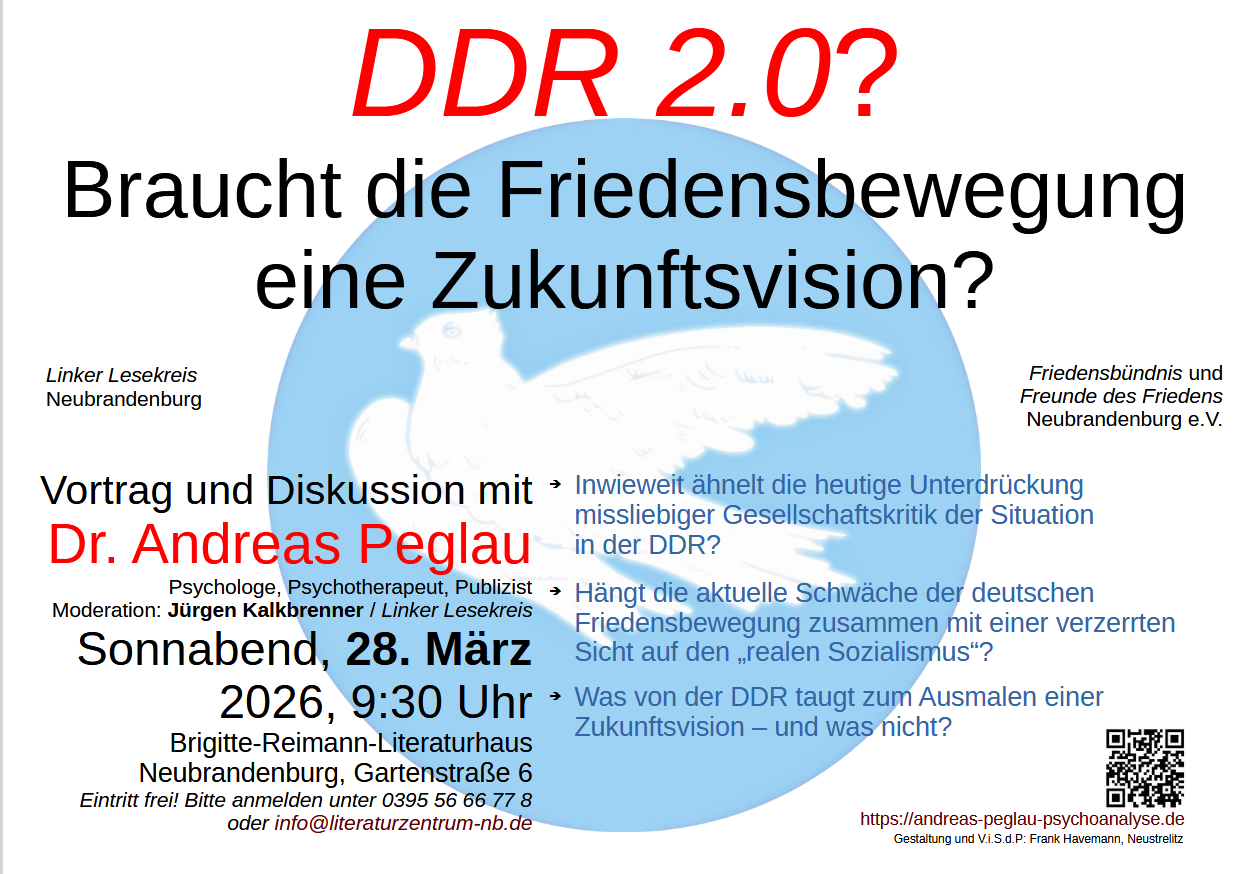
GDR 2.0? Does the Peace Movement Need a Vision for the Future?

by Andreas Peglau

Lecture delivered on March 28, 2026, at the Brigitte Reimann Literature House in Neubrandenburg[1]


Download as pdf


*

What I can offer you today is not an academic overview, but rather a mix of facts, personal experiences, and subjective assessments.

I assume that most of you also have roots in the GDR. I am aware that this may evoke very different experiences for you than it does for me. That is probably why you will not agree with everything I say; you may know some things not only differently, but also better. We can then use the discussion to compare our perspectives.

It was not easy for me to write down what I am about to read to you. I began thinking about this back in December—and was still polishing my text just yesterday. Once again, I realized: I am not done with the GDR, neither in a good way nor in a bad way.[2] Weiterlesen

People are NO puppets! A utopia that goes beyond Karl Marx—and whose realization can begin tonight

by Andreas Peglau


Download als pdf


If we are born as good beings, there is only one thing we need to do: ensure that these predisposition is allowed to flourish. Then we will inevitably build a community that is in accordance with these predisposition—and thus a good one as well. Who or what could possibly stand in our way?

*

Despite all its shortcomings, there is no more comprehensive and thoroughly developed conception of society than the one traceable to Friedrich Engels and Karl Marx. It provides detailed proof that exploitative systems such as the capitalist one are profoundly unjust, inhumane, and necessarily undemocratic. Since the socialist world system led by the Soviet Union was laid to rest around 1990, “left-wing,” non-capitalist social models have nevertheless been largely dismissed as obsolete. In doing so, something was wrongly discarded that should, however, have been holistically completed—and fundamentally revised.

Marx and Engels had only rather general, half-baked ideas about how to achieve and shape a better society. Believing in a supposed primacy of the economy, they fought against any perspective that deviated from it. As their doctrine became increasingly “economistic,” what is most essential to human beings—the psyche—disappeared from it.
In the article People as Puppets? How Marx and Engels Suppressed the Real Psyche in Their Teaching,[1] I elaborated on this point in detail in 2024. In the present text, I take up the thread once again: How do we arrive at a humane social order? Weiterlesen

People as puppets. List of 10 parts and one continuation

by Andreas Peglau


Part 1: Starting points, Max Stirner and „German Ideology“ (https://andreas-peglau-psychoanalyse.de/people-as-puppets-how-marx-and-engels-suppressed-the-real-psyche-in-their-teaching-part-1-starting-points-max-stirner-and-german-ideology/)

Part 2: Character masks (https://andreas-peglau-psychoanalyse.de/people-as-puppets-how-marx-and-engels-suppressed-the-real-psyche-in-their-teaching-part-2-character-masks/)

Part 3: Individual scope, Friedrich Engels, Robert Owen (https://andreas-peglau-psychoanalyse.de/people-as-puppets-how-marx-and-engels-suppressed-the-real-psyche-in-their-teaching-part-3-individual-scope-friedrich-engels-robert-owen/)

Part 4: Condition of the working class, empty heads and human-creating work (https://andreas-peglau-psychoanalyse.de/people-as-puppets-how-marx-and-engels-suppressed-the-real-psyche-in-their-teaching-part-4-condition-of-the-working-class-empty-heads-and-human-creating-work/)

Part 5: What is „capital“?/ The animated monster (https://andreas-peglau-psychoanalyse.de/people-as-puppets-how-marx-and-engels-suppressed-the-real-psyche-in-their-teaching-part-5-what-is-capital-the-animated-monster/)

Part 6: Strange beings and „social laws of nature“ (https://andreas-peglau-psychoanalyse.de/people-as-puppets-how-marx-and-engels-suppressed-the-real-psyche-in-their-teaching-part-6-strange-beings-and-social-laws-of-nature/)

Part 7: Doubtful pre- and review, wishful thinking (https://andreas-peglau-psychoanalyse.de/people-as-puppets-how-marx-and-engels-suppressed-the-real-psyche-in-their-teaching-part-7-doubtful-pre-and-review-wishful-thinking/)

Part 8: From Immanuel Kant to child labour (https://andreas-peglau-psychoanalyse.de/people-as-puppets-how-marx-and-engels-suppressed-the-real-psyche-in-their-teaching-part-8-from-immanuel-kant-to-child-labour/)

Part 9: Vulgar psychology, half-hearted mitigations and conclusion (https://andreas-peglau-psychoanalyse.de/people-as-puppets-how-marx-and-engels-suppressed-the-real-psyche-in-their-teaching-part-9-vulgar-psychology-half-hearted-mitigations-and-conclusion/)

Part 10: Alternative ways of thinking (https://andreas-peglau-psychoanalyse.de/people-as-puppets-how-marx-and-engels-suppressed-the-real-psyche-in-their-teaching-part-10-alternative-ways-of-thinking/)

Quellenverzeichnis/ List of sources (in German) (https://andreas-peglau-psychoanalyse.de/menschen-als-marionetten-quellenverzeichnis/)


Continuation:
People are NO puppets! A utopia that goes beyond Karl Marx—and whose realization can begin tonight (https://andreas-peglau-psychoanalyse.de/people-are-no-puppets-a-utopia-that-goes-beyond-karl-marx-and-whose-realization-can-begin-tonight/

Please see also: No socialism without slavery, war as a great communal work. Addendum to my critique of Marx


People as puppets? How Marx and Engels suppressed the real psyche in their teaching (complete text and download)

by Andreas Peglau


Download as pdf: AP People as puppets – How Marx and Engels suppressed the real psyche in their teaching


Please note that this text has a continuation as of March 20, 2026: People are NO puppets! A utopia that goes beyond Karl Marx—and whose realization can begin tonight

On June 23, 2026, I also published an „Addendum to my critique of Marx“: No socialism without slavery, war as a great communal work.


This is a DeepL translation I have not checked.
I apologize for any errors and inaccuracies that are sure to occur.
Please use the original German text, written in 2024, for comparison:
https://andreas-peglau-psychoanalyse.de/menschen-als-marionetten-wie-marx-und-engels-die-reale-psyche-in-ihrer-lehre-verdraengten/).
A.P.

  Weiterlesen

People as puppets? How Marx and Engels suppressed the real psyche in their teaching, Part 1: Starting points, Max Stirner and „German Ideology“

by Andreas Peglau  


Download the entire text as a PDF file.


Starting points

Today, as the US-led „West“ accepts the destruction of the entire planet in order to maintain its „rules-based“ hegemony, there is a greater need than ever to find alternatives to irresponsible greed for profit and power, warmongering and hostility towards life.

Socialism, which had been tried out in practice, at least to some extent, in several countries, was seen as such an alternative. Its most important theoretical starting point was the teachings of Karl Marx (1818–1883) and Friedrich Engels (1820–1895), which were often distorted in the context of ‚Marxism-Leninism‘. „Real socialism“ was massively discredited early on, particularly by state terror under Stalin and later under Mao Tse Tung and Pol Pot, and collapsed around 1990. Since then, such concepts have generally been considered permanently discredited, and capitalism has been regarded as without alternative. Weiterlesen

People as puppets? How Marx and Engels suppressed the real psyche in their teaching, Part 2: Character masks

by Andreas Peglau


Download the entire text as a PDF file.


No definitive solutions

The old Engels would certainly have agreed that Marx’s teachings should be critically revisited. In 1895, six months before his death, he recapitulated in a letter: „But Marx’s whole approach is not a doctrine, but a method. It does not provide ready-made dogmas, but points of reference for further investigation.“[1] Five years earlier, he had said that the „conception of history“ developed by him and Marx was „above all a guide to study“.[2] As early as 1886, he described it as a „great fundamental idea“ of materialist dialectics „that the world should not be understood as a complex of finished things, but as a complex of processes in which the seemingly stable things undergo no less than their mental images in our heads, the concepts, a continuous change of becoming and passing away.“ Therefore, „the demand for definitive solutions and eternal truths must cease once and for all; one must always be aware of the necessary limitations of all knowledge gained.“[3]
However, anyone who consistently applied this to the concept of Marxism quickly found themselves labelled a dissident in „real socialism“ and ran the risk of being persecuted or – under Stalin – murdered.

Why should anything be further developed that Lenin had defined in 1913 as follows: „Marx’s doctrine is all-powerful because it is true. It is self-contained and harmonious; it gives people a unified world view.“[4]  Weiterlesen

People as puppets? How Marx and Engels suppressed the real psyche in their teaching, Part 3: Individual scope, Friedrich Engels, Robert Owen

by Andreas Peglau


Download the entire text as a PDF file.


Individual scope

For those who, in the second half of the 19th century, still mostly worked more than 10 hours a day for little money, there was indeed little energy and opportunity left to rise above their circumstances. For this reason alone, and because of the power imbalance, the responsibility of an individual proletarian for the capitalist economic system was minimal.
But throughout history, people have broken out of their circumstances. In 73 BCE, for example, the slaves who liberated themselves in the Spartacus uprising did so – an example that Marx was familiar with.[1] Since then, countless people have committed themselves to other people, to a wide variety of goals and ideas, even when they knew that they were putting their physical integrity or their very existence at risk. During the lifetimes of Marx and Engels, this was already happening in the struggle for liberation from capitalist oppression, as in the Paris Commune uprising of 1871. During its suppression, up to 35,000 people were massacred and thousands more were later deported.[2]

In the same year, Marx commemorated the „self-sacrificing pioneers of a new and better society“ in his work The Civil War in France.[3] Had these pioneers not cast off their „character masks“? Weiterlesen

People as puppets? How Marx and Engels suppressed the real psyche in their teaching, Part 4: Condition of the working class, empty heads and human-creating work

by Andreas Peglau


Download the entire text as a PDF file.


The condition of the working class

After spending 21 months in Great Britain researching industrial development and its consequences, Engels published his book The Condition of the Working Class in England in 1845. It contains harrowing accounts of the living conditions of the English proletariat. Engels writes of the dwellings in the London district of St. Giles, saying that

„the filth and dilapidation exceed all imagination – there is hardly a window pane intact, the walls are crumbling, the doorposts and window frames are broken and loose, the doors are nailed together from old boards or do not exist at all – here in this thieves‘ quarter, doors are not even necessary because there is nothing to steal. Piles of dirt and ashes lie everywhere, and the dirty liquids poured out in front of the doors collect in stinking puddles. This is where the poorest of the poor live, the lowest-paid workers […]“.[1]

Weiterlesen

People as puppets? How Marx and Engels suppressed the real psyche in their teaching, Part 5: What is „capital“?/ The animated monster

by Andreas Peglau


Download the entire text as a PDF file.


What is „capital“?

Marx’s three-volume work of the same name does not provide a definition of the subject referred to in the title, but rather a multitude of sometimes contradictory statements on the subject. [1]
A small selection: Capital is what becomes of a value that is ‚exploited‘ and turns into ’surplus value‘.[2] „Every new capital enters the stage for the first time […] still as money, […] which is to be transformed into capital through certain processes.“[3] „Capital is money, capital is commodity.“[4] In the third volume of Capital, it then states:

„But capital is not a thing, but a specific social relation of production belonging to a specific historical social formation, which is represented by a thing. Capital is not the sum of the material and produced means of production. Capital is the means of production transformed into capital, which in themselves are as little capital as gold and silver are money in themselves. It is the means of production monopolised by a certain section of society, which have become independent of living labour and the conditions under which this labour is performed.“[5]

According to Marx, capital is therefore simultaneously surplus value, money, commodities, products and means of production. But he believes that it is nevertheless „not a thing“ – rather, it is a production relationship, and thus, in his understanding, an extremely comprehensive category that includes raw materials, means of production and human labour, as well as the processes that take place between them and the existing „conditions of activity“.[6] Weiterlesen