
Expanded version of 29 July 2026
by Andreas Peglau
Download of the expanded version as pdf.
(Download of th earlier version)
*
Child Misery Under Capitalism
In “People as Puppets? How Marx and Engels Suppressed the Real Psyche in Their Teaching”, I explained why, in my view, no adequate solutions to the current national and international crises can be found in the theory of Karl Marx and Friedrich Engels. There, I also demonstrated—using his endorsement of child labor as an example—that Marx’s belief in progress could lead to inhumane conclusions.[1] I would like to build on that.
In the “Instructions for the Delegates of the Provisional Central Council” of the International Workingmen’s Association, written by Marx in 1866, it stated:
“We regard the tendency of modern industry to enlist children and adolescents of both sexes in the great work of social production as a progressive, healthy, and justified tendency, although the manner in which this tendency is realized under the rule of capital is an abominable one.”[2]
As Marx knew and documented on numerous occasions, every month child labor claimed the health or lives of thousands of children. In Capital as well, he cited a report on the fate of “many thousands of these small, helpless creatures” who had previously been torn from their parents’ care:
“Overseers were appointed to supervise their work. It was in the interest of these slave drivers to work the children to the utmost […]. They were driven to their deaths by excessive labor … they were whipped, chained, and tortured with the most exquisite refinement of cruelty; in many cases they were starved to the bone while the whip kept them at work … Yes, in some cases they were driven to suicide! … The beautiful and romantic valleys of Derbyshire, Nottinghamshire, and Lancashire, hidden from public view, became grim wastelands of torture and—often of murder! … The manufacturers’ profits were enormous.”[3]
Nevertheless, in 1875 Marx still considered a “general ban on child labor” to be
“incompatible with the existence of large-scale industry and therefore nothing more than a pious wish. Implementing such a ban—if even possible—would be reactionary, since, with strict regulation of working hours according to different age groups and other precautionary measures to protect children, the early combination of productive work with education is one of the most powerful agents of transformation in today’s society.”[4]
Marx must have known how futile adequate child protection was in the capitalism of 1875, especially within “large-scale industry.” Yet he gave priority to the future social transformation he hoped for over the real misery of children in his own time.
In 1845, in Die Lage der arbeitenden Klasse in England (The Condition of the Working Class in England), Friedrich Engels had described how proletarian children fared even outside the sphere of work:
“Nowhere are so many children run over or trampled underfoot; nowhere do so many fall to their deaths, drown, or burn to death as in the large cities of England. In particular, deaths resulting from burns or scalding with hot water are frequent—in Manchester, almost once a week during the winter months, in London as well […]. These poor children, who meet such a terrible end, are purely the victims of our social disorder and of the propertied class, which has a vested interest in maintaining this disorder […]. This is how far things have come in England—and the bourgeoisie reads all of this daily in the newspapers and pays no heed to it. But it will not be able to complain either if, based on the official and unofficial evidence cited—which it must be aware of—I accuse it outright of social murder.”[5]
In 1892, on the occasion of a new edition of his book, Engels stated, “As far as the vast mass of workers is concerned, the level of misery and precariousness of their existence is today just as low, if not lower, than ever.” However, there was no longer any mention of the bourgeoisie’s guilt: “the cause of the working class’s misery” was to be “sought […] in the capitalist system itself […,] solely in the system itself”.[6]
What had happened? Engels had adopted the view that human history is determined by “economic laws of nature”[7], which Marx had been the first to recognize. In Capital, he then wrote regarding the “figures of the capitalist and the landowner”: “Less than any other, my standpoint—which conceives of the development of the economic social formation as a process of natural history—can hold the individual responsible for conditions of which he remains, socially speaking, a creature.”[8] Where the inevitable had to be obeyed, there was no longer any room for personal guilt.
Marx also believed that the “laws” he had discovered brought about an inevitable social advance toward socialism. Therefore, anything that enabled or facilitated this advance (and thus simultaneously confirmed the theses of Marx and Engels) was to be welcomed.
The fact that this kind of “progress” cost countless human lives apparently seemed to them not only inevitable but also of secondary importance.
At the Expense of the Majority
This became particularly clear in 1853 when Marx addressed British colonial terror, which had already claimed the lives of millions of Indians by that point.[9] According to Marx, “[t]he intervention of the English […] brought about the greatest and, to tell the truth, the only social revolution” “that Asia has ever seen.” He did admit, however, that it might “go against human sensibilities […] to witness how myriads of industrious, patriarchal, and harmless social organizations are shattered and dissolved into their constituent parts, hurled into a sea of suffering.”[10] Yet he countered this by pointing to the alleged economic, political, cultural, and intellectual backwardness of these “idyllic village communities,” chauvinistically piling up typical Western clichés,[11] only to ask, “Can humanity fulfill its destiny without a radical revolution in social conditions in Asia? If not”— —and Marx was unequivocally of the opinion that this was not possible—“then England, whatever crimes it may have committed, was nevertheless the unwitting instrument of history in bringing about this revolution.”[12]
Ten years later, in Theorien über den Mehrwert (Theories of Surplus Value), written in 1862–1863 and published posthumously, Marx wrote: Although the development of the human species “initially[13] proceeds at the expense of the majority of human individuals and entire human classes,” the “higher development of individuality” in a socialist future must be “ […] must be ‘purchased through a historical process’ in which ‘individuals are sacrificed.’”[14]
Since this was a fundamental stance of Marx’s,[15] it repeatedly manifested itself in his treatment of other, no less controversial topics.
The Beautiful Side of Slavery
In 1847, in his writing Misère de la philosophie (The Misery of Philosophy), the 29-year-old Marx remarked that slavery was an “economic category” like any other and therefore
“also has its two sides. Let us not dwell on the bad side, but speak of the beautiful side of slavery.[16] To be clear, we are speaking here only of direct slavery—the enslavement of Black people in Suriname, in Brazil, and in the Southern states of North America.
Direct slavery is the linchpin of bourgeois industry, just as much as machines, etc. Without slavery, there would be no cotton; without cotton, there would be no modern industry. It is slavery alone that has given the colonies their value; the colonies created world trade; and world trade is the prerequisite for large-scale industry. Thus, slavery is an economic category of the utmost importance.
Without slavery, North America—the most advanced country—would be transformed into a patriarchal society. Remove North America from the world map, and you have anarchy, the complete collapse of trade and modern civilization. Let slavery disappear, and you wipe America off the world map.”[17]
Exploitation Instead of Eating
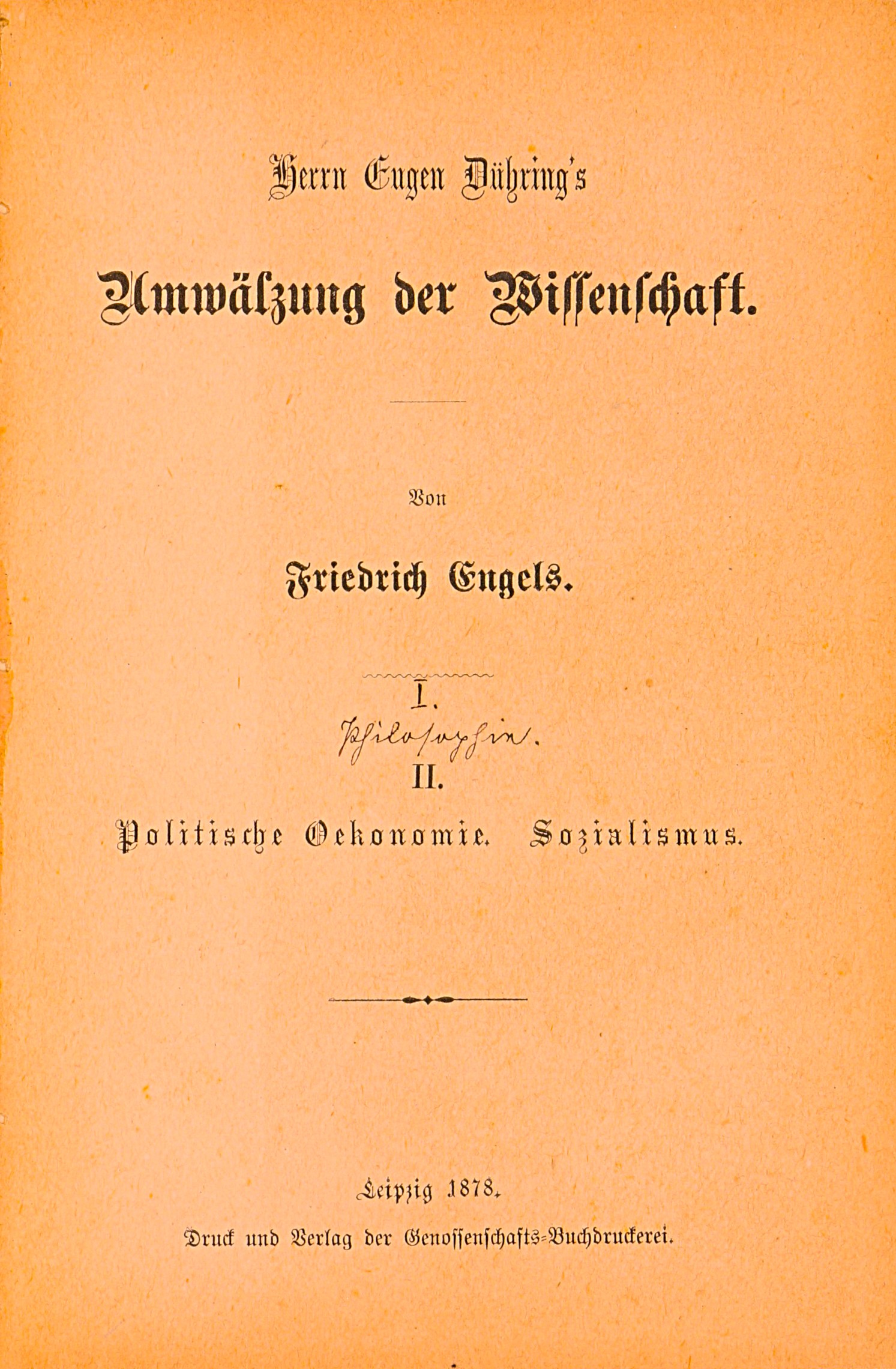 In 1877, Engels published “Anti-Dühring” (Mr. Eugen Dühring’s Subversion of Science).[18] Regarding this book, the editors of the Marx-Engels Collected Works noted that Marx “took a direct part in its creation” and contributed a chapter, so that “the ‘Anti-Dühring’ expressed from beginning to end the standpoint […] of Engels and Marx.”[19]
Engels also addressed the issue of slavery here. He began with a state of affairs from long ago, when it had first become possible for farming families to “incorporate one or more foreign laborers”:
“But their own community and the confederation to which it belonged did not provide any available, surplus labor. War, on the other hand, provided them, and war was as old as the simultaneous existence of several communal groups side by side. Until then, people had not known what to do with prisoners of war, so they had simply killed them; even earlier, they had eaten them. But at the stage of the ‘economic situation’ now reached, they acquired a value; so people let them live and put their labor to work for themselves. […] Slavery had been invented.”[20]
According to Engels, then, “the simultaneous existence of several communal groups side by side” is synonymous with war: as soon as people band together, they begin to wage war against one another. When he wrote this, it was speculation due to a lack of relevant archaeological evidence. Based on current knowledge, it is just as false an assumption[21] as the one regarding the original practice of killing or even eating prisoners of war.[22]
Engels now placed the invention of slavery in its proper context:
“It was slavery alone that made the division of labor between agriculture and industry possible on a larger scale, and with it the flourishing of the ancient world, Hellenism. Without slavery, there would have been no Greek state, no Greek art and science; without slavery, no Roman Empire. But without the foundation of Greek civilization and the Roman Empire, there would also be no modern Europe. We should never forget that our entire economic, political, and intellectual development presupposes a state of affairs in which slavery was as necessary as it was universally accepted. In this sense, we are justified in saying: Without ancient slavery, there would be no modern socialism.“[23]
Later, it is stated that anyone who “turns up their nose at Greek civilization because it was founded on slavery” could “accuse the Greeks, with equal justification, of not having had steam engines or electric telegraphs.”[24]
In response to the expected outrage at this line of reasoning, Engels countered:
“It is all too easy to rail against slavery and the like in general terms and to pour out high moral indignation over such infamy. Unfortunately, this says nothing more than what everyone already knows, namely that these ancient institutions no longer correspond to our present-day conditions and to the feelings shaped by those conditions.”[25]
Is aversion to slavery merely modern sentimentalism? Even Diogenes, the ancient philosopher well known to Marx and Engels, criticized slavery.[26]
Might not the slaves themselves have always harbored strongly negative feelings toward their enslavement? But Engels glossed over that as well:
“Even for the slaves, this was a step forward; the prisoners of war, from whom the bulk of the slaves were recruited, now at least retained their lives, whereas previously they had been murdered or, even earlier, roasted alive.”[27]
Slavery as the best possible solution for all involved.
That the present would look different—or would not have come about at all—without what came before is, in turn, a platitude. To conclude from this, however, that everything that came before had to be that way is simply nonsense. Or a belief in divine predestination. For Marx and Engels, it was a belief in those “economic laws” that operate in a god-like manner.
Engels continued his argument:
“But this tells us nothing about how these institutions arose, why they existed, and what role they played in history. And if we address this, we must say—as contradictory and heretical as it may sound—that the introduction of slavery was a great step forward under the circumstances of the time.”[28]
Slavery as a Brake on Progress
As for U.S. slavery, Marx and Engels had, of course, long since shifted their focus by the time “Anti-Dühring” was published. In 1851, Marx had begun to improve his precarious financial situation by writing articles for the explicitly anti-slavery newspaper “ New York Daily Tribune,” a newspaper explicitly critical of slavery. There, for example, on July 14, 1853, he wrote: “Without the prolonged successive phases of stagnation, prosperity, boom, crisis, and misery through which modern industry passes in periodically recurring cycles,” “the working class of Great Britain and all of Europe would be an oppressed, weak-willed, worn-out, submissive mass […], whose emancipation by their own efforts would prove just as impossible as that of the slaves of ancient Greece and Rome.”[29] In 1858, he described the contemporary slave trade as “shameful.”[30] From 1861 to 1865, during the American Civil War, he engaged most intensively with this issue.[31]
His main criticism was that U.S. slavery had become an obstacle to the emergence of a united labor movement —and thus for the development toward socialism. Slavery, he argued, had by then fulfilled its role as a necessary component of economic development and now stood in the way of further progress. Therefore, it should be abolished.
On December 30, 1864, when the defeat of the Southern states was already clearly on the horizon, Marx congratulated U.S. President Abraham Lincoln on his reelection on behalf of the International Workingmen’s Association. He concluded:
“As long as the workers—the true bearers of political power in the North [of the U.S.]—allowed slavery to defile their own republic […]—they were incapable of achieving true freedom of labor or of supporting their European brothers in their struggle for liberation. This obstacle to progress has been swept away by the red sea of the Civil War.
The workers of Europe are imbued with the conviction that, just as the American War of Independence ushered in a new era of the middle class’s rise to power, so the American War against slavery will usher in a new era of the working class’s rise to power.”[32]
Good Wars?
In 1846, the U.S. had invaded Mexico and annexed nearly half the country, including Texas, New California, and New Mexico. Thousands of Mexicans were killed[33]—a fact that must have been known in 1848 when Engels, presumably also on behalf of Marx, commented on this invasion:
“In America, we have watched the conquest of Mexico and rejoiced in it. It is also a step forward that a country which until now was preoccupied exclusively with itself, torn apart by perpetual civil wars and prevented from any development—a country that, at best, was destined to fall into industrial vassalage to England—that such a country is forcibly drawn into the historical movement. It is in the interest of its own development that it be placed under the tutelage of the United States in the future. It is in the interest of the development of all of America that the United States, through its possession of California, maintain dominance over the Pacific Ocean.”[34]
Of course, wars can also lead to something that can be classified as positive. But it would never occur to me to say that World War II had the positive aspect that the UN was subsequently founded. Or to rejoice in hindsight over Hitler’s Germany’s invasion of the USSR in 1941—which ultimately claimed the lives of 27 million Soviet citizens—simply because it led to the destruction of the Nazi empire. If a man’s head is cut off, he no longer has to shave. That’s true—but it’s no reason to regard the event as a whole as something to be celebrated.
Engels and Marx could even imagine a world war as a driver of progress. In February 1849, Engels predicted in the Neue Rheinische Zeitung that a “general war” would soon break out, which would bring the 1848 Revolution to a successful conclusion.
According to Engels, only the Germans, the Poles, and the Hungarians had stood on the side of this revolution.
“That is why they are now revolutionary. […] All other tribes and peoples, large and small, have for the time being the mission of perishing in the revolutionary storm sweeping the world. That is why they are now counterrevolutionary. […]
The next world war will wipe not only reactionary classes and dynasties but also entire reactionary peoples off the face of the earth.
And that, too, is progress.”[35]
War as the Original State
The following five quotations underscore that Marx’s views on war were in harmony with those of Engels. In 1858, he completed the Grundrisse der Kritik der politischen Ökonomie (Grundrisse of the Critique of Political Economy), which remained unpublished during his lifetime. In this “rough draft”—which is partly sketch-like—he noted:[36]
“War developed earlier than peace [sic].”[37]
“War is therefore the great collective task, the great communal labor that is required, whether to occupy the objective conditions of living existence or to protect and perpetuate the occupation of those conditions. The community consisting of families is therefore initially organized along warlike lines.”
“The hunting ground is the same among the wild Indian tribes in America; the tribe regards a certain region as its hunting ground and defends it by force against other tribes or seeks to drive other tribes out of the territory they have claimed. […] The only barrier the community can encounter in its treatment of the natural conditions of production—the earth—[…] as its own, is another community, which is already […] claiming it. War is therefore one of the most primordial activities of each of these naturally formed communities, both for the assertion of property and for its new acquisition.”
These sentences are taken from Volume 1 of Capital, first published in 1867: “Linguet[38] […] may not be wrong when he declares hunting to be the first form of cooperation and the hunting of humans (war) to be one of the first forms of hunting.”[39] Waging war, killing fellow humans as—perhaps—the first form of human cooperation. And, in keeping with this: “As is well known, conquest, subjugation, robbery, murder—in short, violence—play a major role in real history.”[40]
With this negative assessment, Marx was largely in agreement with thinkers such as Thomas Hobbes, John Locke, Adam Smith, G. W. F. Hegel, and Arthur Schopenhauer.
Yet there were also more positive views of humanity and history with which he was familiar, represented by Jean-Jacques Rousseau, Robert Owen, Charles Fourier, Ludwig Feuerbach, Auguste Comte, and Max Stirner. Acknowledging that humans possess innate constructive capacities, a peaceful nature, or prosocial tendencies, however, did not fit with Marx’s idea that we come into the world as blank slates upon which social conditions write their text—as beings who, due to economic “laws,” can only live together in a good, peaceful, and humane manner in the future.
Marx and Engels as Role Models for the Peace Movement?
Political scientist Georg Fülberth sums it up:
“For most of their political lives, Karl Marx and Friedrich Engels were what we would probably call ‘bellicists’ today. Like almost all their contemporaries, they followed the thinking of the Prussian military theorist Carl von Clausewitz, according to whom war is the continuation of politics by other means. These were considered controllable; war, therefore, was considered winnable.
In 1848–49, Marx and Engels called for a German people’s war against the Russian tsar. In their eyes, he was the mainstay of all reactionary regimes and—after his army crushed the Hungarian uprising—the butcher of the revolution. Engels accused the British government of failing to pursue the Crimean War (1853–1856) to Russia’s final defeat—out of concern for the European balance of power and fear of revolutionary consequences. For a long time, he leveled a similar accusation against the Northern states in the American Civil War.”[41]
If “bellicists” are understood to mean people who glorify war, this does not apply to Marx and Engels. If, however, the term refers to viewing war as a legitimate means of achieving political goals, then Fülberth is correct: both Engels and Marx advocated military conflicts that they believed would bring about what they considered social progress.[42] Fülberth also points out, however, that the elderly Engels came to the realization,
“that the era of limited—and therefore manageable—military conflicts was over. Now the prospect of a horrific world war was opening up. In March 1889, Engels wrote to Paul Lafargue, a son-in-law of Karl Marx: ‘As for war, it is for me the most terrible of all possibilities. […] a war in which there will be ten to 15 million combatants, which, simply to feed them, will bring about unprecedented devastation; a war that will bring about intensified and widespread repression of our movement, a rise in chauvinism in all countries, and ultimately a weakening of our movement, […] a period of reaction resulting from the exhaustion of all bled-dry peoples—and all this for the slim chance that a revolution might emerge from this bitter war—that horrifies me.”[43]
We owe the two socialist classics novel and essential insights into the economic underpinnings of wars, especially under capitalism. Nevertheless, anyone committed to peace must look closely at how they can draw on Marx and Engels in this regard. The same applies to those who strive for social progress.
***
Download of the expanded version as pdf.
Please cite as Andreas Peglau (2026): No socialism without slavery, war as a great communal work. Addendum to my critique of Marx (expanded version)
© 2026 Andreas Peglau – All rights reserved. Löcknitzer Str. 33, 17309 Pasewalk
info@andreas-peglau-psychoanalyse.de
This is a DeepL translation I have not checked. I apologize for any errors and inaccuracies that are sure to occur. Please use the original German text for comparison: https://andreas-peglau-psychoanalyse.de/ohne-sklaverei-kein-sozialismus-krieg-als-grosse-gesamtaufgabe-ergaenzung-zu-meiner-marx-kritik/
Forwarding and distributing this text for noncommercial purposes is expressly encouraged. Licensed under a Creative Commons license (Attribution – Noncommercial – No Derivatives 4.0 International).
Notes and sources
[2] Marx-Engels Works (MEW), Vol. 16, p. 193.
[3] MEW, Vol. 23, p. 786.
[4] MEW, Vol. 19, p. 32.
[5] MEW, Vol. 2, p. 338.
[6] Ibid., pp. 645, 639–640.
[8] MEW, Vol. 23, p. 16.
[9] https://en.wikipedia.org/wiki/Famine_in_India, https://de.wikipedia.org/wiki/Aufst%C3%A4nde_und_Revolten_gegen_die_britische_Herrschaft_in_Indien, https://www.spiegel.de/politik/das-kranke-england-a-66fca745-0002-0001-0000-000040350904.
[10] MEW, Vol. 9, p. 132.
[11] For example, that the Indians “came to that bestial, crude worship of nature, the degeneration of which was expressed in the fact that man, the master of nature, devoutly sank to his knees before Hanuman, the monkey, and Sabbala, the cow” (ibid., p. 133). Did he find it more progressive to kneel before “capital” in the Western manner? On racist tendencies in Marx and Engels: Hund, W. D./ Egger, L./ Lösing, F. (2025): Marx, Engels, and the Racism of Their Time. Vienna/Berlin.
[12] MEW, Vol. 9, p. 133.
[13] A puzzling choice of words, since Marx knew, on the one hand, that human development had already spanned extremely long periods of time and, on the other hand, expected socialism to arrive shortly.
[14] MEW, Vol. 26.2, p. 111.
[15] For differing views held by the young Marx, who was not yet fixated on economics, see Fromm, E. (1989): “The Concept of Man in Marx,” in idem: Complete Works, Vol. 5. Munich, pp. 335–393.
[16] MEW, vol. 4, pp. 131–132. Here, Marx argues against Proudhon, who believed it was possible to eliminate the negative aspects of economic categories while retaining the positive ones. As early as his letter of December 28, 1846, to the Russian journalist Pavel Annenkov, Marx—presumably drawing on notes for The Misery of Philosophy—makes an identical argument regarding the “good side of slavery” (MEW, vol. 27, p. 458).
[17] MEW, Vol. 4, pp. 131–132.
[18] See https://de.wikipedia.org/wiki/Herrn_Eugen_D%C3%BChrings_Umw%C3%A4lzung_der_Wissenschaft
[19] MEW, vol. 20, p. VII.
[20] Quotes from *Anti-Dühring* taken from MEW, vol. 20, pp. 167–169.
[21] See https://andreas-peglau-psychoanalyse.de/wir-sind-keine-geborenen-krieger-zu-psychosozialen-voraussetzungen-von-friedfertigkeit-und-kriegstuechtigkeit/ and Graeber, D./ Wengrow, D. (2022): Beginnings. A New History of Mankind, Stuttgart. In 1884, Engels described an early phase of human history as “a wonderful state in all its childlike innocence and simplicity […]. Without soldiers, gendarmes, or police officers; without nobility, kings, governors, prefects, or judges; without prisons, […] household management is shared communally among a number of families; the land is tribal property; only the small plots are provisionally allocated to the households […] . All are equal and free—including the women. There is still no place for slaves, nor, as a rule, for the subjugation of foreign tribes.” However, he justified the absence of “the poor and needy” by pointing out that these early communities recognized “their obligations toward the elderly, the sick, and those maimed in war [!]” (MEW, vol. 21, pp. 95–96). He explains why communities living under the conditions he described would wage war against one another as follows: “What lay outside the tribe lay outside the law” (ibid., p. 97). He does not cite a plausible reason for this legal situation.
[22] Engels does not cite any sources for this, but he likely referred here as well to L. H. Morgan, mentioned in the 1885 preface, who assumed that cannibalism was characteristic of the “barbaric” phase (see https://www.marxists.org/reference/archive/morgan-lewis/ancient-society/ch02.htm). Furthermore, contemporary accounts of voyages to the “New World” painted pictures shaped by racist stereotypes of “primitive savages” (Peter-Röcher, H.: Cannibalism in Prehistoric Research: Studies on a Paradigmatic Interpretation and Its Foundations, Bonn 1994, pp. 158–212). However, Heidi Peter-Röcher found in the sources “from prehistoric, ancient, medieval, and modern times […] no convincing, unequivocal evidence […] that would allow the conclusion that
cannibalism ever existed as a socially accepted and practiced custom” (ibid., p. 213). Graeber and Wengrow (as in footnote 21, pp. 207–233) demonstrate in detail that in pre-colonial America, slavery existed only regionally and was practiced in very different ways. There can certainly be no question of widespread killing or even cannibalism.
[23] As in footnote 20.
[24] Ibid., here applied to Dühring.
[25] Ibid.
[27] As in footnote 20.
[28] Ibid.
[29] MEW, Vol. 9, p. 171.
[30] MEW, Vol. 12, pp. 507–511.
[31] See also https://monthlyreview.org/articles/marx-and-slavery/.
[32] MEW, Vol. 16, p. 19.
[33] Their number is estimated at 25,000 (https://en.wikipedia.org/wiki/Mexican%E2%80%93American_War).
[34] MEW, Vol. 4, p. 501. The editors of this volume of the MEW deemed it necessary to include a footnote: “Marx and Engels later changed […] their assessment of this event as presented here.” In 1861, Marx wrote in The American Civil War (MEW, vol. 15, pp. 329–338), Marx described the goal of U.S. expansionist policy as “the acquisition of new territories for the expansion of slavery and the rule of the slaveowners.” This wrongly suggests that Marx unequivocally condemned this annexation there or that he and Engels had departed from their earlier assessments (see MEW, Vol. 15, pp. 329–338).
[35] MEW, Vol. 6, pp. 168, 176.
[36] The following quotations: MEW, Vol. 42, pp. 43, 386, 399.
[37] On how unrealistic this view is: https://andreas-peglau-psychoanalyse.de/wir-sind-keine-geborenen-krieger-zu-psychosozialen-voraussetzungen-von-friedfertigkeit-und-kriegstuechtigkeit/. The 6 million years of human evolution or the 300,000 years of Homo sapiens existence stand in contrast to the last 7,000 years, for which there is evidence of wars for the first time.
[38] https://de.wikipedia.org/wiki/Simon_Nicolas_Henri_Linguet
[39] MEW, Vol. 23, p. 353, footnote 23a.
[40] Ibid., p. 742.
[41] https://www.nd-aktuell.de/artikel/1145026.krieg-und-frieden-das-ende-des-bellizismus.html
[42] For a detailed discussion, see Suvanto, P. (1985): Marx and Engels on the Problem of Violent Conflict, Helsinki (https://www.doria.fi/bitstream/handle/10024/167584/SH018_opt.pdf?sequence=1&isAllowed=y). See also Goldschmidt, W. (1999): “Just War for a Just World Order?”, in Zeitschrift für marxistische Erneuerung 1999, Issue 40, pp. 103–121.
[43] As in footnote 41.