
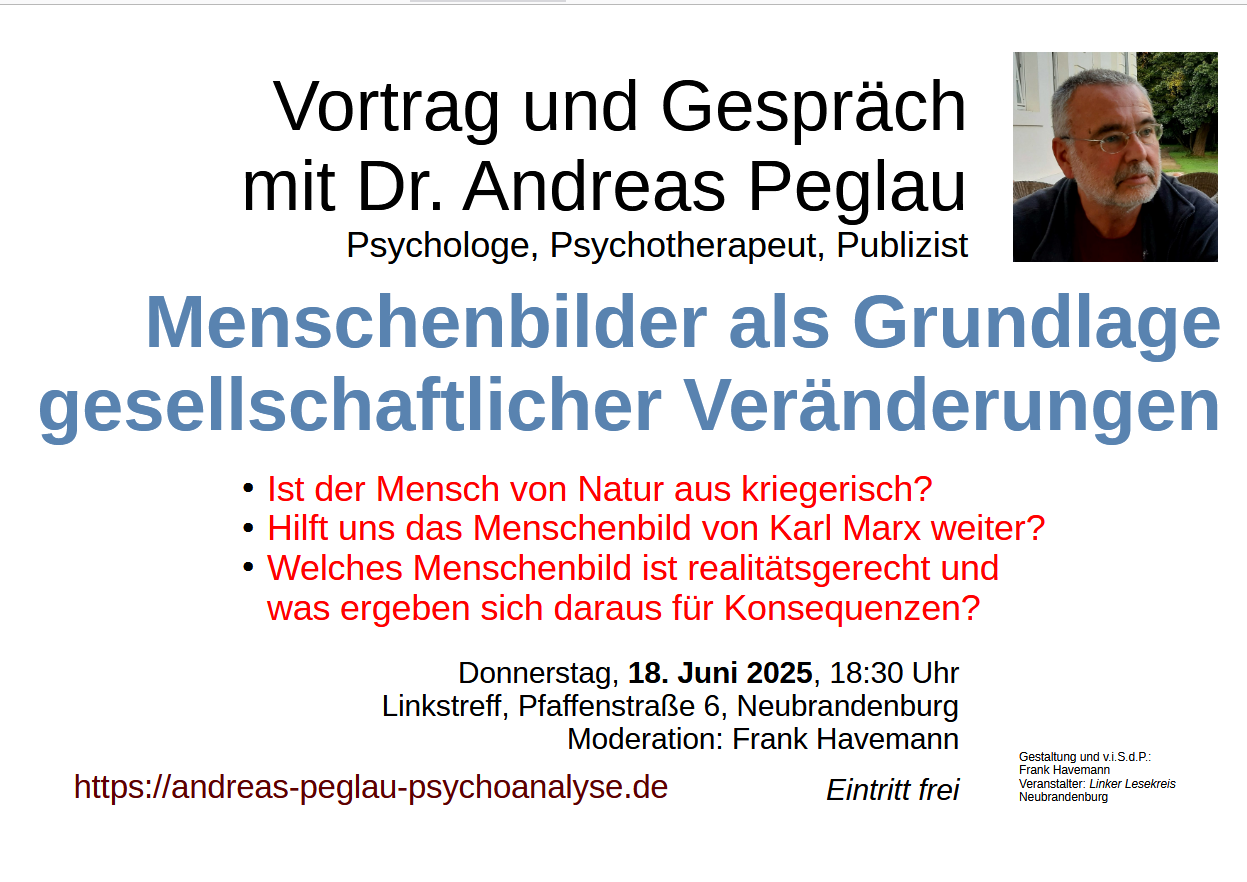
Lecture by Andreas Peglau
*
What is a concept of human beings?
Something that everyone carries within themselves—often more unconsciously than consciously.
It is the sum of assumptions about what people are generally like, what characteristics they share, and what can therefore be expected, hoped for, or feared from them.
A central question here is:
Are people good—or evil?
There are four basic positions on this, which can be simplified as follows:
Position 1) Apart from biological factors, people are born as blank slates onto which external factors later inscribe their text. They are by nature neither good nor evil, for they have no inherent nature that they bring into the world.
This view was advocated, among others, by Karl Marx beginning in 1845. I’ll come back to that.
Position 2) People are innately egocentric, deceitful, greedy, malicious, and antisocial. This view is supported, among other things, by Christian notions of “original sin,” but also by some aspects in the theories of Sigmund Freud. It makes reflection on the causes of war, murder, and violence seemingly superfluous and provides those in power within families and society with excuses to educate, boss around, control, and punish.
Position 3) Good and evil behavioral options are equally inherent. Here, the argument often—though not always—revolves around genetics and/or the assumption that external factors, in conjunction with the instinct for self-preservation or the preservation of the species, determine which option is ultimately chosen: humans as slaves to genes, animal instincts, and external circumstances.*
Position 4) We are innately good, in the sense of being compassionate, sociable, loving, lovable, curious, creative, supportive, peace-loving, and pro-social. Our innate dispositions also include the healthy, vital capacity for aggression. We need this ability—whose name is derived from the word “aggredere,” meaning to attack something—to assert ourselves, defend ourselves, and set boundaries. This has nothing to do with “being evil.” We can only be made “evil”—in the sense of being destructive, sadistic, or “warlike”—by having our innate tendencies suppressed and our healthy development hindered.
This view is held, among others, by the psychoanalysts Wilhelm Reich and Erich Fromm. And by me as well.
I will mention some of the arguments I rely on in this regard below.
How do concepts of human beings arise?
In an ideal society, its fundamental basis would be an unclouded self-perception. Throughout my life, I am the only person I know deeply, the one I can continually come to understand more fully through introspection. Since the human species is united by psychological commonalities, essential generalizations could be derived from this self-perception and continuously tested through contact with others. In an ideal society, therefore, people would have realistic concepts of human beings.
In reality, however—which is by no means ideal—concepts of human beings are distorted by painful experiences and traumas that alienate us from ourselves, as well as by oppressive conditions within the family and society.
Adults’ concepts of human beings therefore often no longer have much to do with reality. Self-perception is replaced by the judgments and evaluations that authorities impose upon us. It is not the pupil who decides whether the flower he has drawn is beautiful, but the art teacher. It is not the patient who knows whether he is healthy, but the doctor.
It is not the citizens who are allowed to judge whether we should go to war, but the government.
Since large groups are influenced by similar social institutions, their concepts of human beings often share common elements, transcending social barriers.
A significant example: In West Germany after 1945, stereotypes of “ethnic” superiority over “Russian subhumans” were continued—partly openly, partly indirectly—and reinforced through indoctrination in the family, at school, and in the media. Those who identified with this ideology—that is, the majority—were able to avoid confrontations with those in power, project their own instilled destructiveness onto supposedly evil Russians, and at the same time blame them for militarization, rearmament, and the erosion of democracy.
This is based on a concept of human beings rooted in separation, repression, and denial: “I am right, they are wrong; I am good, they are evil.” Since those in power currently feel compelled once again to switch to a war economy and warmongering, they can effectively build on this foundation.
However, this is not equally true in the eastern part of the country. There, until 1990, a socialization process took place that differed in essential respects—including a different relationship to the Soviet Union.
I don’t want to sugarcoat anything here. By no means did all GDR citizens feel a deep connection to the USSR. But after more than 40 years of diverse—albeit often orchestrated—encounters with Soviet citizens, intensive engagement with Soviet and Russian culture starting in school, various collaborative projects, and numerous trips to that country, at least one thing seems to have been deeply internalized by most GDR citizens: “They are people just like us.”
In this respect, many “Ossis” had—and still have—a far more realistic view of human beings than many “Wessis.” Consciously or unconsciously, such internalized attitudes are also passed on to subsequent generations. Consequently, anti-Russian war propaganda takes a stronger hold in the eastern part of the country than in the west.
To what extent—as my lecture title suggests—do concepts of human beings serve as a basis for social change?
If I want to bake a yeast cake, I should know what ingredients I need—especially that without yeast, it won’t turn into a cake at all.
If I want to influence human society—perhaps even change it for the better in a revolutionary way—I should have a realistic picture of human beeings in mind—especially of what makes them unique, what distinguishes them most strongly from all other living creatures. And that is not something physical, biological, or genetic.
As you probably know, human genes match those of chimpanzees by 98.7% and those of fruit flies by up to 70%. What makes humans special is something else: their mental and emotional makeup, their PSYCHE.
A concept of human beings that does not adequately take the psyche into account therefore misses the reality of what it means to be human—the very essence of humanity. Such a concept is unsuitable as a foundation for meaningful social change.
Are most revolutionaries, world-changers, and politically active individuals aware of these connections?
Not at all.
Here’s an example. In early May, the BSW announced the formation of the Commission on Fundamental Values, led by Sahra Wagenknecht, which is intended to “provide advisory support for programmatic development.” The members of this commission include: the founder of a consumer protection organization, two writers, two journalists, two economists, a mathematician, a lawyer, a physician, a sociologist, a political scientist, and a singer-songwriter. In response,
I wrote the following to the BSW, among other things:
“I think it’s great who you’ve brought together here, and I certainly welcome the BSW’s commitment to peace. But where is the search for a realistic, holistic concept of human beings—which should surely be the foundation of all political endeavors? Isn’t that a core value? Economic and tax issues, yes—psychology, no? Or do you think sociology and political science cover that as a side note? Hasn’t the brief history of the BSW already clearly shown how essential individual personality structures are for political action as well?”
After three weeks, an anonymous “Helpdesk Team” replied that my letter would be forwarded as part of a “valuable snapshot of public sentiment.”
I suppose that was about all I could have expected. Sahra Wagenknecht’s book Reichtum ohne Gier (Wealth Without Greed), published in 2016, does include the psychological aspects in its title, but only briefly touches on related topics at the beginning—before essentially circling around economics.
She is not alone in this. In 2011, a Streitschrift zum Programm der Linken (pamphlet on the Left’s program) was published under the Marx quote „Alle Verhältnisse umzuwerfen“ (“To Overthrow All Relations”), which was miles away from even naming “all” human relations, let alone discussing how they might be explored and overthrown. Economics: Yes, in great detail. Concepts of human beings, the psyche? Not a trace. The same applies to Michael Brie, who in 2021—as his book title suggests—wanted to rediscover socialism (Sozialismus neu entdecken).
Numerous examples of this approach could be added.
Did the authors mentioned invent this perspective, which ignores the real psyche?
No. They can cite none other than Karl Marx.
Marx and Engels tended to portray people as largely helpless appendages of supposedly objective economic “laws of nature,” as their puppets. While analyzing a social constellation in urgent need of revolutionary upheaval—capitalism—they simultaneously described people as beings who were entirely incapable of bringing about revolutions.
Marx and Engels hoped for a community in which “the free development of each is the condition for the free development of all” and in which the principle applies: “From each according to their ability, to each according to their needs.” Yet they considered the questions of what defines a free individual, what conditions are necessary for freedom, what abilities people possess, and what needs motivate them to be unimportant or even reactionary, since, in their view, economics already explained everything essential.
Although they acknowledged the explosive nature of their own theses, they otherwise regarded the thoughts of all other people as—to quote them—“fog in the brain.” Morality, religion, ideology, and the corresponding “forms of consciousness,” they wrote in 1845, possessed neither “autonomy” nor “history” nor “development.”
In the second edition of Capital, Marx then informed his readers: “For me, […] the ideal is nothing other than the material transformed and translated in the human mind.” This human mind was apparently—apart from animal instincts and drives—initially completely empty; in any case, it contained nothing spiritual, psychological, or “ideal.”
Marx seemed to assume that we are born without any internal criteria for what we need on a psychosocial level and what harms us, without a need for emotional and physical closeness or for communication, without intellect, curiosity, or creativity, and without the prerequisites for self-organization: simply blank pages onto which “the material,” “society”—and in particular the relations of production—somehow write the text.
If that were true, infants would be antisocial, dull, machine-like beings who perceive their mothers exclusively as providers for satisfying physical needs. We would thus come into the world in a more pitiful state than plants, whose internal blueprint for growth and development not only enables them to flourish under favorable conditions but also allows them to actively and creatively seek out what they need to live: light, water, nutrients, and appropriate proximity or distance from their own kind.
Despite all the advances in understanding that the theories of Marx and Engels brought in other respects, their concept of human beings is unsuitable as a starting point for meaningful social change.
It even hinders such change: The fact that the anti-psychological view of the communist classics was never consistently questioned contributed significantly to the failure of “real socialism.”
Even today, Marxists mostly seek to liberate “the people” without asking themselves who humans actually are, and they aim to build a society without giving a thought to its foundation.
What is this foundation?
It is certainly not economic “laws of nature” that supposedly operate independently of human beings. Such laws do not exist. The economy is not created or determined by non-human entities, but by real, concrete individuals. And it is precisely these individuals who form the foundation of any society. The term “individuals” indicates that each and every one of them is unique and one-of-a-kind. Yet they are united by their commonalities.
These include not only biological, anatomical, and physiological characteristics, but also psychological dispositions and basic needs.
Erich Fromm noted on this point:
“Even the full satisfaction of those ‘needs that humans share with animals—hunger, thirst, and the need for sleep and sexual satisfaction’ […] does not yet guarantee mental and emotional health. This depends on the satisfaction of those needs and passions that are specifically human.”
It is now a widely accepted theory that for all members of the Homo sapiens species—which has existed for at least 300,000 years—as well as for the Neanderthals, who appeared much earlier, we can assume a “psychological unity,” that is, in principle, similar psychological and mental dispositions and structures. Only through the most precise understanding possible of these commonalities could we deduce which social structures are appropriate for humans. A viable social model that can be successfully implemented over the long term requires a realistic, scientifically grounded view of human nature as its foundation.
No such model exists. This is not because there is a lack of knowledge. Rather, it is because this interdisciplinary knowledge—derived from many people, cultures, and eras—has not been synthesized.
I would like to present a small excerpt from this body of knowledge that seems particularly important to me—and thereby also underscore my concept of human beings mentioned at the outset.
Are we born stupid and antisocial?
Quite the contrary. In infant research, evidence is mounting that “the infant brain is equipped at the beginning of life to process the greatest possible variety of stimulus categories” and that humans are “individuals capable of learning and interacting from birth.”
A long-term study initiated in 1968 with 1,600 children underscored this fact—and at the same time showed how our intellectual capacities develop over time. The study focused on “genius”—understood as the ability to find many different, even contradictory, answers to a single question; to think not in a linear or one-dimensional way, but creatively and in an interconnected manner.
At ages three to five, 98 percent of the children tested could be classified as “genius” in this sense. Just five years later, at ages eight to ten, that percentage had dropped to 32 percent. Another five years later, among the now 13–15-year-olds, only ten percent were still considered “geniuses.”
This figure was, after all, clearly higher than the results of a control group of 200,000 adults aged at least 25: a mere two percent of them had retained their “genius.”
Thus, the usual “growing into” conventional social structures does not primarily expand the possibilities for individual (and societal!) development, but rather severely restricts them. We suffer a dramatic loss of intellectual potential and creative possibilities—and thus also of healthy self-confidence.
And what about the ability and willingness to feel, think, and act socially: Must this first be taught to us?
That is certainly not the case. Even before birth, we interact with our mothers. Once we are born, we attune ourselves to them with all our senses; we want to smell them, still hear their heartbeat and their voice; we need eye contact and skin-to-skin contact with them; we react intensely to their emotional state; we are just as in need of connection as we are capable of it; and we signal our needs, including those for closeness and affection. An antisocial infant would not be able to survive.
Three-month-old babies “show empathy” and can “distinguish between good and bad behavior.” Young children possess a sense of justice, “comfort others in times of sorrow,” are able to “develop goals together with others,” and are motivated to “help others and share with them.” These findings stem from studies across various scientific disciplines and are supported by further research.
So we are not only born “genius,” but also good; we possess a kind of “good core.” This is not something passive that first needs to be awakened from a deep slumber, like Sleeping Beauty. Our innate dispositions actively and energetically strive to realize themselves. Just as the roots of trees seek water and nutrients, our potential seeks opportunities to unfold.
We want to live in accordance with our inner nature, to interact appropriately with ourselves, other people, and the natural world, and to resolve inevitable conflicts constructively. For only such a way of life brings us healthy satisfaction. It serves both self-preservation and the preservation of our species.
If this good core exists, why doesn’t it unfold?
Because for several millennia it has been suppressed, mostly by social structures often described as “patriarchal.” People who are psychologically quite healthy at birth are broken down in such a way that they fit into these structures. Their hierarchical structure—the division into powerful rulers and disempowered subjects—is reflected in individuals: Their psychological dispositions are distorted into a lust for power and subservience, into an “authoritarian character” that kowtows to those above and—when it can—kicks those below. In the past, both women and children were “below” in nuclear families. At least children still are today.
This “socialization” goes hand in hand with brainwashing, the suppression of emotions, and dumbing down. Those in power believe their rule is necessary and justified. In order for the subjects to accept this nonsense—to swallow such rubbish as the “narrative” of an alleged coronavirus pandemic or alleged Russian imperialism—their intellectual and psychological capacities, as well as their emotional sensitivity, must be curtailed at an early age.
This is exactly what is happening.
In Germany today, nearly one in three children is born by cesarean section, a decision made by others: more than double the rate since 1993. “Others decide for you” thus becomes a welcoming motto and a foretaste of things to come: conformist submission to parents, caregivers, teachers, bosses, doctors, state institutions, the government, and profit-driven interests.
Children, as Wilhelm Reich described it, first pass through “the authoritarian miniature state of the family, […] in order to later be able to fit into the general social framework.” This makes them “anxious, shy, fearful of authority, well-behaved in the bourgeois sense, and malleable.” Those who have endured this process can hardly remember that they are capable of self-determination; they believe they need leaders to tell them which way to go and, as Erich Fromm put it, have a “fear of freedom.”
Because the resulting healthy anger toward oppressive authorities cannot be openly expressed—after all, who is allowed to kick their father, mother, teachers, or later bosses in the shin?—it gradually builds up into destructive hatred. This makes most adults, to varying degrees and without their realizing it, susceptible to warmongering and exploitable for the purposes of warfare.
Wilhelm Reich put it this way: The fact that the psychologically deformed person “acts, feels, and thinks” contrary to his or her own life interests constitutes “an essential part of the mass-psychological foundation of that war […] which is staged by a select few out of imperialist interests.”
I would like to use a prominent case to illustrate how such a development can unfold—but also how that “good core” resists it, at least for a time.
Joseph Goebbels was born in 1897. During his childhood and youth, he was a dreamer; he wrote poems, plays, and piano pieces; he read, among others, Gottfried Keller, Theodor Storm, Schiller, and Goethe; he fell in love and hoped for a life full of love and recognition. His clubfoot, which developed in childhood, played a part in the fact that this hope was increasingly dashed—or rather, the negative reactions to this disability did. For his strictly Catholic parents, it represented a “trial” that was best denied. Among relatives and classmates, it provoked aversion bordering on revulsion; later, it did the same among some of the women he desired. Gradually, the “fatherland” came to the fore as a substitute for his unfulfilled love for other people.
Yet as late as 1919, as a 22-year-old with “völkisch” leanings, Goebbels successfully applied to a Jewish professor for a doctoral degree and described him as “an extraordinarily amiable” and “courteous man.”
In 1920, Goebbels reflected on the initially victorious “leftist” mass uprising against the reactionary Freikorps and the Reichswehr as follows: “Red Revolution in the Ruhr region […]. I am thrilled from afar.”
In his search for a “genius” who might redeem him and Germany, he first heard of Adolf Hitler in 1921—and was disappointed. He wrote a rhyme: “The moment I see a swastika, I get the urge to take a dump.”
Professional and personal frustrations, unemployment, hunger, and existential insecurity followed, and mental health issues mounted: feelings of meaninglessness, suicidal thoughts, alcohol abuse, and nervous breakdowns. He now alternated between “phases of deep depression” and “outbursts of fanatical will.”
He wrote a novel that no publisher would accept and noted in his diary: “Sometimes in the morning I’m afraid to get out of bed. Nothing awaits me—no joy, no pain, no duty, and no task. After all, a dignified life requires, above all, a fixed purpose.” In 1922, Goebbels—by then a doctor of German studies—learned from his fiancée that she was “half-Jewish”; though he was taken aback, he did not end the relationship at first. In 1924, he was still able to find positive aspects in Karl Marx’s *Capital*. Even within National Socialist ideology, which was now becoming increasingly important to him, Goebbels would continue for some time to emphasize the “socialist” aspect more than Hitler did.
But eventually, he fell completely under the spell of the cult of the Führer, which allowed him to compensate for feelings of inferiority, suppress depression, see a purpose, and find meaning in life. In 1926, as he wrote, “up there in the sky, a white cloud took the shape of a swastika.”
The unconditional follower of Hitler was complete. This process, however, took nearly 30 years.
In societies such as the one in which Goebbels grew up, or the one in which we live today, one’s innate potential cannot be preserved unscathed throughout childhood.
Nevertheless, compared to adults, children are not only more intelligent but also better people. If today’s five- to ten-year-olds were allowed to vote and decide whether the money generated in the Federal Republic of Germany should continue to be spent primarily on armament, warmongering, and preparations for war, or on constructive, peaceful, understanding—and ideally loving—cooperation within families, kindergartens, schools, the workplace, society, and among nations: We would be immediately saved from the homegrown threat of war. The adults, however, once again vote in the majority for war-mongering parties.
In the Bible, Jesus is quoted as saying: “Unless you repent and become like children, you will never enter the Kingdom of Heaven.” Updated, it must surely read: “Unless you repent and become like children, you will perish.”
Does this concept of human beings I’ve outlined suggest the possibility of social change?
Yes.
And it’s a conclusion that is as logical as it is astonishingly simple. Since people possess these good qualities, we basically need to do only one thing: ensure that this potential can flourish.
If enough adults gain sufficient access to their own goodness and genius, and successfully fight to ensure that all children on our planet can develop these innate qualities unhindered, these children—as adults—will inevitably create a community in keeping with their innate qualities—that is, a good one as well. Who or what could possibly stand in their way then?
Mentally healthy people would never establish a capitalist society—why should they harm themselves?
Human innate qualities not only do not stand in the way of a good social order in any way; rather, these qualities urge us to create such an order. The reason we do not live in a good order is—and it is solely because—these qualities are suppressed and perverted.
It is therefore revolutionary in the best sense of the word—and at the same time the best “investment” in our future—to commit ourselves to ensuring that children can grow up healthy in the fullest sense of the word.
This is, of course, a fundamentally different view from that of Karl Marx, who believed that progress arises almost of its own accord through the workings of “economic laws of nature” and can, at most, be slightly accelerated or delayed.
Can we draw hope from human history regarding the feasibility of such changes as I have just described?
Indeed. And this, too, has to do with the concept of human beings.
In 1848, the Communist Manifesto opens with the sentence: “The history of all hitherto existing society is the history of class struggles.”
When Engels republished this text in 1888, new findings on anthropogenesis had come to light. He then added a succinct footnote to the sentence: “That is to say, strictly speaking, the history preserved in writing.” Even by the standards of knowledge at the time, this was an extreme qualification.
Today we know that the origins of writing date back about 5,300 years. Human evolution is generally estimated to have spanned six million years. According to Engels’ dictum, this would mean that classes have been in conflict with one another for less than 0.01 percent of human history. Or, if we take only the 300,000 years of Homo sapiens as our basis: for less than two percent of that time.
In fact, archaeological and anthropological research has yielded no evidence whatsoever of institutionalized oppression, exploitation, states, classes, or war for nearly the entire history of human evolution. Evidence of war only exists for the last 7,000 years.
7,000 years—compared to 6 million years of human evolution or 300,000 years of Homo sapiens existence—is, in terms of time, absolutely marginal.
In 2024, archaeologist Harald Meller, historian Kai Michel, and evolutionary biologist Carel van Schaik presented the current state of research on the three million years since the emergence of the genus Homo in their book Die Evolution der Gewalt (The Evolution of Violence). They concluded: “There isn’t even a handful of pieces of evidence for the intentional killing of humans.”
But even if these killings were murders—which, in the absence of eyewitness accounts, can never be definitively established—a murder is not a war. And a single murderer—about whom, unlike the victim, no information can be obtained—cannot be considered representative of the human population as a whole.
Harald Meller and his co-authors also note:
“If one searches for prehistoric evidence of war, murder, and manslaughter, one discovers instead indications of care and compassion. The paleoarchaeological evidence attests that humans helped and supported one another; otherwise, many injuries would have been tantamount to a death sentence.”
As an example, they cite a Neanderthal who died approximately 430,000 years ago and who suffered “from a whole series of degenerative diseases, traumas, a shortened right arm, and likely blindness in the left eye as well as severe hearing loss,” yet reached an age of “forty to fifty years”—which was only conceivable with “daily support” from his group, including wound care.
Thus, treating one another with peace and solidarity seems to be the anthropogenetic norm.
We should urgently integrate this into our cocept of human beings, especially in times when we are being relentlessly told that wars are an inherent part of being human. Or, as Barack Obama put it in 2009 when he was awarded the extremely undeserved Nobel Peace Prize: “War came into the world, in one form or another, with the first human being.”
What is needed for the anthropogenetic norm of peaceful and supportive coexistence to be restored?
The changes required for this permeate all areas of life: family, school, work, relationships, sexuality, art, culture, politics, economics, ecology … Sooner or later, this will reach the limits of bourgeois order.
Capitalism needs subjects with authoritarian mindsets—those whose sense of self-worth and capacity for relationships and solidarity are impaired—who allow themselves to be dumbed down, exploited, divided, oppressed, and sent off to wage wars of conquest—and who have a correspondingly distorted view of themselves and their fellow human beings.
For a better order to emerge, therefore, the upheaval of capitalist power and property relations is indispensable. Yet as essential as that is: as evidenced by the history of “real socialism”—which was tainted early on by Joseph Stalin’s regime of terror—and ultimately by its collapse, that alone is not enough.
Marx believed that people’s thoughts, feelings, and actions—the so-called “superstructure”—would somehow follow once the economic “base” had been revolutionized. This was the approach taken under “real socialism”—with the well-known failure that in 1990, more than 40 years after the founding of the GDR, most of its inhabitants still felt compatible with the capitalist FRG.
Yet even after nearly 36 years of the Federal Republic of Germany, the thoughts, feelings, and actions of many East Germans remain at odds with the ideas of the now-ruling class and thus with the capitalist “base.” Whether it’s mandatory vaccination, war hysteria, or anti-Russian agitation: in the eastern part of the country, rejection and resistance to these are stronger than in the west.
None of this can be explained by Marx. His well-known statement that social being determines consciousness is inaccurate.
The psyche—which includes not only consciousness but also the unconscious—possesses its own momentum and its own laws. Mediated by masses of individuals, the psychological has a formative effect on society. “Social being” does not exist in and of itself, but is—influenced by biological, physical, geographical, climatic, and ecological conditions—jointly produced by individuals: It is the result of massive individual action, which in turn is based on motivations, attitudes, and stances. In other words: on the psychological.
The “social existence” that arises in this way encompasses far more than the economy. It influences the psyche of every individual from birth at the latest.
This does not make us mere reflections of external circumstances: due to our innate dispositions, we are, after all, born as “described slates.” Family structures, upbringing, and the media continue to reshape this “text” over time. When we then—if we manage to get a job at all—enter the production process, we are therefore already shaped in multiple ways.
It is true that people also encounter many things that have already been set up or established by others. But these things only continue to exist because—and as long as—they keep them going.
Just how quickly “social existence” disappears when individuals no longer keep it going was impressively demonstrated in 1990.
The saying “Imagine there’s a war and nobody goes” refers to the same context. Equally apt is the phrase “Imagine it’s capitalism and nobody goes.”
Between the many individual psyches and the social conditions created or sustained by individuals, there is thus no one-sided dependence, but rather interactions—without it being possible to say which of the two sides has a stronger influence or which emerged first thousands of years ago.
In 1934, in the second edition of his Mass Psychology of Fascism, Wilhelm Reich pointed out a consequence that follows from this:
“If one attempts to change the [psychological] structure of people alone, society resists. If one attempts to change society alone, people resist. This shows that neither can be changed on its own.”
How might one describe a good, humane society?
At the age of 25, Marx called for “the overthrow of all conditions in which man is a degraded, enslaved, abandoned, and despised being.”
Erich Fromm wrote that in a “healthy society,” “no one need feel threatened anymore […], not the child by the parents; not the parents by those above them; no social class by another; no nation by a superpower.”
I would add: A healthy society needs psychic healthy people as its foundation. To be psychic healthy, we need a healthy society. This connection is inseparable.
We are part of the systems into which we were born, which surround us; we have been and continue to be shaped by them, and we contribute—willingly or unwillingly—to their existence and development.
If we want to overcome the negative aspects of a social system, we must also determine to what extent we have internalized these aspects—and take action against them as well.
A humane social order can neither be achieved nor defined through purely economic changes. For this definition, we need answers to questions that are primarily of a psychological nature: What is a “good” life? What makes a person happy? What do we need to be truly content? What exactly is a life of human dignity?
Only to the extent that we develop a realistic, comprehensive concept of human beings can we assess what a social order suited to us should look like.
***
Last accessed June 23, 2026.
*Passage modified on September 12, 2026.
Please cite as Andreas Peglau (2026): Concepts of human beings as a basis of social change (https://andreas-peglau-psychoanalyse.de/concepts-of-human-beings-as-a-basis-for-social-change/)
© 2026 Andreas Peglau – All rights reserved. Löcknitzer Str. 33, 17309 Pasewalk info@andreas-peglau-psychoanalyse.de
This is a DeepL translation I have not checked. I apologize for any errors and inaccuracies that are sure to occur. Please use the original German text for comparison: https://andreas-peglau-psychoanalyse.de/menschenbilder-als-grundlage-gesellschaftlicher-veraenderungen/)
The forwarding and distribution of this text for non-commercial purposes is expressly encouraged. Licensed under a Creative Commons license (Attribution – Non-Commercial – No Derivatives 4.0 International).