
von Andreas Peglau
Vortrag, gehalten am 28. März 2026 im Brigitte-Reimann-Literaturhaus Neubrandenburg[1]
*
Was ich Ihnen heute anbieten kann, ist kein wissenschaftlicher Draufblick, sondern eine Mischung aus Fakten, persönlichen Erlebnissen und subjektiven Bewertungen.
Ich nehme an, dass die meisten von Ihnen ebenfalls Wurzeln in der DDR haben. Mir ist bewusst, dass sich damit für Sie ganz andere Erfahrungen verbinden können als für mich. Wahrscheinlich werden Sie deshalb auch nicht allem beipflichten, was ich erzähle, manches vielleicht nicht nur anders wissen, sondern auch besser. Für den Abgleich unserer Sichtweisen können wir dann ja die Diskussion nutzen.
Es ist mir nicht leichtgefallen, das aufzuschreiben, was ich Ihnen nun vorlesen will. Ich habe schon im Dezember begonnen, darüber nachzudenken – und noch gestern an meinem Text gefeilt. Einmal mehr habe ich gemerkt: Ich bin nicht fertig mit der DDR, nicht im Guten, nicht im Schlechten.[2]
Leben in zwei Systemen
Um verständlicher zu machen, von welcher Position aus ich urteile, kurz zu mir.[3]
Ich bin 1957 geboren in Berlin, Hauptstadt der DDR, habe in Berlin-Pankow gewohnt, 400 Meter entfernt von der Mauer. In Abgrenzung von meinem permanent an der DDR herummäkelnden Vater wurde ich als Jugendlicher ein ziemlich naiver Sozialist mit dogmatischen Zügen, 1976, mit 19 Jahren, auch Mitglied der SED.
Letzteres blieb ich bis zum Februar 1990: Als DDR-Staatsoberhaupt Hans Modrow die Parole „Deutschland einig Vaterland!“ übernahm, bin ich ausgestiegen, das wollte ich auf keinen Fall.
Von 1976 bis `81 habe ich an der Humboldt-Universität Klinische Psychologie studiert, dabei enttäuscht zur Kenntnis genommen, wie dürftig die „marxistische Psychologie“ war, die uns vermittelt wurde.[4] Ich fing an, mich für die Bereicherung des Marxismus durch die Psychoanalyse zu begeistern, speziell für den „linken“ Psychoanalytiker Wilhelm Reich.[5]
Zwischen 1985 und 1991 war ich als Redakteur bei Jugendradio DT 64 vor allem für Lebenshilfesendungen zuständig, die unter den Überschriften „Mensch Du“, „Mensch, Mensch“ oder „Menschenskinder“ liefen, ab März 1989 mit dem Psychotherapeuten Hans-Joachim Maaz als Gesprächspartner.[6]
Nach dem DDR-Anschluss wechselten sich ABM-Stellen und Arbeitslosigkeit mehrmals ab. Eine 2002 begonnene Ausbildung zum psychoanalytischen Psychotherapeuten habe ich 2008 abschlossen. Ende 2025 war Schluss mit dem Therapieren. Ich bin jetzt also formal gesehen: Rentner. Und seit letztem Jahr: Mitglied im Friedensbündnis Neubrandenburg.
Was ich nicht mehr bin, ist: naiver Sozialist. Inzwischen betrachte ich den Marxismus als in hohem Maße revisions- und kritikbedürftig[7] und stehe der DDR in mehreren Aspekten recht kritisch gegenüber.
Der Sinn von Kritik
Deshalb noch ein paar Worte dazu, was ich unter Kritik verstehe.
Jemanden verbal vernichten oder „fertigmachen“ zu wollen, ist keine Kritik, sondern ein Anschlag. Ehrliche und ernsthafte Kritik ist etwas ganz anderes: ein Geschenk. Immer. Selbst wenn sie nicht zutrifft. Wenn ich jemanden kritisiere, halte ich ihn für so wichtig, dass ich es auf mich nehme, mich mit ihm zu konfrontieren, ihn auf etwas hinzuweisen, was ich falsch finde, damit er das ändern kann. Ehrliche Kritik ist ein Versuch, zu helfen.
Die DDR kann nicht mehr verbessert werden. Aber eine im guten Sinne radikale Kritik am „realen Sozialismus“ – den ich vor allem in Gestalt der DDR erlebt habe – ist die unabdingbare Voraussetzung, um es beim nächsten Anlauf besser zu machen. Und ich meine, diesen Anlauf wird es geben.
Ich würde auch nie auf die Idee kommen, den Faschismus zu kritisieren: Ich verurteile ihn.
Den Kapitalismus sollte man, meine ich, ebenfalls nicht kritisieren, sondern: abschaffen.
Die DDR-2.0-These
Die Frage, ob wir in einer DDR 2.0 leben oder darauf zusteuern, erzwingt eine schwierige Gegenüberstellung: der DDR von damals mit der BRD von heute. Ich muss etwas vergleichen, mit dem ich identifiziert, teils überidentifiziert war, was verschwand, als ich 33 war, mit etwas, mit dem ich mich nie identifizieren konnte, das ich zunehmend mit Angst und Zorn erlebe – jetzt, da ich 68 Jahre alt bin.
Zur Untermauerung der DDR-2.0-These wird meist auf drei gegenwärtige, oft als Demokratieabbau zusammengefasste Tendenzen verwiesen, die zugleich als DDR-typisch angesehen werden:
1) Unterdrückung missliebiger Gesellschaftskritik beziehungsweise Einschränkung von Meinungsfreiheit,
2) Gleichschaltung von Medien,
3) Überwachung der Bevölkerung.
Beim dritten Punkt – mit dem ich beginnen will – folgt üblicherweise der Verweis auf das Ministerium für Staatssicherheit. Schon hier werden Äpfel mit Birnen verglichen.
Überwachung
Zum einen hatte die „Stasi“ weit mehr Aufgaben, als die Überwachung der eigenen Bürger. Zum anderen: Geheimdienst ist nicht gleich Geheimdienst. Die Frage, welchem Staat, welcher Politik diese Institution dient, ist wesentlich.
Die Westmächte, die in den Zweiten Weltkrieg ja nicht zuletzt eingegriffen hatten, um den Vormarsch der Sowjetunion zu stoppen,[8] betrieben ab 1945 die Destabilisierung des sich bildenden Ostblocks. Davon war auch die sowjetische Besatzungszone betroffen – unter anderem durch mehrere tausend Zuträger und Kollaborateure, welche von der 1946 gegründeten Vorgängerorganisation des Bundesnachrichtendienstes angeworben wurden.[9] Diese Organisation war auf Initiative des US-Kriegsministeriums entstanden und operierte bis 1955 als Teil der CIA.[10] Mit ihrer Führung wurde Reinhard Gehlen beauftragt, zuvor General der faschistischen Wehrmacht, der im Krieg eine in Osteuropa tätige Spionageeinheit geleitet hatte.[11] Als Mitarbeiter der sogenannten „Organisation Gehlen“ wurden bevorzugt NS-Verbrecher rekrutiert, darunter 33 Angehörige jener „Einsatzgruppen“, die hunderttausende von Morden zu verantworten hatten. Mitte der 1950er Jahre war etwa jeder zehnte BND-Mitarbeiter ein NS-Täter; in den Folgejahren erhöhte sich dieser Prozentsatz.[12]
1950 reagierte die DDR darauf, indem sie zu ihrem Schutz eine zusätzliche Behörde schuf, eben das Ministerium für Staatssicherheit. Geleitet wurde es von Wilhelm Zaisser, im Spanienkrieg geachteter Kommandeur einer Internationalen Brigade.[13]
Doch der nachvollziehbare Zweck heiligte nicht sämtliche Mittel, die zur Anwendung kamen. Autoritär strukturierte, auf Befehlen beruhende und vorwiegend verdeckt agierende Institutionen bilden immer einen günstigen Nährboden für das Ausleben von Herrschsucht, Sadismus und Denunziantentum. Indem zu Unrecht viele Lebensentwürfe gestört oder zerstört wurden, sicherte die im Inland tätige Staatssicherheit die DDR nicht nur, sondern schädigt sie auch.
Das was uns heute bevorsteht, unterscheidet sich davon jedoch sowohl quantitativ als auch qualitativ. Die in der DDR-Opposition aktive Autorin Daniela Dahn hat recherchiert, dass zu keinem Zeitpunkt mehr als 0,5 Prozent der DDR-Bürger – meist deutlich weniger – Objekt von Stasi-Observierung waren.[14] Es ist also realitätsfern, hier, wie es oft getan wird, von „flächendeckender“ Kontrolle zu sprechen.
US-Geheimdienste können dagegen längst jeglichen digitalen und telefonischen Austausch kontrollieren, Datenkraken wie Google oder Amazon liefern fleißig Zuarbeiten, im Gesundheitswesen – auch in der Psychotherapie[15] – zu fragwürdigen Zwecken Patientendaten digital gesammelt, wird die Kontrolle von Internetnutzung und privaten Geldausgaben vorbereitet, planen extrem einflussreiche Billionäre und Transhumanismus-Fanatiker wie Elon Musk, unsere Gehirne zu „verlinken“.
Angesichts dessen zu behaupten, uns drohe eine stasimäßige Überwachung, wäre eine Untertreibung ersten Ranges.[16]
Was jetzt gesichert werden soll, sind die gegen die absolute Mehrheit gerichteten Interessen von Superreichen, für die Staaten nur Vehikel sind – und Menschen größtenteils verzichtbare Schachfiguren. Die bereits stattfindende, erst recht die geplante Überwachung ist schon vom Ansatz her nicht nur menschen-, sondern auch lebensfeindlich.
Meinungs(un)freiheit in West …
Zur Meinungsfreiheit beziehungsweise deren Einschränkung ist zu konstatieren: Vertrat man nicht gerade kommunistische Ideen[17] oder liebäugelte allzu offensichtlich mit dem Nationalsozialismus, konnte man in der BRD bis 2019 fast alles öffentlich aussprechen.
Freilich ohne damit Wesentliches zu ändern. Das wirkungsarme Dampfablassen trug eher dazu bei, den Staat zu stabilisieren, weil es das falsche Bild einer Demokratie suggerierte.
Doch eine Volksherrschaft gab es in der BRD zu keinem Zeitpunkt.[18] Nationale und internationale Kapitalisten sowie deren Handlanger in Staat und Medien hatten und haben das Land fest im Griff.[19]
Aber auch die relative Meinungsfreiheit wurde seit Frühjahr 2020 empfindlich beschnitten. Nicht nur bei einflussreichen Kritikern der regierungsamtlich vorgegebenen „Narrative“ über die angebliche „Corona-Pandemie“ oder den Ukraine-Krieg ist das Stören oder Zerstören von Lebensentwürfen zum Standard geworden – unter Beteiligung von Verfassungsschutz, Gerichten, Medien und Banken. Der Schweizer Militäranalytiker Jaques Baud[20] ist nur eines der jüngsten Beispiele dafür, dass dies auch EU-weit funktioniert.
Während in den letzten sechs Jahren die staatlichen Restriktionen um sich griffen, expandierte immerhin gleichzeitig eine Art Gegenkultur. Am lautesten meldet sie sich zu Wort in alternativen Medien wie apolut, Manova, TKP, multipolar, den Nachdenkseiten, auch in der jungen Welt, manchmal im Nordkurier, der Berliner und anderen Zeitungen wie neuerdings der Ostdeutschen Allgemeinen. Eine absolute Mediengleichschaltung existiert noch nicht. Aber BRD- und EU-Führung arbeiten hart daran, dass sie zustande kommt.
Auch die sonstige, aktuell noch gewährte Restfreiheit kann jederzeit wieder durch Lockdowns und Kontaktverbote abgewürgt werden, vielleicht nach Ausrufung eines – in Wirklichkeit ja leicht vermeidbaren – Energienotstandes, wegen einer angeblichen Grippe-Pandemie oder im Zuge eines herbeigelogenen „Spannungsfalls“. Versammlungen wie die unsrige ließen sich dann eventuell als wehrkraftzersetzend einstufen und verbieten.
… und Ost
Wie fällt der Vergleich aus mit der Deutschen Demokratischen Republik bezüglich Unterdrückung von Gesellschaftskritik und, damit eng verbunden, Mediengleichschaltung?
Beides war in der DDR weitaus stärker ausgeprägt als heute.
Eine Auseinandersetzung mit dem eigenen Staat, wie sie gegenwärtig in den genannten alternativen Medien stattfindet, wäre in der DDR undenkbar gewesen. Wir hätten auch vor Herbst 1989 niemals offiziell, öffentlich angekündigt und öffentlich zugänglich in einer solchen Runde zusammensitzen können, um das uns umgebende Gesellschaftssystem derartig infrage zu stellen.
Von Meinungsfreiheit konnte, sobald es über den privaten Rahmen hinausging, keine Rede sein in der DDR.
Von Demokratie ebenfalls nicht. Weder das Volk noch die Arbeiter und Bauern waren an der Macht.
SED-Diktatur?
Und nicht einmal, wie oft behauptet: „die Partei“. Jedenfalls nicht in dem Sinne, dass die Genossen an der Basis die Linien der Politik mitbestimmten.
Ein fast schon absolutistische Macht konzentrierte sich stattdessen bis 1971 bei Walter Ulricht, anschließend bei SED-Generalsekretär Erich Honecker, die beide recht eigenständige oder selbstherrliche Entscheidungen über das Leben der Bevölkerung treffen konnten.
Unter ihnen agierten – mit rapide abnehmender Machtfülle –, Politbüro, Zentralkomitee und Ministerrat.[21]
Auf der Ebene der Parteigrundorganisationen ging es dann vor allem darum, das von oben Vorgegebene möglichst zustimmend zu diskutieren und kreativ umzusetzen. Auch wenn dort Kritik geäußert wurde, änderte diese nach meiner Erfahrung nie etwas an zentralen Vorgaben.
Im SED-Statut stand, „Kritik und Selbstkritik von unten“ seien „in jeder Weise zu fördern“, „Mängel in der Arbeit ohne Ansehen der Person“ zu benennen.[22] Wer sich daran hielt, war unter Umständen bald kein Genosse mehr.
Sie kennen vielleicht den Aphorismus des DDR-Wirtschaftswissenschaftlers Jürgen Kuczynski[23] „Der Helm eines Kommunisten hat viele Beulen, manche stammen auch vom Gegner.“ In Wirklichkeit waren es oftmals keine Beulen im Helm, sondern Schädelbasisbrüche.
Medien-Vergleich
Um bei meiner Arbeitsstätte DDR-Rundfunk zu bleiben: Aus dem Politbüro kam täglich vom Genossen Joachim Hermann[24] – dem Verantwortlichen für Agitation und Propaganda – über den Vorsitzenden des Rundfunkkomitees und die Intendanten der fünf Sender bis hinunter zu den ausführenden Journalisten die sogenannte „Argumentation“. Das waren keine Vorschläge oder Diskussionsanregungen, sondern Anweisungen, was heute wie zu bewerten, hervorzuheben, zu verheimlichen, zu tun und zu unterlassen sei, oftmals: welche unglaubwürdigen Phrasen an diesem Tage besonders auszumalen waren. Bei all meiner Identifikation mit Staat und Weltanschauung: Diese fortwährenden autoritären Belehrungen, dieses vielfach billige Sich-in-die-eigene-Tasche-Lügen waren schwer auszuhalten.
Allerdings: Was die sogenannten BRD-Leitmedien, ob staatlich oder privat, seit 2014, seit dem Maidan-Putsch in der Ukraine an ebenso dreisten wie plumpen Lügen von sich geben, geht mittlerweile weit hinaus über alles, was ich in der DDR an verordneter Realitätsverdrehung erlebt habe. Von der Rolle heutiger Leitmedien bei Kriegshetze und Kriegsvorbereitung ganz zu schweigen.
In den DDR-Medien spielte zwar das undifferenzierte Einhämmern von Feindbildern – die andern sind die nur Bösen, wir die nur Guten! – eine wichtige Rolle: Aber Kriegshetze kam nicht vor, zu keinem Zeitpunkt. Unsere Anwürfe richteten sich auch nie gegen andere Völker – sondern vor allem gegen Regierungen kapitalistischer Staaten, Hintermänner, Handlanger und Repräsentanten.
Ein Eklat im Jahr 1988
Ich habe als Genosse im DDR-Rundfunk auch keinen Schädelbasisbruch erlitten, halte dennoch eine meiner Beulen für erwähnenswert, weil symptomatisch.
Für die am 5. September 1988 ausgestrahlte Sendung Mensch, Mensch – brauche ich ein Vorbild? hatte ich nicht nur ein langes Gespräch geführt mit dem prominenten Psychologen und Buchautor Professor Reiner Werner,[25] sondern auch mehrere handverlesene Abiturienten interviewt: allesamt sehr DDR-identifiziert, einer wollte sogar NVA-Offizier werden. Sie teilten neben vielem anderen mit, dass KPD-Chef Ernst Thälmann, so wie er in den DDR-Medien dargestellt wurde, für sie kein Vorbild sein könne, denn – so ihre Begründung – einen derartig fehlerlosen Menschen könne es doch gar nicht gegeben haben.[26] Das war eine ehrliche und völlig berechtigte Kritik an unserem oftmals erschreckend schönfärberischen Umgang mit Personen, die wir zu Säulenheiligen umfunktioniert hatten.
Doch nachdem die Kritik der Jugendlichen von einer Westberliner Zeitung, also „vom Gegner“, zustimmend aufgegriffen wurde, kam es zum Eklat. Sämtliche Abteilungen des DDR-Rundfunks mussten sich in extra dafür anberaumten Sitzungen die Sendung anhören, mit der Vorgabe, sich davon zu distanzieren. Was sie auch taten. Meine Chefin wurde strafversetzt, ich vor ein 12-köpfiges Gremium geladen, in dem offenbar zur Debatte stand, mich aus Rundfunk und SED hinauszuzuschmeißen. Dass mir das erspart blieb, lag vermutlich vor allem am Eingreifen meines nun ebenfalls politisch gefährdeten Gesprächspartners Reiner Werner.
Autoritäre Patriarchen
Es kann gut sein, dass dieser „Vorfall“ auch im Politbüro Erwähnung fand. Denn die Staats- und Parteiführung mischte sich bei Bedarf – und der Bedarf war riesig – in nahezu alles ein. Als oberste Marx-Engels-Lenin-Ausdeuter wussten sie natürlich fast alles besser, agierten als Grals- und Tugendwächter mit vermeintlich unumschränkten Kompetenzen.
Da wurde dann eben mal 1968 die Umarbeitung einer Aufführung von Goethes „Faust“ am Deutschen Theater angeordnet, nicht zuletzt, weil Faust dort unzureichend als „positiver Held“, als instinktiver Sozialist dargestellt wurde.[27] Diverse wichtige und gute DEFA-Spielfilme wurden verboten – darunter ein so herausragendes Werk wie die Verfilmung von Erik Neutschs Roman „Spur der Steine“,[28] ein Film, den ich heute noch verschenke, um mein Lebensgefühl in der DDR einfühlbarer zu machen. Pinselstriche von Malern wurden diffamiert, weil sie angeblich nicht dem „sozialistischen Realismus“ entsprachen – ein ausgesprochen schwammiger und ausdeutbarer Begriff.
Dass es am Berliner Ensemble schwierig war, Karten zu bekommen für ein Theaterstück von Michail Schatrow, lag auch daran, dass dort Lenin in den Mund gelegt wurde, ein Maler dürfe tatsächlich etwas derartig Realitätsfremdes auf die Leinwand bringen wie – so der Titel des Stückes – „Blaue Pferde auf rotem Grass“.[29]
Überhaupt hatten es ja viele DDR-Bürger – notgedrungen – perfektioniert, Kritisches „zwischen den Zeilen“ herauszulesen oder herauszuhören. Denn „in den Zeilen“ kam es kaum vor.
Schreckgespenst DDR
DIESE Missstände, die in der DDR übliche Unterdrückung von Individualität, die Gängelei, Kontrolle, Bevormundung, Schönfärberei und mediale Gleichschaltung sind leider tatsächlich gut geeignet, um die DDR als Schreckgespenst erscheinen zu lassen.
Insoweit ist es nachvollziehbar, dass Menschen, die ihr DDR-Bild vielleicht aus Leitmedien, Schulbüchern oder von der „Bundesstiftung zur Aufarbeitung der SED-Diktatur“ übernehmen, Angst haben vor einer DDR 2.0.
Nun zur Kehrseite: Was lässt sich an Argumenten ins Feld führen gegen die DDR-2.0-These?
BRD als kapitalismusfreie Zone
Egal, ob man meint, in der DDR habe es „richtigen Sozialismus“ gegeben, eines ist schwerlich zu leugnen: Sie war ein nicht-kapitalistischer Staat. Kapitalistische Ausbeutung wurde nach Kriegsende sofort massiv beschränkt, später völlig beendet.
Würden wir hierzulande zur DDR-Kopie, hieße das dementsprechend: Die BRD ist gerade dabei, den Kapitalismus abzustreifen. Eine lachhafte Vorstellung.
Nach 1945 gab es zwar eine gesamtdeutsche Diskussion darüber, selbst bei der CDU/CSU, ob man vom Kapitalismus als Grundlage von Faschismus und Krieg wegkommen müsse. Doch in den westlichen Landesteilen wurden diese Ansätze durch die Westmächte torpediert.[30]
Aktuell spitzt sich die Umverteilung des Reichtums, damit auch von Macht zugunsten Superreicher in nie gekannter Weise zu. Superreiche sind letztlich immer Besitzer von „Kapital“.
Der OXFAM-Bericht vom Januar 2026 hält fest: In der BRD ist die Zahl an Milliardären 2025 um ein Drittel gestiegen, auf 172. Einer davon verdient in weniger als anderthalb Stunden das Jahreseinkommen eines Durchnittsbürgers. Gleichzeitig lebt hier ein Fünftel der Menschen in Armut.[31]
Antifaschistisches (West)Deutschland?
Egal, was man an der DDR bemängelt, sie war Zeit ihres Bestehens ein antifaschistisch ausgerichteter Staat. Zunächst von der Sowjetunion vorgegeben und gefördert, wurde Antifaschismus 1949, mit DDR-Gründung, zur Staatsräson.
Zu glauben, auch der BRD-Staat habe jemals antifaschistischen Charakter gehabt, wäre grotesk. Ehemalige höhere NS-Beamte konnten es bis zum Bundeskanzler bringen, zu Ministerposten und Geheimdienst-Chefsesseln sowieso.[32] Dass sich die Zahl von Altnazis in Führungspositionen inzwischen verringert hat, dürfte deren altersbedingtem Aussterben geschuldet sein – jedenfalls keiner irgendwann nachgeholten politischen Säuberung.
Auch wenn heute regierungsamtlich gefordert wird, gegen die AfD mobil zu machen, geht es nicht um Antifaschismus, sondern darum, eine Umverteilung der Macht zu verhindern.
Faschismus ist nicht zuletzt ein Synonym dafür, Völker in kriegerischer Weise aufeinander zu hetzen. Schaut man sich an, wer Entsprechendes vertritt, sind das in allererster Linie die Regierungsparteien.[33] Schon seit 2014 ist es zudem unhinterfragter Bestandteil deutscher Außenpolitik, mit ukrainischen Neonazis zu kooperieren, inzwischen auch längst, sie mit Waffen zu beliefern.
Es gibt ein Transparent des Friedensbündnisses Neubrandenburg mit dem Spruch „Deutsche Panzer vor Russland – weiter rechts geht nicht“.[34] Damit ist, meine ich, das Wesentliche gesagt.
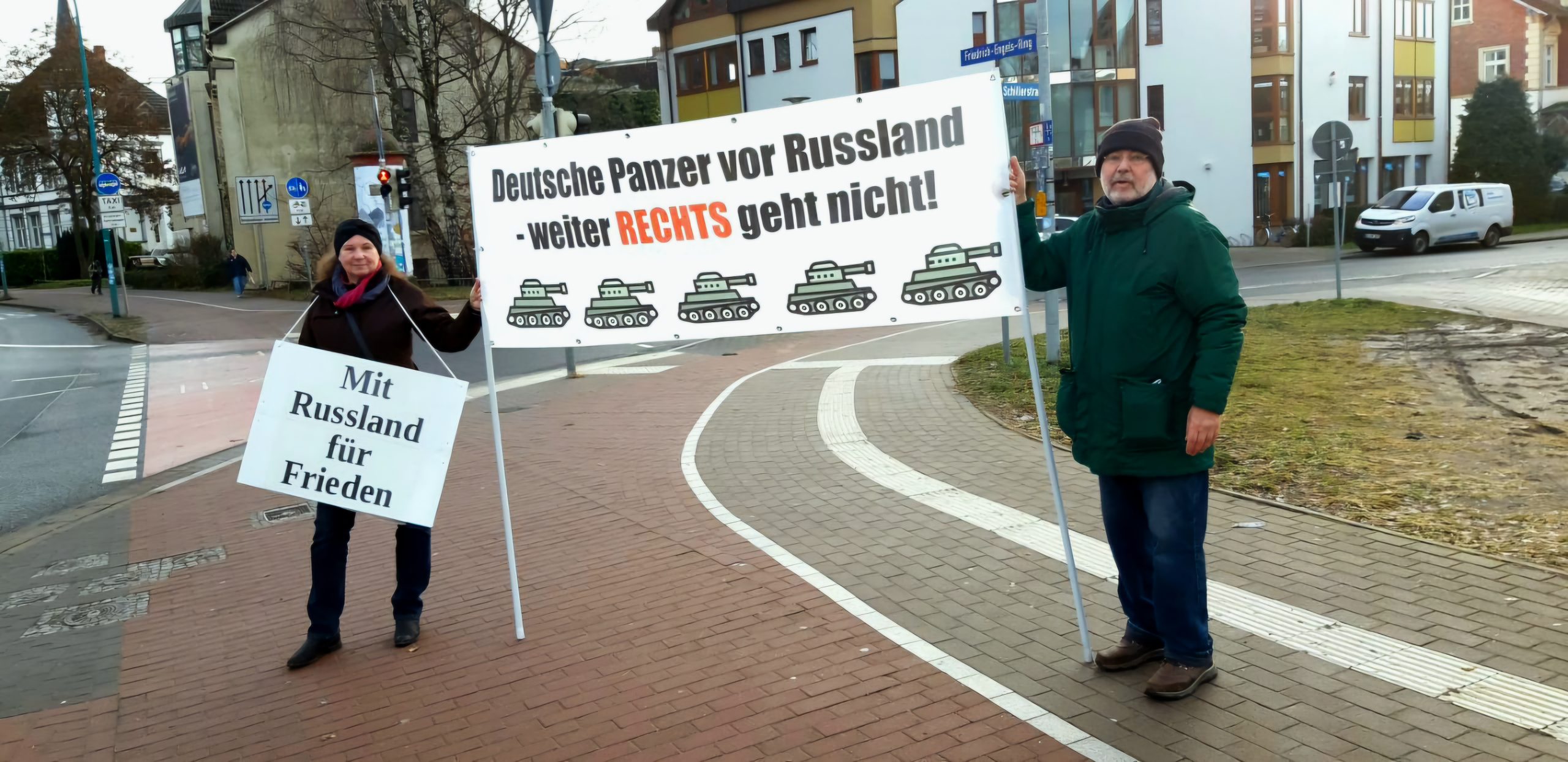
Schilder-Demonstration des Friedensbündnisses Neubrandenburg, 16. Januar 2026.
Aber es ist doch immer wieder zu lesen, in der DDR seien „rechte“ Haltungen stärker verwurzelt gewesen als in der BRD …[35]
Das Gegenteil trifft zu – und lässt sich wissenschaftlich belegen.
Psychische Altlasten
Die seelischen Deformationen, die Faschismus, Krieg, Kaiserreich und jahrhundertelange patriarchal-autoritäre Verhältnisse hinterließen, lösten sich durch die Kapitulation Hitler-Deutschlands nicht in Luft auf. Die psychischen Strukturen der Menschen waren am 9. Mai 1945 immer noch dieselben wie am 7. Mai. Abgesehen davon, dass zahlreiche NS-Verbrecher aus dem Osten in den Westen übersiedelten, hatten beide Landesteile in dieser Hinsicht die gleiche Ausgangsbasis.
Für die BRD ergaben Forschungen immer wieder „ein stabiles Potential“ an Antisemitismus. Die Zahlenangaben schwanken; es ist oft von 15 % eindeutigen und 30–40 % latenten Antisemiten die Rede.[36] 1979/80 durchgeführte Untersuchungen ermittelten bei 13 % der Befragten ein „geschlossenes rechtsextremistisches Weltbild“.[37]
Über die DDR ist zu sagen, dass der offizielle Anspruch, faschistoide Einstellungen in der Bevölkerung völlig überwunden zu haben, nicht zutraf. Was insofern kein Wunder war, als psychische Faktoren in der DDR sträflichst vernachlässigt wurden.
Ob insgeheim – vielleicht von der Staatsicherheit – kontinuierlich empirische Sozialforschung betrieben wurde zu solchen Einstellungen, ist mir nicht bekannt.
Zumindest aus dem Jahr 1965 ist eine aufschlussreiche Untersuchung erhalten geblieben. Knapp 90 Prozent der befragten DDR-Bürger sprachen sich damals gegen eine Verjährung von NS-Verbrechen aus. Die Verurteilung dieser Verbrechen korrespondierte mit der Bewertung des Kriegsendes: Auf die Frage, ob der 8. Mai 1945 als Tag der Niederlage oder der Befreiung empfunden werde, antworteten 91 Prozent, für sie sei es der Tag der Befreiung.[38]
Beides dürfte rechtsextremistische Einstellungen ausschließen.
Nun weiß ich nicht, wie beim Befragen genau vorgegangen wurde, inwieweit vor allem die Anonymität gewahrt blieb. Jahrzehnte später entstandene Daten machen jedoch plausibel, dass dieses Befragungsergebnis weitgehend die Realität widerspiegelte.
Im Anstieg: „rechte“ Orientierungen
In der zweiten Hälfte der 1980er Jahre sah sich das Leipziger Zentralinstitut für Jugendforschung erstmals mit einem „markanten Anstieg […] rechtsextremistischer Orientierungen“ konfrontiert. Das wurde – wie ich meine, zu Recht – auf die vielfältigen, von der DDR-Führung ignorierten Probleme zurückgeführt, die zu einer Erosion der Gesellschaft beitrugen. 1988 ergaben Untersuchungen des Institutes, dass jeder achte 14- bis 18-jährige Jugendlichen der Aussage zustimmte, „Der Nationalsozialismus hatte auch seine guten Seiten“.[39] Die Staatsicherheit ermittelte zu dieser Zeit, dass das „rechte“ Milieu mehr als 15.000, teils gewalttätige Personen umfasste – also etwa 0,09% der DDR-Bevölkerung.[40]
Das waren Alarmzeichen.
Doch ohne es zu bagatellisieren oder zu behaupten, beide Messungen hätten exakt dasselbe Phänomen abgebildet: Zwischen 13 Prozent und 0,09 Prozent besteht ebenso ein enormer Unterschied wie zwischen der Aussage, „der Nationalsozialismus hatte auch gute Seiten“ und einem „geschlossenen rechtsextremistischen Weltbild“.
Verordneter Antifaschismus?
Ein oft zu hörender Einwand lautet: „Der Antifaschismus in der DDR war gar nicht echt, sondern nur von oben verordnet!“ Auch das lässt sich widerlegen.
Denn ein nur verordneter Antifaschismus hätte spätestens am 3. Oktober 1990 seinen Geist aufgeben müssen.
Aber 1992 kam eine BRD-Untersuchung zu folgendem Schluss: Der „Anteil der Ostdeutschen, der sich antisemitisch, rechtsradikal oder ausländerfeindlich äußert“, ist „geringer als der entsprechende Anteil der Westdeutschen. Die Bundesbürger im Osten nehmen die Konsequenzen aus der NS-Vergangenheit für die Gegenwart ernster.“ Unter den Westdeutschen erwiesen sich 16% als Antisemiten, unter den Ostdeutschen 4%.[41] Das Magazin Spiegel kommentierte, „die meisten früheren DDR-Bürger [haben sich] eine Aversion gegen das NS-Regime bewahrt“. [42] Man muss hinzufügen, dass bei derartigen Untersuchungen meist ganz Berlin zum Osten hinzugeschlagen wird – was das Ergebnis stark zu Ungunsten der Ossis verzerren dürfte.
1994 unterstrich eine forsa-Umfrage noch immer: „Die Befragten aus den neuen Bundesländern zeigen durchgehend eine klarere, kundigere und ablehnendere Haltung zum Nationalsozialismus.“[43] Etwa zeitgleich kam der Politikwissenschaftler Jürgen Falter zum Ergebnis, „das rechtsextremistische Einstellungspotenzial im Frühjahr 1994 im Westen“ sei „mehr als doppelt so groß wie im Osten.“[44]
Erst 1998 stellte eine Untersuchung der Friedrich-Ebert-Stiftung fest, „dass rechtsextremistische Einstellungen im Osten häufiger anzutreffen waren als im Westen“.[45] Als Hintergrund wurde die zunehmende Desillusionierung beim „Ankommen“ in der immer unsozialer werdenden Marktwirtschaft vermutet.
Doch als eine Leipziger Forschergruppe 2002 ebenfalls damit begann, diese Einstellungen zu erfassen, vertraten im Westen 11,3 Prozent ein „geschlossenes rechtsextremes Weltbild“ — im Osten hingegen nur 8,1 Prozent. Bis 2016 blieb der „geschlossene Antisemitismus unter Westdeutschen […] fast durchweg verbreiteter als unter Ostdeutschen“.[46] Ebenfalls 2016 bilanzierten andere Forscher, dass sich nun „Ost- und Westdeutsche […] im Ausmaß rechtsextremer Einstellungen kaum“ noch voneinander unterschieden.[47]
Extremismus-Prophylaxe
Wie hat die DDR es geschafft, obwohl 1949 mit derselben geschichtlichen Altlast startend wie die BRD, rechtsextreme Einstellungen im Vergleich zu Letzterer so deutlich – und so nachhaltig – zurückzudrängen?
Eine wichtige Rolle spielte sicherlich das Ausmaß an staatlicher Kontrolle sowie an Ächtung und Bestrafung, die bei „rechten“ Aktionen drohten. Bereits 1964 war in der DDR die Verjährung von NS- und Kriegsverbrechen grundsätzlich aufgehoben worden.[48] In der BRD wurde erst 1979 beschlossen, dass Mord grundsätzlich nicht mehr verjährt – womit unter anderem NS-Morde weiterhin verfolgt werden konnten.[49] Letzteres geschah allerdings weiter äußerst spärlich.[50]
In der DDR waren NS-Verbrechen, auch der Massenmord an den Juden, präsent in Belletristik, Theater, Kino, Fernsehen, Radio und Druckmedien, im Schulunterricht sowieso, wo Besuche ehemaliger Konzentrationslager zum Pflichtprogramm gehörten. Der staatlich verankerte Antifaschismus wurde also durch offensive Geschichtsvermittlung gestützt.[51]
Da sich „rechtsextreme“ Einstellungen oft aus Verelendung und Ausgrenzung speisen,[52] muss sich gegen deren Entstehen auch die – im Vergleich zur BRD – weitaus stärkere materielle Absicherung ausgewirkt haben, die Unmöglichkeit, “in der Gosse“ zu landen sowie die größere soziale Eingebundenheit.
Es gibt einen zusätzlichen Grund, warum sich das antifaschistische Denken und Fühlen in den DDR-Bürgern verankert haben dürfte. Menschen sind von ihren Anlagen her mitfühlende, liebevolle, liebenswerte, pro-soziale, solidarische, friedfertige Wesen.[53] Eine gegen Faschismus, Rassismus und Krieg gerichtete politische Orientierung kommt daher ihrem Wesen, ihrer inneren Natur, ihren gesunden psychischen Bedürfnissen entgegen.
DDR-Charakteristik
Ich will ich einige weitere Merkmale des DDR-Systems auflisten, die helfen, die DDR-2.0“-These zu beurteilen.[54]
1) die weitaus kontinuierlichere und konsequentere Friedenspolitik – und das an der Seite der ebenfalls weitaus friedlicheren Großmacht, der Sowjetunion. Man vergleiche die von den USA initiierten, meist auch von westdeutschen Regierungen flankierten Kriege, Sanktionen, Attentate, Militärputsche, die Millionen von Menschen das Leben kosteten, mit den wenigen militärischen Interventionen der Sowjetunion, die zumal andere Hintergründe hatten.
2) keine Verdrängung (oder gar klammheimliche Verherrlichung wie in der BRD) des Angriffskrieges NS-Deutschlands gegen die Sowjetunion mit dessen bis zu 27 Millionen Opfern auf sowjetischer Seite.
3) die Unterbindung jeglichen Profitinteresses an Rüstung. Den von den Werktätigen erarbeiteten Mehrwert eignete sich keine Elite an, auch nicht etwa das SED-Politbüro.
4) die wesentlich ausgeprägtere Gleichberechtigung der Frauen, inklusive der gleichen Bezahlung für die gleiche Tätigkeit sowie der problemlosen, zügigen und kostenarmen Möglichkeit, sich scheiden zulassen.
5) das umfangreiche Angebot kostenloser staatlicher Kinderbetreuung.
6) das kostenlose, für alle Bürger gleichermaßen zur Verfügung stehende Gesundheitssystem, das sich zu keinem Zeitpunkt gegen die Bürger richtete – wie es hierzulande mit dem Alibi der „Corona-Pandemie“ zur brutalen, oft tödlichen Realität geworden ist.
7) der allen offenstehende, kostenlose oder gut bezahlbare, republikweite Zugang zu kulturellen Veranstaltungen.
8) die im Vergleich zu heute verschwindend geringen Einkommensunterschiede.
9) die weitestgehende berufliche Chancengleichheit durch Überwindung bürgerlicher Bildungsprivilegien.
Zudem gab es 10) in der DDR keine materiellen Existenzsorgen, keinen Konsumterror, keine Obdachlosigkeit, keine Arbeitslosigkeit, keinen Hunger, keine Armut.
Resümee
Ich fasse das bisher Gesagte zusammen:
Die These, wir befänden uns in einer „DDR 2.0“ oder bewegten uns auf sie zu, ist nur bei äußerst oberflächlicher oder voreingenommener Betrachtung aufrechtzuerhalten.
In ihrem Kernist sie schlicht: Blödsinn – der meist eine ungerechtfertigte DDR-Diffamierung verbindet mit einer genauso ungerechtfertigten BRD-Idealisierung.
Nicht nur war die Grundlage der DDR ein gänzlich anders gearteter Gesellschaftsentwurf als in der BRD. Sondern auch das reale Leben in der DDR unterschied sich hochgradig – und vielfach positiv – von dem Zustand, in dem wir heute leben, erst recht von den Zuständen, die uns die Herrschenden offenkundig überstülpen wollen.
Wer ernsthaft an die These einer aufkommenden „DDR 2.0“ glaubt, den bitte ich daher immer, sich damit zu befassen, was „DDR 1.0“ tatsächlich war.
Das in kompetenter Weise beurteilen zu können, hat für diejenigen, die sich für Frieden engagieren, noch einmal eine spezifische Bedeutung.
Das will ich abschließend näher erklären.
Die Schwäche der Friedensbewegung
In einer Reihe von Artikeln wird nach Gründen gesucht für die Schwäche der Friedensbewegung im Vergleich zur BRD der 1980er Jahre. Was in diesen Artikeln fast durchweg fehlt, sind angemessenen Bezüge zu psychologischen Aspekten – und zur DDR.
Zunächst zur Psyche.
Die autoritären Charakterstrukturen, die uns allen, in Ost wie West, in der Kindheit anerzogen wurden – dem einen mehr, dem anderen weniger – stellen ein grundsätzliches Hindernis dar beim Sich-Aufbäumen gegen Obrigkeiten, also auch gegen staatliche Gewalt. Diese sogenannte Radfahrer-Persönlichkeit, die nach oben buckelt und nach unten tritt, wird aber schon seit ein paar tausend Jahren herbeisozialisiert.[55] Daher kann sie nicht die Unterschiede erklären zwischen den 80er Jahren und heute. Doch sie spielt mit hinein.
In der DDR hatte man, wenn man sich an die auch für den Friedenskampf vorgegebenen Richtlinien hielt, keine „Schwerter zu Pflugscharen“-Aufnäher trug, den Staat auf seiner Seite.
Auch in der BRD war es – solange man keine kommunistischen Ideen damit verband – damals viel ungefährlicher, öffentlich für den Frieden einzutreten. Man konnte zum Beispiel wie Wolfgang Niedecken und seine Kölner Band BAP bei der großen Antikriegsdemonstration am 10. Juni 1982 in Bonn auftreten, „Plant uns bloß nicht bei euch ein!“[56] singen, gleichzeitig mit solchen Songs die LP-Hitlisten anführen und viel Geld verdienen. Versuchen Sie das mal heute!
Dann drohen Ihnen als „Lumpen-Pazifisten“ nicht nur massive Verleumdung und Ausgrenzung, sondern möglicherweise auch Kontoschließungen, Reiseverbote oder gar juristische Verfolgung als Putin-Versteher.
Aber warum war es 1982 ungefährlicher, sich im Westen für den Frieden zu engagieren?
Weil es tatsächlich demokratischer zuging.
Warum ging es demokratischer zu?
Zum einen, weil im Zuge der 1968er Bewegungen die reaktionär-faschistoiden Strukturen der BRD ein Stück weit zu bröckeln begonnen hatten.
Doch zum anderen, weil es das sozialistische Weltsystem zu dieser Zeit noch gab – als ernstzunehmenden Systemkonkurrenten für den kapitalistischen Westen.
Um in diesem Kampf der Systeme nicht ins Hintertreffen zu geraten, war es nicht nur wichtig, die BRD-Bevölkerung mit vielen schönen Konsumgütern zu beglücken, sondern ihr auch genügend Spielraum innerhalb der bürgerlichen Demokratiekulisse zu gewähren.
Das Vorhandensein von realem Sozialismus, speziell der DDR, machte es also nötig, der BRD-Bevölkerung größere Freiheiten zuzugestehen inklusive des – im Vergleich zu heute – recht risikoarmen Friedensengagements.
Und es kommt auch hier noch etwas hinzu.
Die DDR verkörperte trotz aller Verfehlungen und Defizite eine Alternative zur westlichen Gesellschaft; sie war der Beweis, dass es anders, in vielen Aspekten auch besser ging. Man musste nur mal einen Blick über die Mauer werfen, um das festzustellen.
Bewusst oder unbewusst dürften daher jene Hunderttausende, die in den 1980er Jahren im Westen gegen Aufrüstung und Krieg demonstrierten – auch wenn sie sich nicht für „links“ hielten –, registriert haben: Der Kapitalismus mitsamt seinen zum Krieg tendierenden Mechanismen ist grundsätzlich abschaffbar und ersetzbar.
Das gestattete, sich Zukunftsvisionen auszumalen.
Genau das fehlt heute.
Ohne Ziel keine Bewegung
Seit um 1990 der „reale Sozialismus“ zusammenbrach, gelten revolutionäre Konzepte als obsolet, griffen Klosprüche um sich wie der vom „Ende der Geschichte“ oder „There is no alternative“. Demonstriert wird daher vorwiegend GEGEN etwas. Das WOFÜR, das WOHIN-STATTDESSEN ging verloren.
Dieses Manko durchzieht auch die als alternativ bezeichneten Medien. Dort sind nach meinem Eindruck meist westsozialisierte, eher bürgerlich-konservativ ausgerichtete Menschen tonangebend.
Bei vielen von ihnen geht der ehrliche und mutige Kampf für Frieden und gegen das Zerstören der letzten Demokratiereste einher mit einer Art Sozialismus-Phobie. Vielleicht, weil sie Sozialismus unreflektiert gleichsetzen mit stalinistischem Terror – oder eben mit jenen Klischees, die ihnen genau jener Staat eingetrichtert hat, dessen Lügen sie doch auf anderen Gebieten so klug durchschauen.
Ihre Vorstellungen darüber, was sich verändern sollte, scheinen daher oft auf Nostalgisches fokussiert: „Es soll wieder sein wie vor 2020, als das Grundgesetz noch galt, als die Gesellschaft noch nicht gespalten war …“.
Aber die BRD-Gesellschaft war seit Anbeginn in vielfältiger Weise gespalten, nicht zuletzt in NS-Täter, -Mitläufer und -Opfer, in Oben und Unten, Reiche und Arme, Mächtige und weitgehend Ohnmächtige. Auch die Würde von Menschen wurde hier zu jeder Zeit angetastet, nicht erst seit den „Corona“-Lockdowns. Wer arm war, durfte schon immer unter Brücken pennen.
Ich behaupte daher: Die momentane Schwäche der deutschen Friedensbewegung hängt hochgradig zusammen mit der beschriebenen, negativ verzerrten Sicht auf die DDR, mit der auch unter Friedensbewegten verbreiteten DDR-2.0-These.
Die seit 1949 anhaltende, auf antikommunistische Nazi-Traditionen aufbauende, von vielen verinnerlichte, seit 1990 immer rabiater werdende DDR-Verteufelung verhindert wahrzunehmen, dass die DDR 40 Jahre als ernstzunehmende Alternative zur BRD existierte.
Das blockiert die Anerkennung der Vorteile sozialistischer, nichtkapitalistischer Politikansätze – insbesondere für eine nachhaltige Friedenssicherung.
Was wiederum dazu beiträgt, dass keine durchdachten Gegenentwürfe zum Bestehenden, keine plausiblen Zukunftsvisionen angeboten werden, welche die Massen mitreißen und wieder auf die Straße bringen könnten.
Wer nicht weiß, wohin er gehen will, muss Schwierigkeiten haben, überhaupt erst loszulaufen.
Also:
Braucht die Friedensbewegung, genauer gesagt, brauchen die Friedensbewegten eine verbindende Zukunftsvision?
Ja. Dabei geht es nicht darum, ein Dogma zu installieren – sondern die Grundlage für einen möglichst breiten Konsens zu schaffen, der viele heterogene Sichtweisen akzeptiert und integriert.
Existiert eine solche Vision?
Nicht dass ich wüsste.
Lässt sich eine solche Vision erarbeiten?
Ganz bestimmt – aber nur, wenn sie einen realitätsgerechten Rückblick auf DDR und „realen Sozialismus“ einschließt und die dort gemachten Erfahrungen auswertet.
Das bedeutet auch: Ehemalige DDR-Bürger können einen ebenso spezifischen wie unverzichtbaren Beitrag zur Stärkung der Friedensbewegung leisten, indem sie authentisch über ihr Leben in der DDR berichten.
Ich danke Ihnen fürs Zuhören.
***
Anmerkungen
[1] Ich danke Gudrun Peters, John Erpenbeck und Wolfgang Stern für hilfreiche kritische Hinweise.
[2] Im Grunde hat meine Auseinandersetzung damit seit 1989 nie aufgehört. Das hat auch den Inhalt des im Jahr 2000 erschienenen Buches „Weltall, Erde … ICH“ mitbestimmt. Siehe https://andreas-peglau-psychoanalyse.de/weltall-erde-ich-de/
[3] Mehr zu mir: https://andreas-peglau-psychoanalyse.de/ueber-mich/
[4] Details: https://andreas-peglau-psychoanalyse.de/meine-annaeherungen-an-die-psychoanalyse-in-ddr-und-brd-von-1957-bis-2000/
[5] Zu Reich siehe u.a.: https://andreas-peglau-psychoanalyse.de/ein-marxistischer-psychoanalytiker-juedischer-herkunft-erlebt-das-ende-der-weimarer-republik/
[6] https://andreas-peglau-psychoanalyse.de/mensch-du-mensch-mensch-menschenskinder-und-stand-up-hans-joachim-maaz-im-gespraech-mit-andreas-peglau-bei-jugendradio-dt-64/
[7] Siehe: https://andreas-peglau-psychoanalyse.de/menschen-sind-keine-marionetten-eine-utopie-die-ueber-karl-marx-hinausgeht-und-deren-verwirklichung-heute-abend-beginnen-kann/
[8] Siehe dazu auch: https://www.nachdenkseiten.de/?p=136088; https://de.wikipedia.org/wiki/Operation_Unthinkable
[9] „Der Vorläufer des Bundesnachrichtendienstes habe vor dessen Gründung 1956 in der Sowjetisch Besetzten Zone, SBZ, und in der früheren DDR extrem erfolgreich Agenten angeworben. ‚[…] Das heißt, bereits in den 1940er Jahren ist damals die Organisation Gehlen in der Lage, weitverzweigte Netze aufzubauen in einem großen geographischen Raum und auch mit einer großen Spannbreite, das heißt es ging nicht nur um Militärspionage, es ging auch um Wirtschaftsspionage, es gab auch Ansätze, auch den Sicherheitsbereich in den Blick zu nehmen.‘ […] 1953 umfasste das Agentennetz mehr als tausend registrierte Zuträger […]. Hinzu kam eine ähnlich hohe Zahl an Mitwissern und Helfern, die Informationen liefern konnten. […] die Bedingungen für Spionage [waren] in der frühen DDR – auch für andere westliche Geheimdienste wie die CIA – besonders günstig: ‚Wir haben offene Grenzen, wir haben Kontakte der Bevölkerung, die sich von keiner Seite vollständig kontrollieren lassen‘“ (https://www.deutschlandfunk.de/geschichte-des-bnd-die-spionage-der-organisation-gehlen-in-100.html).
[10] https://www.bpb.de/kurz-knapp/hintergrund-aktuell/223686/vor-60-jahren-gruendung-des-bnd/
[11] https://de.wikipedia.org/wiki/Reinhard_Gehlen
[12] https://www.deutschlandfunk.de/bnd-bundesnachrichtendienst-nationalsozialismus-ns-taeter-100.html
[13] 1953 wurde Zaisser nach dem Versuch, Walter Ulricht abzulösen, politisch kaltgestellt (https://de.wikipedia.org/wiki/Wilhelm_Zaisser).
[14] Dahn, D. (2009): Wehe dem Sieger! Ohne Osten kein Westen, Reinbek bei Hamburg, S. 174f.
[15] Zu Bestrebungen, den Patientenschutz wenigstens in der Psychotherapie zu verteidigen: https://kollegennetzwerk-psychotherapie.de/index.php?page=58040971&f=1&i=2068426342&s=58040971
[16] Siehe u.a.: https://www.manova.news/artikel/geschlossene-gesellschaft-2
[17] Mitglieder der Kommunistischen Partei, der Vereinigung der Verfolgten des Naziregimes und anderer „linker“ Organisationen, die als staatsgefährdend eingestuft wurden, wurden überwacht, zum Teil verfolgt oder inhaftiert. Sie durften – Stichwort „Radikalenerlass“ – lange Zeit nicht Beamte sein, nicht mal als Briefträger.
[18] Rainer Mausfeld schreibt: „Demokratie wird also nur soweit als ‚zulässig‘ angesehen, wie der Bereich der Wirtschaft von demokratischen Entscheidungsprozessen verschont ist – also solange sie keine Demokratie Ist“ (zitiert in https://andreas-peglau-psychoanalyse.de/wp-content/uploads/2014/09/Rechtsruck-Zweite-Auflage-3-11-17-1.pdf, S. 79). Selbst auf der Webseite der Bundeszentrale für politische Bildung lässt sich seit 2011 nachlesen: „Das derzeit geltende Wahlsystem zum Deutschen Bundestag weist fundamentale Demokratiedefizite auf. Aus diesem Grund ist eine demokratische Wahlreform überfällig.“ (http://www.bpb.de/apuz/33522/hat-deutschland-ein-demokratischeswahlsystem).
[19] https://www.nachdenkseiten.de/?p=115769
[20] https://www.nachdenkseiten.de/?p=144473
[21] Diverse Details dazu zum Beispiel in Krenz, E. (2025): Verlust und Erwartungen. Erinnerungen, Berlin.
[22] Statut der SED (1976), Berlin.
[23] https://de.wikipedia.org/wiki/J%C3%BCrgen_Kuczynski
[24] https://de.wikipedia.org/wiki/Joachim_Herrmann_(Politiker,_1928)
[25] https://de.wikipedia.org/wiki/Reiner_Werner
[26] https://andreas-peglau-psychoanalyse.de/mensch-mensch-brauche-ich-ein-vorbild-dt-64-sendung-vom-5-10-1988/
[27] Böhm, G. (2015): Vorwärts zu Goethe? Faust-Aufführungen im DDR-Theater, Berlin, S. 149–176.
[28] https://de.wikipedia.org/wiki/Spur_der_Steine; https://de.wikipedia.org/wiki/Spur_der_Steine_(Film)
[29] https://de.wikipedia.org/wiki/Blaue_Pferde_auf_rotem_Gras
[30] Dahn 2009 (wie Anm. 14), S. 37–48.
[31] https://www.oxfam.de/presse/pressemitteilungen/2026-01-19-so-schnell-nie-so-gross-nie-milliardaersvermoegen-erreichen
[32] „Im Tagesspiegel vom 11. Februar 2020 [verweist] Caroline Fetscher […] auf im Dritten Reich verwurzelte ‚Kontinuitäten in fast allen Bereichen der [west!]deutschen Gesellschaft, in Konzernen, Behörden, im Bildungswesen, der Medizin, dem Militär und im Kulturbetrieb‘. […] Etwa ‚65 hohe Funktionsträger der CDU, 20 der CSU und 35 Politiker der FDP waren‘, so Fetscher weiter, ‚Mitglieder der NSDAP, ehe sie ihre Ämter in der bundesrepublikanischen Demokratie antraten, als Bürgermeister, Landtagsabgeordnete, Bundestagsabgeordnete, Fraktionsvorsitzende, Ministerpräsidenten, stellvertretende Ministerpräsidenten und hochrangige Diplomaten.‘ Caroline Fetscher benennt drei weitere prominente Fälle: Hans Globke, Mitverfasser der Nürnberger ‚Rassegesetze‘ und bis 1963 Kanzleramtschef unter Konrad Adenauer, Kurt Georg Kiesinger, Bundeskanzler von 1966 bis 1969, stellvertretender Leiter der Rundfunkpolitischen Abteilung im Auswärtigen Amt des NS-Staates sowie Hans Filbinger, Ministerpräsident von Baden-Württemberg bis 1979. Letzterer ‚fällte als Marinerichter noch Ende des Zweiten Weltkriegs Todesurteile gegen Deserteure‘“ (https://www.manova.news/artikel/die-schattentrager). Nicht nur in Bezug auf prozentuale Anteile ehemaliger NSDAP-Mitglieder in Bundestag und Volkskammer, sondern auch in Bezug auf deren jeweilige Verstrickung bestanden gravierende Unterschiede: https://de.wikipedia.org/wiki/Liste_ehemaliger_NSDAP-Mitglieder,_die_nach_Mai_1945_politisch_t%C3%A4tig_waren. Weitere Informationen: Dahn, D. (2019): Der Schnee von gestern ist die Sintflut von heute. Die Einheit – eine Abrechnung, Reinbek bei Hamburg, S. 89–144.
[33] Siehe auch: https://andreas-peglau-psychoanalyse.de/lebensbejahend-lebensfeindlich-eine-alternative-zur-links-rechts-einteilung/
[34] https://friedensbuendnis-nb.de/fotos-3/#090326
[35] So war in der Frankfurter Rundschau unter der Überschrift „Das braune Erbe der DDR“ zu erfahren: „Ostdeutschland hat ein Problem mit dem Rechtsextremismus. Wissenschaftler finden dafür eine Erklärung im System der DDR.“ (https://www.fr.de/politik/braune-erbe-11707837.html).
[36] https://de.wikipedia.org/wiki/Geschichte_des_Antisemitismus_seit_1945
[37] Stöss, Richard (2010): Rechtsextremismus im Wandel, Berlin, S. 61.
[38] Niemann, H. (1995): Hinterm Zaun. Politische Kultur und Meinungsforschung in der DDR – die geheimen Berichte an das Politbüro der DDR, Berlin, S. 65–69.
[39] Friedrich, W. (2001): Ist der Rechtsextremismus im Osten ein Produkt der autoritären DDR? (https://www.bpb.de/system/files/pdf/HRDB0X.pdf), S. 19, 21f. Ausführlicher: Friedrich, W. (2002): Rechtsextremismus im Osten. Ein Resultat der DDR-Sozialisation? Leipzig (https://sachsen.rosalux.de/fileadmin/ls_sachsen/dokumente/Publikationen/Einzelpublikationen/Friedrich__Walter__Rechtsextremismus_im_Osten._2002._119_S..pdf).
[40] http://www.zeit.de/2012/08/DDR-Nazis/ Die DDR-Bevölkerung umfasst 1988 etwa 16,5 Millionen Menschen: https://de.statista.com/statistik/daten/studie/249217/umfrage/bevoelkerung-der-ddr/
[41] Stöss 2010 (wie Anm. 37), S. 62f.
[42] Ebd., S. 63f.
[43] Ebd.
[44] Ebd.
[45] Ebd.
[46] Decker, O./ Brähler, E. (Hrsg.) (2018): Flucht ins Autoritäre. Rechtsextreme Dynamiken in der Mitte der Gesellschaft, Gießen, S. 84.
[47] Zick, A./ Küpper, B./ Krause, D. (2016): Gespaltene Mitte – Feindselige Zustände. Rechtsextreme Einstellungen in Deutschland 2016, hg. von Melzer, R., Bonn, S. 130.
[48] Dementsprechend hieß es im Verfassungsartikel 91 der DDR: „Die allgemein anerkannten Normen des Völkerrechts über die Bestrafung von Verbrechen gegen den Frieden, gegen die Menschlichkeit und von Kriegsverbrechen sind unmittelbar geltendes Recht. Verbrechen dieser Art unterliegen nicht der Verjährung“ (https://www.verfassungen.de/ddr/verf68-i.htm)
[49] https://de.wikipedia.org/wiki/Verj%C3%A4hrungsdebatte
[50] http://www.michael-greve.de/strafen.htm
[51] Ausführlich dazu: Dahn, D. 2019 (wie Anm. 32), S. 145–182. Siehe auch: https://de.wikipedia.org/wiki/Die_Bilder_des_Zeugen_Schattmann; Pätzold, K. (2010): Die Mär vom Antisemitismus, Berlin. Antisemitische Aspekte der SED-Politik bis 1967 diskutiert Mario Keßler: https://zeitgeschichte-digital.de/doks/frontdoor/deliver/index/docId/912/file/ke%C3%9Fler_sed_juden_repression_toleranz_1995_de.pdf, Zusammenfassung S. 149–151.
[52] https://andreas-peglau-psychoanalyse.de/wp-content/uploads/2014/09/Rechtsruck-Zweite-Auflage-3-11-17-1.pdf, S. 81–84.
[53] https://andreas-peglau-psychoanalyse.de/wir-sind-keine-geborenen-krieger-zu-psychosozialen-voraussetzungen-von-friedfertigkeit-und-kriegstuechtigkeit/
[54] Für Belege der folgenden zehn Punkte siehe die genannten und weitere Bücher von Daniela Dahn sowie (auto)biografische Werke ehemaliger DDR-Bürger, die zum Beispiel im Verlag Neues Leben erschienen sind: https://www.eulenspiegel.com/buecher/neues-leben.html?start=0. Einen kurzen Überblick bietet Roesler, J. (2013): Geschichte der DDR, Köln. Zu den US-Verbrechen nach 1945 siehe zum Beispiel: https://de.wikipedia.org/wiki/Patrice_Lumumba; https://de.wikipedia.org/wiki/Salvador_Allende; https://de.wikipedia.org/wiki/Vietnamkrieg; https://de.wikipedia.org/wiki/Operation_Ajax. Zu den Toten durch Sanktionen: https://www.telepolis.de/article/Millionen-Tote-fuer-Demokratie-und-Freiheit-9191381.html?seite=all.
[55] https://andreas-peglau-psychoanalyse.de/vom-nicht-veralten-des-autoritaeren-charakters/
[56] Erschienen auf der LP „Vun drinne noh drusse“ (1982) (https://bap.de/songtext/zehnter-juni/)
Letzte Internetabfrage 27.3.2026
Bitte zitieren als
Andreas Peglau (2026): DDR 2.0? Braucht die Friedensbewegung eine Zukunftsvision? (https://andreas-peglau-psychoanalyse.de/ddr-2-0-braucht-die-friedensbewegung-eine-zukunftsvision/)
© 2026 Andreas Peglau – Alle Rechte vorbehalten. Löcknitzer Str. 33, 17309 Pasewalk
info@andreas-peglau-psychoanalyse.de
Die Weiterleitung und Verbreitung dieses Textes zu nichtkommerziellen Zwecken ist ausdrücklich erwünscht. Lizensiert unter einer Creative Commons-Lizenz (Namensnennung – Nicht kommerziell – Keine Bearbeitungen 4.0 International).
Weiterlesen- und -sehen: 7. Oktober 1949: Vor 76 Jahren wurde die Deutsche Demokratische Republik gegründet.