
by Andreas Peglau
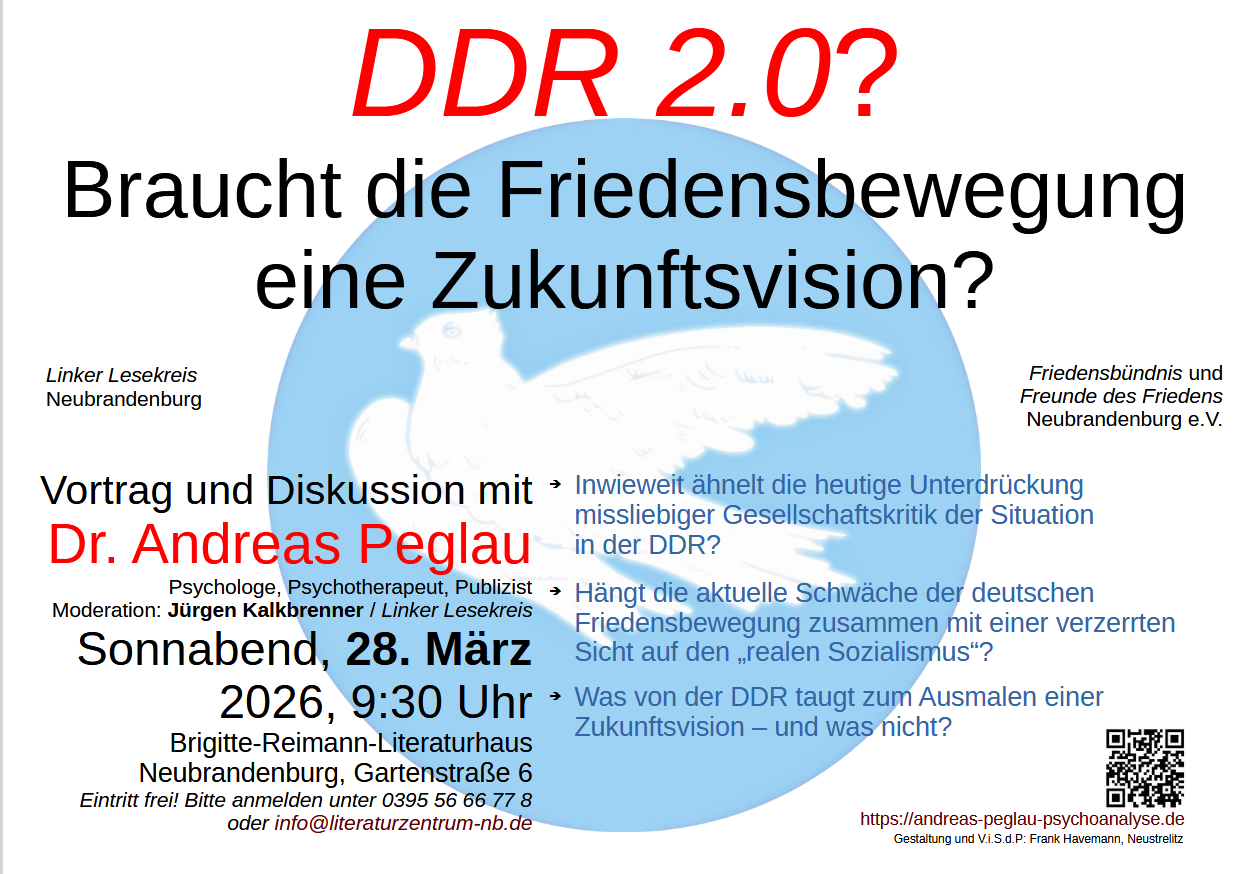
Lecture delivered on March 28, 2026, at the Brigitte Reimann Literature House in Neubrandenburg[1]
*
What I can offer you today is not an academic overview, but rather a mix of facts, personal experiences, and subjective assessments.
I assume that most of you also have roots in the GDR. I am aware that this may evoke very different experiences for you than it does for me. That is probably why you will not agree with everything I say; you may know some things not only differently, but also better. We can then use the discussion to compare our perspectives.
It was not easy for me to write down what I am about to read to you. I began thinking about this back in December—and was still polishing my text just yesterday. Once again, I realized: I am not done with the GDR, neither in a good way nor in a bad way.[2]
Life in Two Systems
To make it clearer from what perspective I’m speaking, a brief introduction to myself.[3] I was born in 1957 in Berlin, the capital of the GDR, and lived in Berlin-Pankow, 400 meters from the Wall. In contrast to my father, who constantly found fault with the GDR, I became a rather naive socialist with dogmatic tendencies as a teenager, and in 1976, at the age of 19, I also joined the SED. I remained a member until February 1990: When GDR head of state Hans Modrow adopted the slogan “Germany, united fatherland!”, I left the party—I absolutely did not want that.
From 1976 to 1981, I studied clinical psychology at Humboldt University, where I was disappointed to realize how meager the “Marxist psychology” we were taught actually was.[4] I began to become enthusiastic about the enrichment of Marxism through psychoanalysis, especially the work of the “leftist” psychoanalyst Wilhelm Reich.[5]
Between 1985 and 1991, I worked as an editor at the youth radio station DT 64, where I was primarily responsible for self-help programs that ran under the titles “Mensch Du,” “Mensch, Mensch,” or “Menschenskinder,” and from March 1989 onward, I had psychotherapist Hans-Joachim Maaz as a guest.[6]
After the anschluss of the GDR , I alternated several times between public works jobs and unemployment. I began training as a psychoanalytic psychotherapist in 2002 and completed it in 2008. I stopped practicing therapy at the end of 2025. So, formally speaking, I am now a retiree. And since last year: a member of the Neubrandenburg Peace Alliance.
What I am no longer is: a naive socialist. I now view Marxism as in great need of revision and criticism[7] and am quite critical of the GDR in several respects.
The Meaning of Criticism
So, a few more words on what I understand by criticism.
Wanting to verbally destroy or “tear someone down” is not criticism, but an attack. Honest and serious criticism is something entirely different: a gift. Always. Even if it isn’t accurate. When I criticize someone, I consider them important enough that I take it upon myself to confront them, to point out something I find wrong, so they can change it. Honest criticism is an attempt to help.
The GDR can no longer be improved. But a radical critique—in the best sense of the word—of “real socialism”—which I experienced primarily in the form of the GDR—is the indispensable prerequisite for doing better the next time around. And I believe there will be a next time.
It would never occur to me to criticize fascism: I condemn it. Capitalism, I believe, should not be criticized either, but rather: abolished.
The GDR 2.0 Thesis
The question of whether we are living in a GDR 2.0 or heading toward one forces a difficult comparison: the GDR of the past with the FRG of today. I must compare something with which I identified—and in some ways over-identified—something that disappeared when I was 33, with something I could never identify with, something I increasingly experience with fear and anger – now that I am 68 years old.
To support the GDR 2.0 thesis, reference is usually made to three current trends, often summarized as the erosion of democracy, which are also viewed as typical of the GDR:
1) Suppression of unpopular social criticism or restriction of freedom of speech,
2) Media conformity,
3) Surveillance of the population.
Regarding the third point—with which I wish to begin—reference is usually made to the Ministry for State Security. Even here, apples are being compared to oranges.
Surveillance
For one thing, the “Stasi” had far more responsibilities than just monitoring its own citizens. For another: not all intelligence agencies are the same. The question of which state and which political agenda this institution serves is essential.
The Western powers, which had intervened in World War II not least to halt the Soviet Union’s advance, [8] worked from 1945 onward to destabilize the emerging Eastern Bloc. This also affected the Soviet occupation zone—among other things, through several thousand informants and collaborators recruited by the predecessor organization of the Federal Intelligence Service, founded in 1946. [9] This organization was created on the initiative of the U.S. War Department and operated as part of the CIA until 1955.[10] Reinhard Gehlen, formerly a general in the fascist Wehrmacht who had led a spy unit operating in Eastern Europe during the war, was put in charge of it.[11] Nazi criminals were given preference for recruitment as members of the so-called “Gehlen Organization,” including 33 members of those “Einsatzgruppen” responsible for hundreds of thousands of murders. By the mid-1950s, roughly one in ten BND employees was a Nazi perpetrator; in the years that followed, this percentage increased.[12]
In 1950, the GDR responded by creating an additional agency for its protection: the Ministry for State Security. It was led by Wilhelm Zaisser ,[13] a commander of an International Brigade who had earned respect during the Spanish Civil War. Yet the understandable purpose did not justify all the means that were employed. Authoritarian institutions, structured around orders and operating predominantly in secret, always provide fertile ground for the indulgence of a lust for power, sadism, and a culture of informants. By unjustly disrupting or destroying many people’s lives, the State Security operating within the country not only secured the GDR but also harmed it.
What we face today, however, differs from that both quantitatively and qualitatively. Author Daniela Dahn, who was active in the GDR opposition, has researched that at no point were more than 0.5 percent of GDR citizens—usually significantly fewer—subject to Stasi surveillance.[14] It is therefore unrealistic to speak here, as is often done, of “comprehensive” control.
US intelligence agencies, on the other hand, have long been able to monitor all digital and telephone communications, data giants like Google or Amazon diligently provide the raw data; in the healthcare sector—including psychotherapy[15]—patient data is being digitally collected for questionable purposes; the monitoring of internet usage and private spending is being prepared; and extremely influential billionaires and transhumanism fanatics like Elon Musk are planning to “link” our brains. To claim, in light of this, that we face Stasi-style surveillance would be an understatement of the first order. [16] What is now to be secured are the interests of the super-rich, directed against the absolute majority, for whom states are merely vehicles—and people are largely expendable pawns. The surveillance already taking place, and even more so the planned surveillance, is, from its very inception, not only hostile to humanity but also hostile to life.
Freedom (or lack thereof) of speech in the West …
Regarding freedom of speech—or rather, its restriction—it must be noted: Unless one espoused communist ideas[17] or flirted all too obviously with National Socialism, one could say almost anything publicly in the FRG until 2019.
Admittedly, without thereby changing anything substantial. This largely ineffective venting of frustration tended to stabilize the state because it suggested the false image of a democracy.
Yet there was never any popular rule in the FRG.[18] National and international capitalists, along with their henchmen in the state and the media, had and still have the country firmly in their grip.[19]
But even relative freedom of speech has been severely curtailed since spring 2020. It is not only influential critics of the government-sanctioned “narrative” regarding the alleged “Corona pandemic” or the war in Ukraine who have seen their lives disrupted or destroyed as a matter of course—with the involvement of the domestic intelligence service, courts, media, and banks. Swiss military analyst Jaques Baud[20] is just one of the most recent examples showing that this also works across the EU.
While state restrictions have spread over the past six years, a kind of counterculture has nonetheless expanded at the same time. It makes itself heard most loudly in alternative media such as apolut, Manova, TKP, multipolar, the Nachdenkseiten, as well as in the junge Welt, sometimes in the Nordkurier, the Berliner, and other newspapers such as, more recently, the Ostdeutsche Allgemeine. Absolute media conformity does not yet exist. But the leadership of the Federal Republic of Germany and the EU are working hard to bring it about.
Even the remaining freedoms currently still granted can be stifled at any time by lockdowns and contact bans, perhaps following the declaration of an—in reality easily avoidable – energy crisis, due to an alleged flu pandemic, or in the wake of a fabricated “power shortage.” Gatherings like ours could then potentially be classified as undermining national defense and banned.
… and the East
How does the situation compare to that of the German Democratic Republic regarding the suppression of social criticism and, closely linked to this, media conformity?
Both were far more pronounced in the GDR than they are today.
A critical examination of one’s own state, such as is currently taking place in the aforementioned alternative media, would have been unthinkable in the GDR. Nor could we ever have officially, announce publicly or sit together in such a forum, accessible to the public, to question the social system surrounding us in this way.
There was no question of freedom of speech in the GDR as soon as it went beyond the private sphere. Nor was there any democracy. Neither the people nor the workers and peasants were in power.
SED dictatorship?
And not even, as is often claimed: “the Party.” At least not in the sense that the comrades at the grassroots level had a say in shaping policy.
Instead, an almost absolutist power was concentrated until 1971 in the hands of Walter Ulbricht, and subsequently in those of SED General Secretary Erich Honecker, both of whom were able to make quite independent or autocratic decisions regarding the lives of the population. Operating beneath them—with rapidly diminishing authority—were the Politburo, the Central Committee, and the Council of Ministers. [21]
At the level of the party’s grassroots organizations, the main focus was on discussing directives from above in as supportive a manner as possible and implementing them creatively. Even when criticism was voiced there, in my experience it never changed central directives.
The SED Statute stated that “criticism and self-criticism from below” were to be “encouraged in every way” and that “shortcomings in work” were to be identified “without regard to the person.” [22] Anyone who adhered to this might soon find themselves no longer a comrade. You may be familiar with the aphorism by GDR economist Jürgen Kuczynski[23]: “A communist’s helmet has many dents; some come from the enemy.” In reality, these were often not dents in the helmet, but fractures at the base of the skull.
Media Comparison
To stay with my workplace, GDR Radio: Every day, the so-called “argumentation” came from the Politburo via Comrade Joachim Hermann[24]—the person in charge of agitation and propaganda—through the chairman of the Broadcasting Committee and the directors of the five stations, all the way down to the journalists on the ground. These were not suggestions or topics for discussion, but instructions what was to be evaluated, emphasized, concealed, done, and refrained from doing that day, and often: which implausible phrases were to be particularly embellished on that day. For all my identification with the state and its ideology: these constant authoritarian lectures, this often cheap self-serving lies were hard to bear.
However: The brazen and clumsy lies that the so-called mainstream media of the Federal Republic of Germany—whether state-run or private—have been spouting since 2014, since the Maidan coup in Ukraine, now far exceed anything I experienced in the GDR in terms of mandated distortion of reality. Not to mention the role of today’s mainstream media in warmongering and preparations for war.
In the GDR media, the hammering home of undifferentiated enemy stereotypes—the others are the only bad guys, we are the only good guys!—did play an important role: But warmongering did not occur, at any time. Our accusations were also never directed against other peoples—but primarily against the governments of capitalist states, the masterminds, henchmen, and representatives.
A Scandal in 1988
As a SED comrade at GDR Radio, I never suffered a skull fracture, yet I consider one of my bumps worth mentioning because it is symptomatic.
For the program Mensch, Mensch – brauche ich ein Vorbild?, broadcast on September 5, 1988, I had not only conducted a long conversation with the prominent psychologist and author Professor Reiner Werner,[25] but also interviewed several hand-picked high school graduates: all of them strongly identified with the GDR; one even wanted to become an NVA officer. Among other things, they stated that KPD leader Ernst Thälmann, as portrayed in the GDR media, could not be a role model for them, because—so their reasoning went—such a flawless person could not possibly have existed.[26] This was an honest and entirely justified critique of our often alarmingly whitewashed treatment of individuals whom we had turned into saints.
But after the youths’ criticism was taken up approvingly by a West Berlin newspaper—that is, “by the enemy”—a scandal erupted. All departments of GDR Radio were required to listen to the broadcast in specially convened meetings, with the directive to distance themselves from it. Which they did.
My boss was transferred as a disciplinary measure, and I was summoned before a 12-member committee where it was apparently under discussion to expel me from the radio station and the SED. That I was spared this fate was likely due primarily to the intervention of my interlocutor, Reiner Werner, who was now also politically vulnerable.
Authoritarian Patriarchs
It is quite possible that this “incident” was also mentioned in the Politburo. For the state and party leadership interfered in virtually everything whenever necessary—and the need was immense. As the supreme interpreters of Marx, Engels, and Lenin, they naturally knew almost everything better, acting as guardians of the Grail and keepers of virtue with supposedly unlimited authority.
So in 1968, a reworking of a production of Goethe’s “Faust” at the Deutsches Theater was ordered, not least because Faust was portrayed there inadequately as a “positive hero,” as an instinctive socialist.[27] Various important and good DEFA feature films were banned —including such an outstanding work as the film adaptation of Erik Neutsch’s novel “Spur der Steine,”[28] a film I still give away today to help others better understand my experience of life in the GDR. Painters’ brushstrokes were denigrated because they allegedly did not conform to “socialist realism”—an extremely vague and open-to-interpretation term.
The fact that it was difficult to get tickets at the Berliner Ensemble for a play by Mikhail Shatrov was also due to the fact that Lenin was quoted there as saying that a painter might actually put something so unrealistic on the canvas as—according to the play’s title—“Blue Horses on Red Grass.”[29]
In general, many GDR citizens had—out of necessity—perfected the art of reading or hearing criticism “between the lines.” For “in the lines” it hardly ever appeared.
The Specter of the GDR
THESE grievances—the suppression of individuality, the micromanagement, control, paternalism, whitewashing, and media conformity that were common in the GDR—are, unfortunately, indeed well-suited to making the GDR appear as a specter.
In this respect, it is understandable that people who perhaps derive their image of the GDR from mainstream media, school textbooks, or the “Federal Foundation for the Reappraisal of the SED Dictatorship,” are afraid of a GDR 2.0.
Now for the flip side: What arguments can be brought to bear against the GDR 2.0 thesis?
The FRG as a Capitalism-Free Zone
Regardless of whether one believes that the GDR had “true socialism,” one thing is hard to deny: it was a non-capitalist state. Capitalist exploitation was massively restricted immediately after the war and later ended entirely. If we were to become a copy of the GDR here, that would mean, accordingly, that the FRG is in the process of shedding capitalism. A laughable notion.
After 1945, there was indeed a nationwide German debate—even within the CDU/CSU—about whether capitalism, as the foundation of fascism and war, needed to be abandoned. Yet in the western parts of the country, these initiatives were torpedoed by the Western powers.[30]
Currently, the redistribution of wealth—and thus of power—in favor of the super-rich is intensifying in an unprecedented manner. Ultimately, the super-rich are always owners of “capital.” The OXFAM report from January 2026 notes: In the FRG, the number of billionaires rose by a third in 2025, to 172. One of them earns the annual income of an average citizen in less than an hour and a half. At the same time, one-fifth of the population here lives in poverty.[31]
Anti-fascist (West) Germany?
Regardless of what one may criticize about the GDR, it was also an anti-fascist state throughout its existence. Initially dictated and promoted by the Soviet Union, anti-fascism became a matter of state policy in 1949 with the founding of the GDR.
To believe that the FRG ever had an anti-fascist character would be grotesque. Former high-ranking Nazi officials were able to rise to the position of Federal Chancellor, not to mention ministerial posts and the heads of intelligence agencies.[32] The fact that the number of former Nazis in leadership positions has since decreased is likely due to their age-related passing—certainly not to any political purge carried out at a later date.
Even though government officials today are calling for a mobilization against the AfD, this is not about anti-fascism, but about preventing a redistribution of power.
Fascism is, not least, a synonym for inciting peoples against one another in a bellicose manner. If one looks at who advocates such policies and bears responsibility for them, it is first and foremost the governing parties.[33] Moreover, since 2014, cooperating with Ukrainian neo-Nazis has been an unquestioned component of German foreign policy, and supplying them with weapons has long since become standard practice.
There is a banner from the Neubrandenburg Peace Alliance with the slogan “German tanks against Russia—you can’t get any further to the right.”[34] With that, I believe, the essential point has been made.
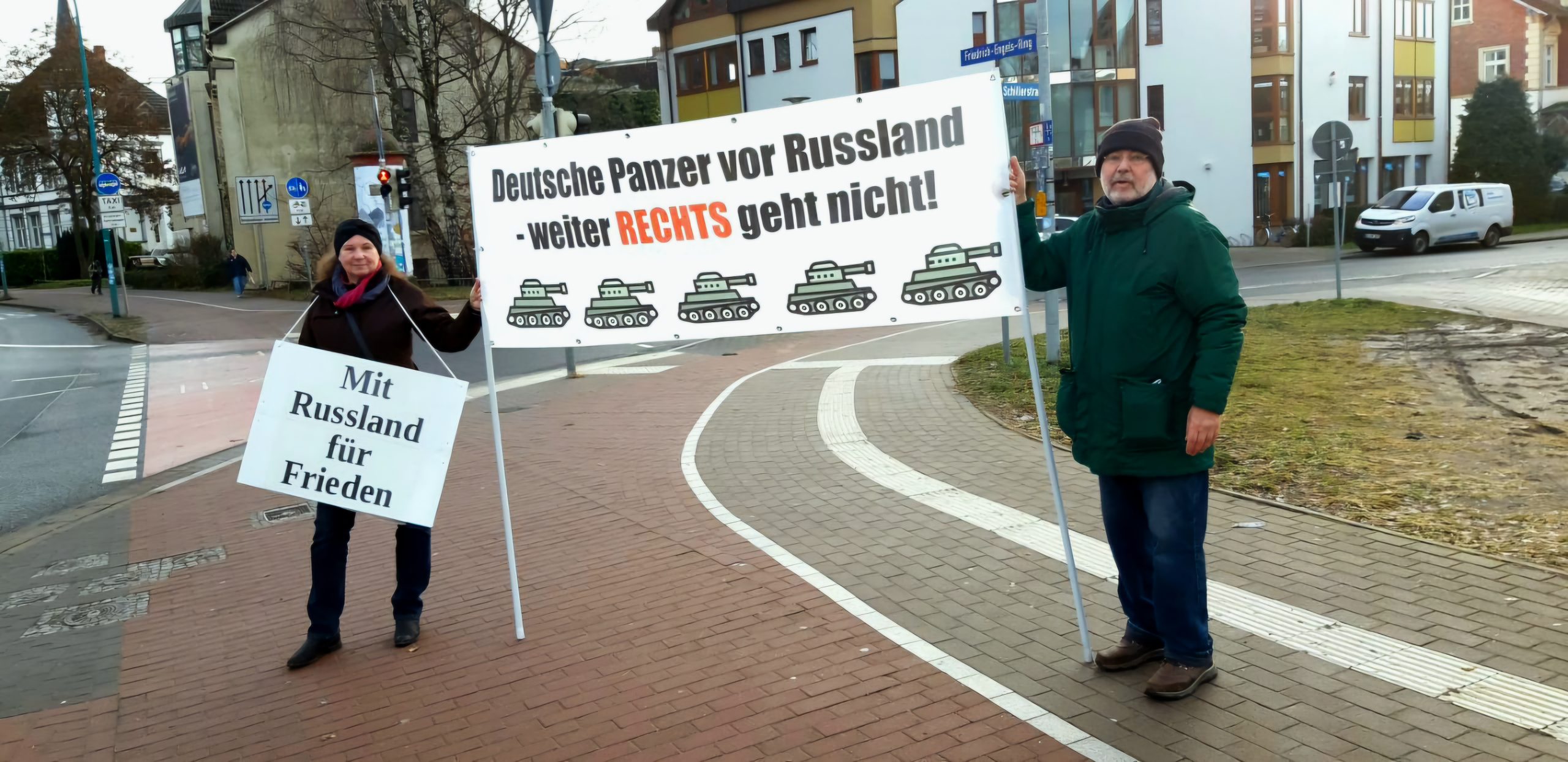
Sign-carrying demonstration by the Neubrandenburg Peace Alliance, January 16, 2026.
Yet time and again we read that “right-wing” attitudes were more deeply rooted in the GDR than in the FRG …[35]
The opposite is true—and can be scientifically proven.
Psychological Legacy
The psychological deformations left behind by fascism, war, the German Empire, and centuries of patriarchal
authoritarian conditions left behind did not vanish into thin air with the surrender of Hitler’s Germany. On May 9, 1945, people’s psychological structures were still the same as they had been on May 7. Apart from the fact that numerous Nazi criminals moved from the East to the West, both parts of the country had the same starting point in this regard.
For the FRG, research repeatedly revealed “a stable potential” for anti-Semitism. The figures vary; there is often mention of 15% overt and 30–40% latent anti-Semites.[36] Studies conducted in 1979/80 found that 13% of respondents held a “coherent right-wing extremist worldview .”[37]
Regarding the GDR, it must be said that the official claim of having completely overcome fascist attitudes among the population was not true. This was hardly surprising, given that psychological factors were grossly neglected in the GDR.
I am unaware of whether empirical social research on such attitudes was conducted secretly—perhaps by the State Security—on an ongoing basis.
An insightful study from at least as early as 1965 has survived. At that time, nearly 90 percent of the GDR citizens surveyed spoke out against a statute of limitations for Nazi crimes. The condemnation of these crimes corresponded with the assessment of the end of the war: When asked whether May 8, 1945, was perceived as a day of defeat or liberation, 91 percent answered that for them it was the day of liberation.[38]
This would likely rule out far-right extremist attitudes.
I do not know exactly how the survey was conducted, particularly to what extent anonymity was preserved. However, data collected decades later make it plausible that this survey result largely reflected reality.
On the Rise: “Right-Wing” Orientations
In the second half of the 1980s, the Leipzig Central Institute for Youth Research was confronted for the first time with a “marked rise […] in right-wing extremist orientations.” This was attributed—in my view, rightly so—to the manifold problems ignored by the GDR leadership, which contributed to the erosion of society. In 1988, studies by the institute revealed that one in eight 14- to 18- agreed with the statement, “National Socialism also had its good sides.”[39] At that time, the Stasi determined that the “right-wing” milieu comprised more than 15,000 individuals, some of whom were violent—that is, about 0.09% of the GDR population.[40]
These were warning signs.
Yet without downplaying it or claiming that both measurements depicted exactly the same phenomenon: there is just as enormous a difference between 13 percent and 0.09 percent as there is between the statement, “National Socialism also had good sides,” and a “cohesive right-wing extremist worldview.”
Prescribed Anti-Fascism?
A frequently heard objection is: “Anti-fascism in the GDR wasn’t real at all, but merely imposed from above!” This, too, can be refuted.
For an anti-fascism that was merely imposed would have had to give up the ghost by October 3, 1990, at the latest.
But in 1992, a West German study reached the following conclusion: The “proportion of East Germans who express anti-Semitic, right-wing extremist, or xenophobic views” is “lower than the corresponding proportion of West Germans. East German citizens take the consequences of the Nazi past for the present more seriously.” Among West Germans, 16% were found to be anti-Semitic, while among East Germans, 4%.[41] The magazine Spiegel commented that “most former GDR citizens [have] retained an aversion to the Nazi regime.” [42] It must be added that in such surveys, all of Berlin is usually counted as part of the East—which is likely to skew the results heavily against the East Germans.
In 1994, a Forsa survey still emphasized: “Respondents from the new federal states consistently demonstrate a clearer, more informed, and more rejecting attitude toward National Socialism.”[43] Around the same time, political scientist Jürgen Falter concluded that “the potential for right-wing extremist attitudes […] in the West” was “more than twice as high as in the East.”[44]
It was not until 1998 that a study by the Friedrich Ebert Foundation found “that right-wing extremist attitudes were more common in the East than in the West.”[45] The increasing disillusionment with “arriving” in an increasingly anti-social market economy was suspected to be the underlying cause.
Yet when a research group in Leipzig also began surveying these attitudes in 2002, 11.3 percent in the West held a “coherent far-right worldview”—compared to only 8.1 percent in the East. Until 2016, “coherent anti-Semitism remained […] almost consistently more widespread among West Germans than among East Germans.”[46] Other researchers concluded in the same year that “East and West Germans […] hardly differed” from one another in terms of the extent of far-right attitudes.[47]
Extremism Prevention
How did the GDR manage, despite starting in 1949 with the same historical baggage as the FRG, to suppress far-right attitudes so significantly—and so sustainably—compared to the latter?
The extent of state control, as well as the ostracism and punishment that threatened “right-wing” actions. As early as 1964, the statute of limitations for Nazi and war crimes had been abolished in the GDR.[48] In the FRG, it was not until 1979 that it was decided that murder would no longer be subject to a statute of limitations—meaning that among other things, Nazi murders could continue to be prosecuted.[49] The latter, however, continued to occur extremely rarely.[50]
In the GDR, Nazi crimes—including the mass murder of Jews—were present in fiction, theater, cinema, television, radio, and print media, and of course in school curricula, where visits to former concentration camps were mandatory. State-sanctioned anti-fascism was thus supported by proactive historical education.[51]
Since “far-right” attitudes often stem from impoverishment and marginalization,[52] the far greater material security—compared to the FRG—must also have played a role in preventing their emergence, as must the impossibility of “ end up ‘in the gutter,’ as well as the greater social integration.
There is an additional reason why anti-fascist thinking and sentiment likely took root among GDR citizens. By nature, people are compassionate, loving, lovable, pro-social, supportive, and peace-loving beings. [53] A political orientation directed against fascism, racism, and war therefore aligns with their essence, their inner nature, and their healthy psychological needs.
Characteristics of the GDR
I would like to list a few additional features of the GDR system that help assess the GDR 2.0 thesis.[54]
1) the far more continuous and consistent peace policy—and this alongside the equally far more peaceful superpower, the Soviet Union. Compare the wars, sanctions, assassinations, and military coups—which cost millions of lives—with the Soviet Union’s few military interventions, which, moreover, had different underlying causes.
2) No suppression (or even covert glorification, as in the FRG) of Nazi Germany’s war of aggression against the Soviet Union, which claimed up to 27 million victims on the Soviet side.
3) The elimination of any profit motive in the arms industry. No elite appropriated the surplus value generated by the working people, not even the SED Politburo.
4) Significantly greater gender equality, including equal pay for equal work as well as the straightforward, swift, and low-cost option to obtain a divorce.
5) The extensive provision of free state-run childcare.
6) The free healthcare system, equally available to all citizens, which never turned against the people—unlike what has become a brutal, often deadly reality here under the pretext of the “COVID-19 pandemic.”
7) Nationwide access to cultural events that was open to all, either free or affordable.
8) Income disparities that were negligible compared to today.
9) The greatest possible equality of opportunity in the workplace through the elimination of bourgeois educational privileges.
Furthermore, 10) in the GDR there were no material worries about survival, no consumerism frenzy, no homelessness, no unemployment, no hunger, no poverty.
Summary
I will summarize what has been said so far.
The claim that we are in a GDR 2.0 or moving toward one can only be sustained by an extremely superficial or biased perspective.
At its core, it is simply nonsense—which usually combines an unjustified defamation of the GDR with an equally unjustified idealization of the FRG.
Not only was the foundation of the GDR a social model of a completely different nature than that of the FRG, but real life in the GDR also differed greatly—and in many ways positively—from the conditions in which we live today, let alone from the conditions that those in power clearly want to impose on us.
I therefore always ask anyone who seriously believes in the thesis of an emerging GDR 2.0 to examine what GDR 1.0 actually was.
Being able to assess this competently holds a specific significance for those committed to peace. I would like to explain this in more detail in conclusion.
The Weakness of the Peace Movement
A series of articles has sought to identify the reasons for the weakness of the peace movement compared to that in West Germany in the 1980s. What is almost entirely missing from these articles are appropriate references to psychological aspects—and to the GDR. First, regarding the psyche.
The authoritarian character structures instilled in all of us—in East and West alike—during childhood—in some more, in others less—constitute a fundamental obstacle to rebelling against authority, including state power. This kind of personality has, however, been socialized into us for a few thousand years.[55] Therefore, it cannot explain the differences between the 1980s and today. But it does play a role.
In the GDR, if one adhered to the guidelines set forth—even for the peace movement—and did not wear “swords into plowshares” patches, the state was on one’s side.
In the FRG, too, it was much safer back then to advocate publicly for peace—as long as one did not associate it with communist ideas. For example, you could perform like Wolfgang Niedecken and his Cologne band BAP at the big anti-war demonstration on June 10, 1982, in Bonn, sing “Just don’t plant us among you!”[56], and at the same time top the LP charts with such songs and earn a lot of money. Try that today!
Then, as “lumpen-pacifists,” you’d face not only massive defamation and ostracism, but possibly also bank account closures, travel bans, or even legal prosecution as a Putin sympathizer.
But why was it less dangerous to advocate for peace in the West in 1982?
Because things were actually more democratic.
Why was it more democratic?
On the one hand, because in the wake of the 1968 movements, the reactionary, fascist-like structures of the Federal Republic of Germany had begun to crumble somewhat.
But on the other hand, because the socialist world system still existed at that time—as a serious systemic rival to the capitalist West.
To avoid falling behind in this struggle of systems, it was not only important to delight the FRG population with many attractive consumer goods, but also to grant them sufficient leeway within the bourgeois democratic facade.
The existence of real socialism, specifically the GDR, thus made it necessary to grant the population of the FRG greater freedoms, including—by today’s standards—a relatively low-risk commitment to peace.
And there is another factor at play here as well.
Despite all its shortcomings and deficiencies, the GDR embodied an alternative to Western society; it was proof that things could be different—and in many respects, better. One only had to glance over the Wall to see that.
Consciously or unconsciously, the hundreds of thousands who demonstrated in the West against rearmament and war in the 1980s—even if they did not consider themselves “left-wing”—likely realized: Capitalism, along with its war-prone mechanisms, can fundamentally be abolished and replaced. This allowed people to envision the future.
That is exactly what is missing today.
No movement without a goal
Since “real socialism” collapsed around 1990, revolutionary concepts have been deemed obsolete, and catchphrases like “the end of history” or “there is no alternative” have spread. Consequently, demonstrations are primarily AGAINST something. The WHAT FOR, the WHERE TO INSTEAD, has been lost.
This shortcoming also pervades the media described as “alternative.” In my view, the tone there is mostly set by people socialized in the West, with a rather bourgeois-conservative orientation.
For many of them, the honest and courageous struggle for peace and against the destruction of the last remnants of democracy goes hand in hand with a kind of phobia of socialism. Perhaps, because they uncritically equate socialism with Stalinist terror—or precisely with those clichés that were drummed into them by the very state whose lies they so shrewdly see through in other areas.
Their ideas about what should change therefore often seem focused on nostalgia: “It should be like it was before 2020, when the Basic Law still applied, when society was not yet divided …”.
But FRG society has been divided in many ways from the very beginning, not least into Nazi perpetrators, followers, and victims, into the haves and have-nots, rich and poor, the powerful and the largely powerless. Human dignity, too, has been violated here at all times, not just since the “Corona” lockdowns. Those who were poor have always been allowed to sleep under bridges.
I therefore assert: The current weakness of the German peace movement is closely linked to the described, negatively distorted view of the GDR, to the GDR 2.0 thesis—which is widespread even among peace activists and simultaneously divides the peace movement.
The demonization of the GDR, which has persisted since 1949, is based on anti-communist Nazi traditions, has been internalized by many, and has become increasingly virulent since 1990, prevents people from recognizing that the GDR existed for 40 years as a serious alternative to the FRG.
This blocks the recognition of the advantages of socialist, non-capitalist political approaches—especially for sustainable peacekeeping. This, in turn, contributes to the lack of well-thought-out alternatives to the status quo and plausible visions of the future that could inspire the masses and bring them back onto the streets.
Those who do not know where they want to go will find it difficult to even get started.
So:
Does the peace movement—or, more precisely, do those committed to peace—need a unifying vision of the future?
Yes. This is not about establishing a dogma—but about laying the groundwork for the broadest possible consensus that accepts and integrates many diverse perspectives.
Does such a vision exist?
Not that I know of.
Can such a vision be developed?
Certainly—but only if it includes a realistic retrospective on the GDR and “real socialism” and evaluates the experiences gained there.
This also means: Former GDR citizens can make a contribution to strengthening the peace movement that is both specific and indispensable by authentically recounting their lives in the GDR.
Thank you for listening.
***
Notes
[1] I would like to thank Gudrun Peters, John Erpenbeck, and Wolfgang Stern for their helpful critical feedback.
[2] In essence, my engagement with this topic has never ceased since 1989. This also helped shape the content of the book “Weltall, Erde … ICH,” published in 2000. See https://andreas-peglau-psychoanalyse.de/weltall-erde-ich-de/
[3] More about me: https://andreas-peglau-psychoanalyse.de/ueber-mich/
[4] Details: https://andreas-peglau-psychoanalyse.de/meine-annaeherungen-an-die-psychoanalyse-in-ddr-und-brd-von-1957-bis-2000/
[5] For more on Reich, see, among others: https://andreas-peglau-psychoanalyse.de/a-marxist-psychoanalyst-of-jewish-origin-experiences-the-end-of-the-weimar-republic/
[6] https://andreas-peglau-psychoanalyse.de/mensch-du-mensch-mensch-menschenskinder-und-stand-up-hans-joachim-maaz-im-gespraech-mit-andreas-peglau-bei-jugendradio-dt-64/
[7] See: https://andreas-peglau-psychoanalyse.de/people-are-no-puppets-a-utopia-that-goes-beyond-karl-marx-and-whose-realization-can-begin-tonight/
[8] See also: https://www.nachdenkseiten.de/?p=136088; https://de.wikipedia.org/wiki/Operation_Unthinkable
[9] “The precursor to the Federal Intelligence Service had, prior to its founding in 1956, recruited agents extremely successfully in the Soviet Occupation Zone, SBZ, and in the former GDR. ‘[…] This means that as early as the 1940s, the Gehlen Organization was able to establish extensive networks across a large geographical area and with a wide scope; that is, it was not only about military espionage, but also about economic espionage, and there were also efforts to focus on the security sector .’ […] By 1953, the agent network comprised more than a thousand registered informants […]. Added to this was a similarly high number of accomplices and helpers who could provide information. […] the conditions for espionage [were] particularly favorable in the early GDR—including for other Western intelligence agencies such as the CIA: ‘We have open borders; we have contacts among the population that cannot be fully controlled by either side’” (https://www.deutschlandfunk.de/geschichte-des-bnd-die-spionage-der-organisation-gehlen-in-100.html).
[10] https://www.bpb.de/kurz-knapp/hintergrund-aktuell/223686/vor-60-jahren-gruendung-des-bnd/
[11] https://de.wikipedia.org/wiki/Reinhard_Gehlen
[12] https://www.deutschlandfunk.de/bnd-bundesnachrichtendienst-nationalsozialismus-ns-taeter-100.html
[13] In 1953, Zaisser was sidelined politically after attempting to replace Walter Ulricht (https://de.wikipedia.org/wiki/Wilhelm_Zaisser).
[14] Dahn, D. (2009): Woe to the Victor! No East, No West, Reinbek near Hamburg, p. 174ff.
[15] On efforts to defend patient protection, at least in psychotherapy: https://kollegennetzwerk-psychotherapie.de/index.php?page=58040971&f=1&i=2068426342&s=58040971
[16] See, among others: https://www.manova.news/artikel/geschlossene-gesellschaft-2
[17] Members of the Communist Party, the Association of Victims of Nazi Persecution, and other “left-wing” organizations deemed a threat to the state were monitored, in some cases persecuted, or imprisoned. They were barred—keyword “Radical Decree” – were long barred from holding public office, not even as mail carriers.
[18] Rainer Mausfeld writes: “Democracy is thus considered ‘permissible’ only to the extent that the economic sphere is spared from democratic decision-making processes—that is, as long as it is not a democracy“ (quoted in https://andreas-peglau-psychoanalyse.de/wp-content/uploads/2014/09/Rechtsruck-Zweite-Auflage-3-11-17-1.pdf, p. 79) . Even on the website of the Federal Agency for Civic Education, the following has been stated since 2011: “The current electoral system for the German Bundestag exhibits fundamental democratic deficits. For this reason, democratic electoral reform is long overdue.” (http://www.bpb.de/apuz/33522/hat-deutschland-ein-demokratischeswahlsystem).
[19] https://www.nachdenkseiten.de/?p=115769
[20] https://www.nachdenkseiten.de/?p=144473
[21] Various details on this, for example, in Krenz, E. (2025): Loss and Expectations. Memoirs, Berlin.
[22] Statutes of the SED (1976), Berlin.
[23] https://de.wikipedia.org/wiki/J%C3%BCrgen_Kuczynski
[24] https://de.wikipedia.org/wiki/Joachim_Herrmann_(Politiker,_1928)
[25] https://de.wikipedia.org/wiki/Reiner_Werner
[26] https://andreas-peglau-psychoanalyse.de/mensch-mensch-brauche-ich-ein-vorbild-dt-64-sendung-vom-5-10-1988/
[27] Böhm, G. (2015): Forward to Goethe? Faust Performances in GDR Theater, Berlin, pp. 149–176.
[28] https://de.wikipedia.org/wiki/Spur_der_Steine; https://de.wikipedia.org/wiki/Spur_der_Steine_(Film)
[29] https://de.wikipedia.org/wiki/Blaue_Pferde_auf_rotem_Gras
[30] Dahn 2009 (as in note 14), pp. 37–48.
[31] https://www.oxfam.de/presse/pressemitteilungen/2026-01-19-so-schnell-nie-so-gross-nie-milliardaersvermoegen-erreichen
[32] “In the Tagesspiegel of February 11, 2020, Caroline Fetscher […] points to ‘continuities rooted in the Third Reich in almost all areas of [West!] German society—in corporations, government agencies, education, medicine, the military, and the cultural sector.’ […] ‘About 65 high-ranking officials of the CDU, 20 of the CSU, and 35 politicians of the FDP were,’ Fetscher continues, “members of the NSDAP before they assumed their offices in the Federal Republic’s democracy, serving as mayors, state parliament members, members of the Bundestag, parliamentary group leaders, state premiers, deputy state premiers, and high-ranking diplomats.” Caroline Fetscher cites three further prominent cases: Hans Globke, co-author of the Nuremberg “Racial Laws” and head of the Chancellery under Konrad Adenauer until 1963, Kurt Georg Kiesinger, Chancellor from 1966 to 1969, deputy head of the Radio Policy Department in the Nazi regime’s Foreign Office; and Hans Filbinger, Minister-President of Baden-Württemberg until 1979. The latter ‘as a naval judge, was still handing down death sentences against deserters at the end of World War II’” (https://www.manova.news/artikel/ die-schattentrager). There were significant differences not only in terms of the percentage of former NSDAP members in the Bundestag and the People’s Chamber, but also in terms of their respective involvement: https://de.wikipedia.org/wiki/ List_of_former_NSDAP_members_who_were_politically_active_after_May_1945. Further information: Dahn, D. (2019): Yesterday’s Snow Is Today’s Deluge. Unity—A Reckoning, Reinbek near Hamburg, pp. 89–144.
[33] See also: https://andreas-peglau-psychoanalyse.de/life-affirming-life-averse-an-alternative-to-the-left-right-division/
[34] https://friedensbuendnis-nb.de/fotos-3/#090326
[35] As reported in the Frankfurter Rundschau under the headline “The Brown Legacy of the GDR”: “East Germany has a problem with right-wing extremism. Scholars find an explanation for this in the GDR system.” (https://www.fr.de/politik/braune-erbe-11707837.html).
[36] https://de.wikipedia.org/wiki/Geschichte_des_Antisemitismus_seit_1945
[37] Stöss, Richard (2010): Right-Wing Extremism in Transition, Berlin, p. 61.
[38] Niemann, H. (1995): Behind the Fence. Political Culture and Opinion Research in the GDR – The Secret Reports to the GDR Politburo, Berlin, pp. 65–69.
[39] Friedrich, W. (2001): Is Right-Wing Extremism in the East a Product of the Authoritarian GDR? (https://www.bpb.de/system/files/pdf/HRDB0X.pdf), p. 19, 21ff. For more details: Friedrich, W. (2002): Right-wing Extremism in the East. A Result of GDR Socialization? Leipzig (https://sachsen.rosalux.de/fileadmin/ls_sachsen/dokumente/Publikationen/Einzelpublikationen/Friedrich__Walter__Rechtsextremismus_im_Osten._2002. _119_S..pdf).
[40] http://www.zeit.de/2012/08/DDR-Nazis/ The population of the GDR numbered approximately 16.5 million in 1988: https://de.statista.com/statistik/daten/studie/249217/umfrage/bevoelkerung-der-ddr/
[41] Stöss 2010 (as in note 37), pp. 62ff.
[42] Ibid., pp. 63ff.
[43] Ibid.
[44] Ibid.
[45] Ibid.
[46] Decker, O./ Brähler, E. (eds.) (2018): Flight into Authoritarianism. Far-Right Dynamics in the Center of Society, Giessen, p. 84.
[47] Zick, A./ Küpper, B./ Krause, D. (2016): A Divided Center – Hostile Conditions. Far-Right Attitudes in Germany 2016, ed. by Melzer, R., Bonn, p. 130.
[48] Accordingly, Article 91 of the GDR Constitution stated: “The generally recognized norms of international law regarding the punishment of crimes against peace, against humanity, and war crimes are directly applicable law. Crimes of this kind are not subject to the statute of limitations” (https://www.verfassungen.de/ddr/verf68-i.htm)
[49] https://de.wikipedia.org/wiki/Verj%C3%A4hrungsdebatte
[50] http://www.michael-greve.de/strafen.htm
[51] For details: Dahn, D. 2019 (as in note 32), pp. 145–182. See also: https://de.wikipedia.org/wiki/Die_Bilder_des_Zeugen_Schattmann; Pätzold, K. (2010): Die Mär vom Antisemitismus, Berlin. Mario Keßler discusses antisemitic aspects of SED policy up to 1967: https://zeitgeschichte-digital.de/doks/frontdoor/deliver/index/docId/912/file/ke%C3%9Fler_sed_juden_repression_toleranz_1995_de.pd, summary pp. 149–151.
[52] https://andreas-peglau-psychoanalyse.de/wp-content/uploads/2014/09/Rechtsruck-Zweite-Auflage-3-11-17-1.pdf, pp. 81–84.
[53] https://andreas-peglau-psychoanalyse.de/we-are-not-born-warriors-on-the-psychosocial-prerequisites-for-peacefulness-and-warlike-behavior/
[54] For evidence supporting the following ten points, see the aforementioned and other books by Daniela Dahn, as well as (auto)biographical works by former GDR citizens, published, for example, by the Neues Leben publishing house: https://www.eulenspiegel.com/buecher/neues-leben.html?start=0. A brief overview is provided by Roesler, J. (2013): Geschichte der DDR, Cologne. On U.S. crimes after 1945, see, for example: https://de.wikipedia.org/wiki/Patrice_Lumumba; https://de.wikipedia.org/wiki/Salvador_Allende; https://de.wikipedia.org/wiki/Vietnamkrieg; https://de.wikipedia.org/wiki/Operation_Ajax. On deaths caused by sanctions: https://www.telepolis.de/ article/Millionen-Tote-fuer-Demokratie-und-Freiheit-9191381.html?seite=all.
[55] See: https://andreas-peglau-psychoanalyse.de/vom-nicht-veralten-des-autoritaeren-charakters/
[56] Released on the LP “Vun drinne noh drusse” (1982) (https://bap.de/songtext/zehnter-juni/)
Last accessed March 27, 2026
Please cite as
Andreas Peglau (2026): GDR 2.0? Does the peace movement need a vision for the future? (https://andreas-peglau-psychoanalyse.de/gdr-2-0-does-the-peace-movement-need-a-vision-for-the-future/)
© 2026 Andreas Peglau – All rights reserved. Löcknitzer Str. 33, 17309 Pasewalk info@andreas-peglau-psychoanalyse.de
This is a DeepL translation I have not checked. I apologize for any errors and inaccuracies that are sure to occur. Please use the original German text for comparison: https://andreas-peglau-psychoanalyse.de/ddr-2-0-braucht-die-friedensbewegung-eine-zukunftsvision/
The forwarding and distribution of this text for non-commercial purposes is expressly encouraged. Licensed under a Creative Commons license (Attribution – Non-Commercial – No Derivatives 4.0 International).
Further reading: GDR 2.0 or where do we live today