
by Andreas Peglau

If we are born as good beings, there is only one thing we need to do: ensure that these predisposition is allowed to flourish. Then we will inevitably build a community that is in accordance with these predisposition—and thus a good one as well. Who or what could possibly stand in our way?
*
Despite all its shortcomings, there is no more comprehensive and thoroughly developed conception of society than the one traceable to Friedrich Engels and Karl Marx. It provides detailed proof that exploitative systems such as the capitalist one are profoundly unjust, inhumane, and necessarily undemocratic. Since the socialist world system led by the Soviet Union was laid to rest around 1990, “left-wing,” non-capitalist social models have nevertheless been largely dismissed as obsolete. In doing so, something was wrongly discarded that should, however, have been holistically completed—and fundamentally revised.
Marx and Engels had only rather general, half-baked ideas about how to achieve and shape a better society. Believing in a supposed primacy of the economy, they fought against any perspective that deviated from it. As their doctrine became increasingly “economistic,” what is most essential to human beings—the psyche—disappeared from it.
In the article People as Puppets? How Marx and Engels Suppressed the Real Psyche in Their Teaching,[1] I elaborated on this point in detail in 2024. In the present text, I take up the thread once again: How do we arrive at a humane social order?
I share Marx and Engels’ hope for a global, classless community in which “the free development of each is the condition for the free development of all” and in which the principle applies: “From each according to their ability, to each according to their needs”.[2] But reaching that point is only possible if we finally investigate and take into account what exactly characterizes a free individual, what specific conditions they need to be free, what abilities people possess, and what—healthy!—needs motivate them.
The Foundation
The fact that the anti-psychological stance of Marx and Engels[3] was never consistently questioned in “real socialism” contributed significantly to its failure. Even today, Marxists[4] mostly want to liberate “humanity” without asking who humanity actually is; they intend to build a society without caring about its foundation.
What is this foundation? Precisely not any so-called “economic laws of nature” supposedly operating independently of humans,[5] as Marx believed he perceived them. Such laws do not exist. The economy is not shaped by entities outside of humanity, but by real, concrete individuals.[6] And it is precisely these individuals who form the foundation of any society.[7]
The term “individuals” indicates that each and every one of them is unique and one-of-a-kind. Yet their commonalities bind them together. These include not only biological, anatomical, and physiological realities, but also psychological dispositions and basic needs. Erich Fromm noted: “Even the full satisfaction of those ‘needs that humans share with animals—hunger, thirst, and the need for sleep and sexual satisfaction – […] does not yet guarantee mental and emotional health. This depends on the satisfaction of those needs and passions that are specifically human.”[8]
It is now a widely accepted theory that for all members of Homo sapiens, a species that has existed for at least 300,000 years[9], a “psychological unity” should be assumed—that is, in principle, similar mental and emotional dispositions and structures. “A person who lives by hunting elephants or gathering lotus buds can,” write anthropologist David Graeber and archaeologist David Wengrow, “be just as analytical, critical, skeptical, and resourceful […] as someone who earns a living as a truck driver or innkeeper or heads a university department.” [10]
Only from the most precise understanding of these commonalities could one deduce which social structures are appropriate for humans. A viable vision of society requires a realistic, scientifically grounded view of human nature as its foundation.[11]
No such vision exists. This is no longer due to a lack of knowledge. Rather, it is because this interdisciplinary knowledge—derived from many people, peoples, and eras—has not been synthesized.
Brilliant Nonconformists
How do we come into the world, stupid and antisocial? Quite the opposite.
In infant research, evidence is mounting that “the infant brain is equipped at the beginning of life to process the greatest possible variety of stimulus categories” and that humans are “individuals capable of learning and interacting from birth.”[12]
A long-term study initiated in 1968 with 1,600 children underscored this fact—and at the same time showed how our intellectual capacity develops. The study focused on “genius”—understood as the ability to find many different, even contradictory answers to a single question; to think not linearly and one-dimensionally, but creatively and in a networked way; one could also say: to think nonconformistically, laterally. When classified as “genius” in this way at the age of three to five. Just five years later, at the age of eight to ten, their proportion had fallen to 32 percent. Another five years later, among the now 13–15-year-olds, there were only ten percent “geniuses” left. This was, after all, clearly higher than the results of a control group of 200,000 adults aged at least 25: a mere two percent of them had retained their “genius.”[13]
The usual “growing into” conventional social structures thus does not primarily expand the possibilities of individual (and societal!) development, but rather severely restricts them.[14] We suffer a dramatic loss of intellectual potential and creative possibilities, and thus also of healthy self-confidence.
And what about the ability and willingness to feel, think, and act socially: Must this first be taught to us? That is certainly not the case. Even before birth, we interact with our mothers.[15] Once we are born, we attune ourselves to them with all our senses; we want to smell them, still hear their heartbeat and their voice, need eye and skin contact with them, react intensely to their emotional state, and are just as in need of relationships as we are capable of forming them.[16] Three-month-old infants “show empathy” and can “distinguish between good and bad behavior.”[17] Young children possess a sense of justice,[18] “comfort others in times of sorrow,”[19] are capable of “developing goals together with others,” and are motivated to “help others and share with them.”[20] Research across various scientific disciplines supports these findings.[21]
Therefore, the notion put forward by Marx and Engels—that, in terms of our mental and spiritual lives, we are blank slates onto which society somehow writes its text, or hollow vessels to be filled by the dictates of the economy.[22]
The good core …
So we are not only born “brilliant,” but also good. By nature, humans are sensitive, sociable, compassionate, loving, lovable, curious, inquisitive, creative, and prosocial beings. We possess a kind of “good core.”[23] This is not something passive that first needs to be kissed awake from a deep sleep like Sleeping Beauty.
Our dispositions actively and energetically strive to realize themselves.[24] Just as the roots of trees seek water and nutrients, and their leaves seek light,[25] our potential seeks opportunities for development. We want to live in accordance with our inner nature, to treat ourselves, other people, and the external world appropriately, and to resolve inevitable conflicts constructively. When we succeed in this, it makes us peaceful, content,[26] perhaps happy, and at the same time serves the preservation of both the self and the species.
… is buried …
Yet for several millennia, this good core has been increasingly suppressed by social structures often described as “patriarchal”[27]; people who come into the world psychologically quite sound[28] are so broken that they fit into these societies.[29] Their hierarchical structure, the division into powerful rulers and disempowered subjects, is reflected in the individuals: Their innate psychological dispositions are distorted into a lust for power and subservience, into an “authoritarian character” that kowtows to those above and—when it can—kicks those below.[30]
This goes hand in hand with brainwashing and the suppression of emotions. Those in power believe their rule is necessary and justified. To ensure that their subjects accept this nonsense, their intellectual and spiritual capacities, as well as their emotional responsiveness, must be curtailed at an early stage. Children, as Wilhelm Reich described in 1933, therefore first pass through “the authoritarian miniature state of the family, [… ] so that they may later fit into the general social framework. This makes them “anxious, shy, fearful of authority, well-behaved and malleable in the bourgeois sense .”[31] Those who have endured this process hardly remember that they are capable of self-determination; they believe they need leaders (or misleaders) to tell them which way to go and, as Erich Fromm put it, have “a fear of freedom .”[32]
Because the resulting healthy anger toward oppressive authorities cannot be expressed openly—after all, who is allowed to kick their father, mother, teachers, or future bosses in the shin?—it gradually builds up into destructive hatred. Most adults are, without realizing it, psychosocial time bombs, and are thus unconsciously susceptible to warmongering and exploitable for the purposes of warfare.
Wilhelm Reich put it this way: The fact that the psychologically deformed person “acts, feels, and thinks” contrary to their own life interests constitutes “an essential part of the mass-psychological foundation of that war (…) which is staged by a few for imperialist interests”.[33]
… and remains alive
However, there are now a large number of people who recognize these traumas within themselves and are working in various ways, not least through psychotherapy, to overcome them. Our buried core remains alive and can be uncovered throughout life. Its not possible to completely heal all the disturbances inflicted upon us. Yet we can come significantly closer to a state of mental health again.
And: Every newborn brings the potential for a fresh start into the world. Even if, in societies like ours, this potential cannot be preserved unscathed through the process of growing up: Compared to adults, children are not only the more intelligent ones, but also better human beings. If today’s five- to ten-year-olds were allowed to vote and decide whether the money generated in the Federal Republic of Germany should continue to be spent primarily on armament, war mongering, and war preparations, or for constructive, peaceful, understanding, and ideally loving cooperation within families, kindergartens, schools, workplaces, society, and among nations: we would be immediately saved from the homegrown threat of war.
Today, however, the majority of adults once again vote for war-hungry governing parties.
In the Bible, Jesus is quoted as saying: “Unless you repent and become like children, you will never enter the kingdom of heaven.”[34] Updated, it must surely mean: “Unless you repent and become like children, you will perish.”
(No) Simple Solution
The view of humanity I have outlined leads to a conclusion that may be surprising but is logical.
If we are born with the predispositions to be good and „genious“, there is only one thing we need to do: ensure that these predispositions are allowed to flourish. Then we will inevitably build a commu-nity that is in accordance with these predispositions—and thus a good one as well. Who or what could possibly stand in our way?
This does not mean that the path to it will be easy.
It must be noted: This involves an entirely different approach than the expectation that progress arises through the workings of “economic laws of nature,” which merely need to be recognized and observed.
Instead, well-founded hope for the feasibility of such a community can be drawn from human history.
In 1848, the opening sentence of the Communist Manifesto reads: “The history of all hitherto existing society is the history of class struggles.”[35] When Engels republished this text in 1888, new findings regarding anthrop . He now added a succinct footnote to the sentence: “That is to say, strictly speaking, the history handed down in writing.”[36] Even by the standards of knowledge at the time, this was an extreme qualification. Today we know that the origins of writing date back some 5,300 years.[37] Human evolution is generally estimated to have taken six million years. According to Engels’ dictum, this would mean that classes have been fighting one another for less than 0.01 percent of human development. Or, if we take the 300,000 years of Homo sapiens as a basis: for less than two percent of its existence. [38]
In fact, archaeological and anthropological research has found no evidence of institutionalized oppression, exploitation, states, classes, or war for nearly the entire history of human evolution. In contrast to the human psyche, all of this is—from a temporal perspective—absolutely marginal.
There is indeed evidence of acts of interpersonal violence even from prehistoric times; the earliest is dated to approximately 430,000 years ago.[39] Yet after archaeologist Harald Meller, historian Kai Michel, and evolutionary biologist Carel van Schaik combed through the entire three million years since the emergence of the genus Homo, “leaving no significant trace […] out,” they conclude: “There isn’t even a handful of pieces of evidence for the intentional killing of humans.”[40]
Even if these killings were murders—which, in the absence of eyewitness accounts, can never be determined: A murder is not a war. Harald Meller and his co-authors also note:
“If one searches for prehistoric evidence of war, murder, and manslaughter, one discovers instead indications of care and compassion. The paleoarchaeological evidence testifies: Humans helped and supported one another; otherwise, many injuries would have amounted to a death sentence.”
As an example, they cite a Neanderthal who also died approximately 430,000 years ago and who suffered from “a whole range of degenerative diseases, traumas, a shortened right arm, and likely blindness in the left eye as well as severe hearing loss,” yet reached an age of “forty to fifty years”—which was only conceivable with “daily [r] support” from his group, including wound care.[41] It was only about 7,000 years ago that mass graves emerged, which experts largely agree constitute evidence of warlike massacres.[42] The formation of states began around 6,000 years ago.[43]
Thus, treating one another peacefully and with solidarity appears to be the anthropogenetic norm.
The Limits of Bourgeois Order
The changes necessary for this norm to be restored permeate all areas of life: family, school, work, relationships, sexuality, art, culture, politics, economics, ecology … Sooner or later, this will reach the limits of civil order.[44] Capitalism[45] requires subjects with authoritarian structures, whose self-esteem and capacity for relationships and solidarity are impaired—subjects who allow themselves to be dumbed down, exploited, divided, oppressed, and sent off to wars of conquest.
The psychological deformations required for this are mass-produced and systematically instilled through socialization.[46] In Germany today, nearly one in three children is born by cesarean section, a decision made by others: more than double the rate since 1993.[47] “Others decide for you” thus becomes a welcoming motto and a foretaste of what is to come: conformist submission to parents, educators, teachers, bosses, doctors, state institutions, the government, and profit interests.
For human potential to be fully realized, the overturning of capitalist power and property relations is indispensable.
Economics is never enough
Yet as essential as this is: as evidenced by the history of “real socialism”—tainted early on by Joseph Stalin’s terror regime—and ultimately its collapse, it is not sufficient as the foundation of a healthy society.
Marx believed that people’s thoughts, feelings, and actions—the social “superstructure”—would somehow follow once the economic “base” had been overthrown.[48] That is exactly how things were handled under “real socialism”—with the well-known failure that in 1990, more than 40 years after the GDR was founded, most of its inhabitants still saw themselves as compatible with the capitalist FRG. In the People’s Chamber election on March 18, 1990, voter turnout was 94 percent. Over 47 percent voted for the CDU-led “Alliance for Germany,” which advocated for the dissolution of the GDR as quickly as possible. In contrast, the PDS, the only party that did not want an imminent “ reunification,” let alone an annexation as it was carried out on October 3, 1990.[49]
Human and Social Structures
As early as 56 years earlier, Wilhelm Reich had pointed out in Massenpsychologie des Faschismus the connection that was subsequently ignored under “real socialism”: “If one attempts to change the structure of people alone, society resists. If one attempts to change society alone, people resist. This shows that neither can be changed on its own.”[50] External innovations are just as insufficient as internal transformations—both are necessary and cannot be realized in isolation from one another. A clear rejection of both economism and psychologism.
I put it this way for myself today: When people work through, alleviate, and heal them, they become healthier than the general population and than what societal norms prescribe. As a result, they trigger insecurity or aggressive defensiveness in others. If they and their nonconformist attitudes become known, the likelihood grows that the power apparatus will turn against them. Should they nevertheless continue to spread their views, they face the threat of persecution, and in the worst case, annihilation. A principle which Wilhelm Reich not only suffered himself,[51] but also illustrated metaphorically through the legend of Jesus Christ. Jesus was—according to Reich’s interpretation—crucified because others could not tolerate his honesty, openness, emotionality, wisdom, and criticism.[52] This has its counterpart in widespread educational practices. Since “normal neurotics” find it difficult to tolerate the vitality, emotionality, spontaneity, creativity, and thirst for knowledge that they themselves have long repressed, they hinder or suppress all of these qualities in children as well. In a sick society[53], no one can remain healthy in the long run.
Yet, as Reich recognized, it is equally doomed to failure to attempt to overcome a past society without taking into account that it lives on within individuals. These individuals were, after all, that society; they sustained it and helped shape it; from childhood onward, its norms, attitudes, and values were drummed into them. As a result, these have become deeply anchored in the psyche. All the more so when they offer a relieving, supportive orientation: “I’m just doing what I’m told. Everyone else thinks the same way, so how could I question it?” Although such a crutch is neurotic and ultimately self-destructive, people usually resist losing it, thereby also resisting positive change and hindering the emergence of better social conditions. And through their upbringing—perhaps in a more tempered form—they pass on their unconsciously retained norms to the next generation.
In all our interests
Who can break this vicious cycle?
People who recognize the psychological distortions they have suffered and work on them, not least in psychotherapeutic settings. And who, at the same time, – preferably together – fight for political, economic, cultural, sexual, and ecological living conditions that enable the generations of their children, grandchildren, and great-grandchildren to suffer this deformation less and less, and eventually not at all.
The two are connected anyway. Recognizing our traumas as a fact and processing them makes us better equipped for constructive upheavals, both privately and socially; for building good and equal partnerships; for enjoying fulfilling sexuality; for confronting life-denying, war-glorifying norms in school, work, the media, the church, politics, and the state; and for seeking out like-minded people with whom we can resist these forces.
And it creates better conditions for guiding children into life in a loving, non-authoritarian way.
Simply because individual guilt at the top of the power pyramid is many times greater than at its base, it is difficult to win over those in power for such profound changes: They must expect condemnation and punishment, or at least disempowerment and contempt, as soon as better times dawn. Objectively speaking, however, it is not only the oppressed who live in undignified circumstances, but also the oppressors: exploiting people, dumbing them down, being responsible for mass misery, rapid environmental destruction, and wars, for hundreds of thousands of deaths—all of this is anything but desirable; it amounts to a completely wasted life, regardless of whether the perpetrators realize it or not. Who would want to trade places with them?
Yet even U.S. presidents and other heads of state who unscrupulously order the murder of individuals or masses, even mercenaries, religious fanatics, and neo-fascists who then commit these murders and massacre those who think differently, were born a few decades ago with healthy potential; they wanted to and were capable of loving.
And: They can only carry out their despicable acts because they are sufficiently supported by the general population. State structures and the authoritarian tendencies instilled in us make us, consciously or unconsciously, into accomplices of those in power, into co-culprits in the life-threatening actions of our state, at the very least by paying taxes that fund weapons used to kill innocent people.
It is therefore in the interest of all of us to create humane conditions.
Psychosocial Revolution …
Since everything is indeed interconnected, the necessary changes can begin anywhere—with self-awareness and the resulting self-transformation starting tonight. But actions must follow that also transform the external world, from partnerships and family to society. We can and should start with ourselves—but we must not stop there. What we need is a psychosocial revolution.[54] This revolution does not need to be added to the political-economic upheaval. Rather, it necessarily includes political-economic upheavals,[55] and cannot be sustainably successful without them.
Psychosocial Revolution thus stands for the totality of the necessary changes.[56] It does not take place only upon the abolition of capitalism, but forms the foundation for abolishing it permanently. And it must continue after its abolition.
… for a human-worthy order
One shortcoming of this term is that it does not specify the goal of this revolution. I propose the following working title for this goal: “a human-worthy order”.
The terms socialism and communism, which are also candidates for this, are not clearly defined, are used in very different ways,[57] and are often misused—not least in “National Socialism”—and were discredited in particular by Stalinism.
“A human-worthy order” – this must also be defined more precisely, but it serves well as a starting point for verifiable social scientific and psychological inquiries: What exactly is worthy of a human being, and by what means is their dignity violated or preserved?
Such an order would also be in line with the demands of the 25-year-old Marx to “overthrow all conditions in which man is a degraded, enslaved, abandoned, and despised being.”[58] “All conditions”—these are far more than just economic ones. Some 130 years later, Erich Fromm captured what should emerge from this in the image of a society “in which no one need feel threatened anymore: not the child by the parents; not the parents by those above them; not one social class by another; no nation by a superpower.”[59]
With or without violence?
Even in its demise in 1989, the GDR revealed one of its many virtues.[60] The choice was between the military suppression of the opposition movements and a nonviolent abdication. The leadership, which evidently still felt connected to the people, opted for the latter. The supposed “peaceful revolution” from below was in reality above all a peaceful—and certainly also resignation-driven—surrender of power from above.[61]
The bitter experiences of many other countries suggest that such a course of action cannot be expected from capitalist rulers. Wherever possible, their removal from power has been delayed, prevented, or reversed through assassinations of opposition figures, terror, military coups, and wars. The fact that this resulted in countless deaths was never of concern to those in power.[62]
Must a revolution intended to sweep away capitalism inevitably be accompanied by the use of enormous violence? Not even the founding fathers of Marxism believed that.
In 1872, at the Hague Congress of the International Workingmen’s Association, Marx acknowledged
“that one must take into account the institutions, customs, and traditions of the various countries, and we do not deny that there are countries, such as America, England, and—if I were more familiar with your institutions—I might perhaps add Holland, where the workers can achieve their goal by peaceful means.”[63]
“[W]ithout an army, without a police force, without courts,” he added, “kings, on the day they would be forced to maintain their power solely through moral influence and moral authority, would be only weak obstacles to the advance of the revolution.”[64]
As late as 1891, four years before his death, Friedrich Engels could “imagine that the old society might peacefully evolve into the new one in countries where the representative body concentrates all power in itself, where one can constitutionally do whatever one wants, as long as one has the majority of the people behind one.” However, he believed this did not apply to “Germany, where the government is almost omnipotent and the Reichstag and all other representative bodies have no real power.”[65]
In 2026, the Federal Republic of Germany is likewise miles away from having an actual people’s representation that concentrates power within itself.
If we follow Engels, the creation of such a body could facilitate a peaceful transition to a new society. Initiatives such as those for “direct-democratic constitution-making”[66] move in this direction and are worthy of support. Yet they ignore the deeply ingrained patriarchal, authoritarian, and destructive aspects of our personalities that haunt us. “Direct democracy,” referendums, and popular rule are only a solution to the extent that the members of the people preserve or reclaim their goodness and “genius.” A healthy community needs psychologically healthy people as its foundation. To be psychologically healthy, we need a healthy community. This connection cannot be broken.
The view of humanity I have outlined also points to opportunities for social transitions with minimal violence. Governing against our healthy interests is only possible as long as not enough of us are aware of these interests. If our innate potential is not buried—or is unearthed again—we sense what is good for us, what we need, and where we should be heading. At the same time: what we should free ourselves from, what harms us. Oppression always harms.
The more people perceive this oppression and consciously suffer under it, the more resistance grows. And the more difficult it becomes for those in power to assert themselves. Mentally healthy people would never build a capitalist society. Why should they harm themselves? Wilhelm Reich noted in 1934: “The larger the mass base of the revolutionary movement, the less violence is necessary, and the more the masses’ fear of the revolution also diminishes.”[67]
Nevertheless, revolution is always, inevitably, an aggressive act. But we need not fear this. Aggression, derived from the Latin “aggredere”—to approach someone or something, to attack something—is not only not a bad thing, but a vital, healthy component of our repertoire of actions.[68] Right from the start of our lives, we need this ability to push our way through the narrow birth canal—at least in the case of a natural birth—to come into the world. Only through aggression are boundaries, assertiveness, self-defense, and self-assertion possible.
Looking in the Mirror
Anyone who wants to commit to a psychosocial revolution faces the question: where to begin?
Various ideas for political and economic upheavals have been published since 1848. I can and need add nothing to that. But even those who wish to commit to changes that address the psyche more directly are not left empty-handed. Before I conclude by pointing out some prior work that can serve as a starting point, I want to identify what most frequently hinders people from engaging with this topic.
In lectures and discussions, whether public or private, I experience this time and again: Most people find the description of psychosocial interactions plausible—as long as it remains general. But as soon as it comes to them personally—to their own life stories, childhoods, relationships with their parents, the emotional distress that resulted from these experiences, and the guilt they have since taken on as fathers, mothers, educators, partners, or citizens—many apparently find the challenge too daunting—and they back out.
When I began to engage more intensively with psychoanalysis in the second half of the 1980s, I, too, struggled with this upheaval.[69] Supported by several years of experience as a patient in Reichian body therapy and (as part of my psychoanalytic training) in analytical psychotherapy, however, it has become second nature to think about myself in this way as well. I am part of the system into which I was born, which surrounds me; I have been shaped by it and, willingly or against my will, contribute to its existence and development. In the social ocean, there are no untouched private islands; the surrounding water seeps in everywhere, and no filter can completely hold it back. Anyone who wants to overcome the negative aspects of a social system must simultaneously examine the extent to which they have internalized these aspects—and also do something against them.
The appeal of Marxism lies not least in the fact that it spares one this confrontation with oneself by attributing the cause of social misery to economic laws or to the personified fantasy figure that became central to Marx, known as “Capital.”[70]
Former inputs
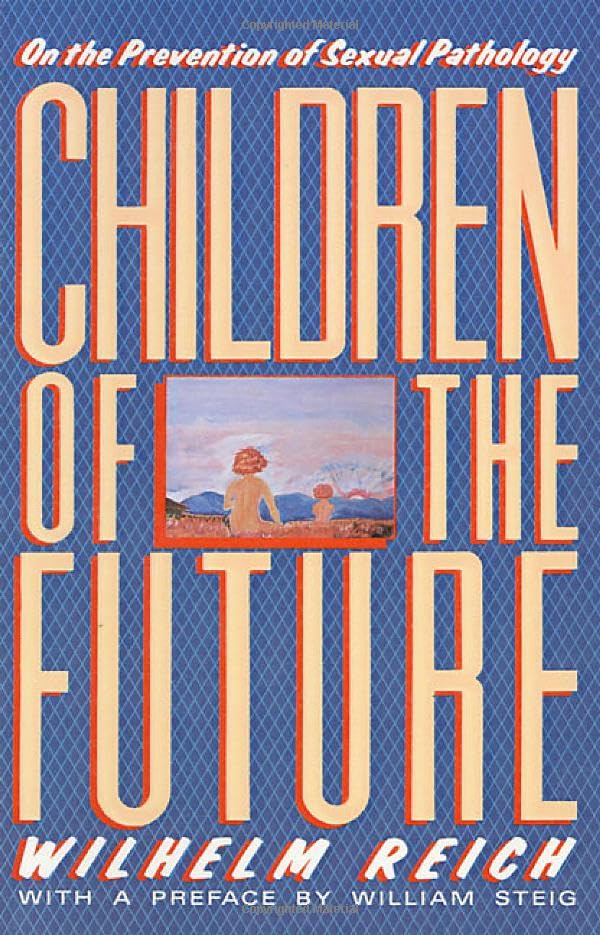
Wilhelm Reich engaged both theoretically and practically with the protection and promotion of human potential. His proposals, some of which he himself implemented and documented, include support for expectant mothers, natural childbirth,[71] loving care for infants and toddlers as they grow up in non-authoritarian, life-affirming environments, gender equality, joyful sexuality, and holistic therapeutic approaches.
This can be read, among other places, in Reich’s book Children oft he Future, which I reviewed here.
Part of this volume, compiled posthumously from Reich’s works, originated in exchanges with his best friend, the Scottish pedagogue Alexander S. Neill.
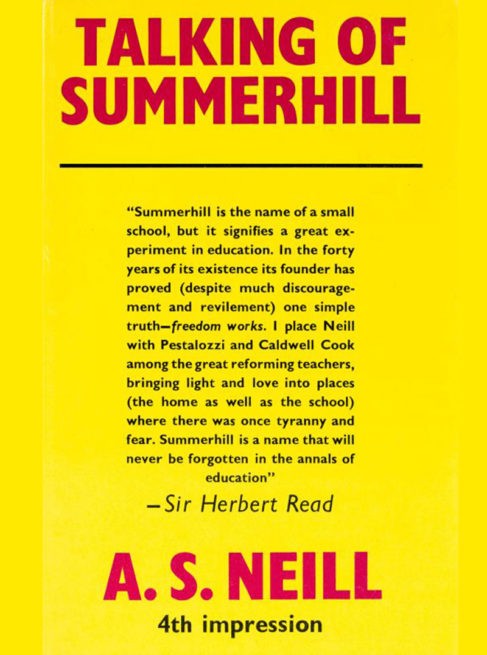
At his Summerhill School, non-authoritarian, democratic education and learning were and are still practiced today, often mistakenly labeled as “anti-authoritarian.” The small book Talking about Summerhill offers the most concise introduction to the fundamentals of this school project, which has been successful for over 100 years.
In 2024, I compiled excerpts from it into an German audiobook, which can be downloaded for free here and listened to.

In the second half of the 1980s, Hans-Joachim Maaz incorporated ideas from Reich, Neill, and others into his concept of a therapeutic culture and later developed this into relationship culture. With Behind the wall, I wish to highlight just one of his books.
Others are listed here.
From March 1989 to April 1991, I conducted interviews with Hans-Joachim Maaz for the (GDR) station Jugendradio DT 64, including discussions on therapeutic culture.
This also inspired the (German) book I published in 2000 together with the association ich.ev: Weltall, Erde, … ICH. Anregungen für ein (selbst)bewussteres Leben. 
The most important contributions from it can be read here.
They are divided into sections including:
– More Natural Birth
– More Accompanying, Less Educating
– Helping Oneself: Together and Alone
– Therapy: Allowing Oneself to Be Helped
– Freer Sexuality, Partnership, and Love
– More Communal Living, Working, and Life
***
Notes
[1] Peglau, A. (2024): People as Puppets? How Marx and Engels Suppressed the Real Psyche in Their Doctrine (https://andreas-peglau-psychoanalyse.de/people-as-puppets-how-marx-and-engels-suppressed-the-real-psyche-in-their-teaching/).
[2] Quoted ibid., p. 63. As early as 1845, Moses Hess and Engels had written that “the false […] proposition: ‘To each according to his abilities,’ […] must be transformed into the proposition: To each according to his needs” (Dr. Kuhlmann aus Holstein; MEGA Vol. 5, Berlin/Boston, pp. 590–601, here p. 599).
[3] Peglau 2024 (as in note 1), pp. 60–63.
[4] The teachings of Marx and Engels are not identical with what the term “Marxism” came to denote, much less with “Marxism-Leninism.” After Engels’ death, not only did simplification set in, but soon also the split into opposing, partly hostile “Marxisms” (ibid., pp. 6–7, notes 3, 4, 11).
[5] Such “laws” abound particularly in Capital, Marx’s magnum opus. Already in the preface, there is mention of “the natural laws of capitalist production,” which operate and prevail with “iron necessity.” As “ultimate purpose” of his book, Marx states there, is “to unveil the economic law of motion of modern society.” He regards the “development of the economic social formation” as a “natural-historical process.” There is no escaping these “laws,” Marx argued: “Even if a society has discovered the natural law of its motion […], it can neither skip over nor decree away the natural phases of development. But it can shorten and alleviate the birth pangs” (quoted ibid., pp. 41–45).
[6] At the beginning of their collaboration, this was not foreign to Marx and Engels either. In 1848, in the Communist Manifesto, they expressed their expectation that “bourgeois society” would be replaced by “an association” in which “the free development of each is the condition for the free development of all.” Yet individuals increasingly slipped from their view (ibid., pp. 60–63).
[7] Whereby “society” represents an abstraction, a broadly interpretable term for a multitude of people and the nature of their interactions. The Enzyklopädie Philosophie (2021, ed. by H. J. Sandkühler, Hamburg, p. 869) refers to the definition in the Lexikon der Soziologie: Society “as the most comprehensive system of human coexistence in any given context.” Around 1857, Marx argued that “society does not consist of individuals”; rather, it expresses only “the sum of the relationships and conditions” “in which these individuals stand in relation to one another”—interpersonal relationships, that is, without people: an irresolvable contradiction (quoted in Peglau 2024, as in note 1, p. 60).
[8] Fromm, E. (1989): Wege aus einer kranken Gesellschaft, in ibid.: GA, Vol. 4, Munich, pp. 1–244, here p. 51.
[9] Peglau, A. (2025): We are not born warriors. On the psychosocial prerequisites for peacefulness and “warlike“ behavior (https://andreas-peglau-psychoanalyse.de/we-are-not-born-warriors-on-the-psychosocial-prerequisites-for-peacefulness-and-warlike-behavior/), p. 1.
[10] See Graeber, D./ Wengrow, D. (2021): Anfänge. Eine neue Geschichte der Menschheit, Stuttgart, S. 114f.; Bregman, R. (2020): Im Grunde gut. Eine neue Geschichte der Menschheit, Hamburg, p. 79f.
[11] The connection between the view of human nature and the social system is certainly taken into account in a negative sense: From the assertion that humans are innately evil, antisocial, destructive, or stupid, rulers often derive their right—indeed, their alleged duty—to control, manipulate, and punish.
[12] https://dorsch.hogrefe. com/stichwort/saeuglingsforschung.
[13] For details: Land, G./ Jarman, B. (1993): Breakpoint and Beyond: Mastering the Future – Today, New York. Summary available here, among other places: https://jugend-online-event.de/vom-genie-zum-angepassten-denken-und-handeln/. This study is also referenced in the 2013 film Alphabet – Angst oder Liebe by Erwin Wagenhofer (https://de.wikipedia.org/wiki/Alphabet_(Film)).
[14] We do receive an “education” in school. But how much of what we grapple with there during childhood and adolescence do we actually need later in life? I believe that conventional school systems primarily serve to instill discipline and conformity to social structures—and to impart the knowledge necessary to function within those structures.
[15] https://andreas-peglau-psychoanalyse.de/paradiesische-neun-monate-fruehe-praegungen-zur-gewaltbereitschaft-aus-sicht-der-vorgeburtlichen-psychologie/
[16] See also Dornes, M. (2001): Der kompetente Säugling. Die präverbale Entwicklung des Menschen. Frankfurt a. M.; Dornes, M. (2001): Die frühe Kindheit. Entwicklungspsychologie der ersten Lebensjahre. Frankfurt a. M.; Stern, D. N. (2002): Tagebuch eines Babys. Was ein Kind sieht, spürt, fühlt, denkt. München/ Zürich.
[17] https://www.deutschlandfunkkultur.de/entwicklungspsychologie-babys-sind-kleine-moralapostel-100.html. For more details: Bloom, P. (2014): Jedes Kind kennt Gut und Böse – Wie das Gewissen entsteht, München.
[18] https://www.cell.com/current-biology/fulltext/S0960-9822(15)00558-8? _returnURL=https%3A%2F%2Flinkinghub.elsevier.com%2Fretrieve%2Fpii%2FS0960982215005588%3Fshowall%3Dtrue. See also: https://sciencev2.orf.at/stories/1759992/index.html.
[19] https://www.familienhandbuch.de/babys-kinder/bildungsbereiche/soziale/EmpathieundsozialesVerstehenindenerstenLebensjahren.php. See also: Bischoff-Köhler, D. (2011): Bischoff-Köhler, D. (2011): Soziale Entwicklung in Kindheit und Jugend, Stuttgart.
[20] https://www.mpg.de/4658054/Kooperation_bei_Kleinkindern
[21] See, e.g., Hüther, G. (2003): Die Evolution der Liebe. Was Darwin bereits ahnte und die Darwinisten nicht wahrhaben wollen. Göttingen; Solms, M./ Turnbull, O. (2004): Das Gehirn und die innere Welt. Neurowissenschaft und Psychoanalyse. Düsseldorf/ Zürich, S. 138ff., 148; Tomasello, M. (2010): Warum wir kooperieren, Berlin; Klein, S. (2011): Der Sinn des Gebens. Warum Selbstlosigkeit in der Evolution siegt und wir mit Egoismus nicht weiterkommen. Frankfurt a. M.; Bauer, J. (2011): Schmerzgrenze. Vom Ursprung alltäglicher und globaler Gewalt. München; Bregman, R. 2020 (as in note 10); Peglau 2025 (as in note 9).
[22] As early as 1845, in the manuscripts for Die Deutsche Ideologie, Marx and Engels reduced what was important about “real individuals” and their living conditions to “the physical [!] organization of these individuals & their resulting relationship to the rest of nature.” “One could ‘distinguish humans from animals through consciousness, through religion, through whatever else one wishes.’” Here, consciousness is degraded to one distinguishing feature among many, while simultaneously being placed on the same level as religion, which Marx and Engels combated as irrational. In truth, humans begin “to distinguish themselves from animals as soon as they begin to produce their food, a step that is conditioned by their physical organization.” What “humans say, imagine, or conceive,” on the other hand, are “mists in the brain […], necessary sublimations of their material, empirically verifiable, and to material conditions bound life process.” Morality, religion, ideology, and their corresponding “forms of consciousness” possess neither “autonomy” nor “history” nor “development.” “For me […] the ideal is nothing other than the material translated and transformed in the human mind,” Marx then informed his readers in the second edition of Capital. To justify their predictions of political upheavals, however, Marx and Engels switched, when necessary, to the assumption that economic processes inevitably generated among workers an awareness of their situation, including a willingness and capacity for revolution (cited in Peglau 2024, as in note 1, p. 29; see also pp. 45–47 there) .
[23] Wilhelm Reich (1986, Die Massenpsychologie des Faschismus, Köln, p. 11) spoke here of the “biological” core that enables us to be “an honest, hardworking, cooperative, loving, or, when justified, rationally hating animal under favorable social circumstances.”
[24] Sigmund Freud, who, however, conceived of humans as innately antisocial, quite rightly proceeded from a “dynamic conception of mental processes” (https://www.freudedition.net/node/226697).
[25] See Wohlleben, P. (2015): Das geheime Leben der Bäume. Was sie fühlen, wie sie kommunizieren – die Entdeckung einer verborgenen Welt, München.
[26] In German, the words “peace,” “peaceful,” and “content” are closely related (https://www.dwds.de/ wb/etymwb/Zufriedenheit).
[27] Patriarchal, meaning ruled by men, is too narrow a definition. In these societies, the majority of the population—men and women alike—is oppressed by those in power, who may also include women. While men usually dominate within the family, they oppress the children together with their wives. And: The suppression of healthy feelings and aspirations affects every member of such societies: There can be no question of mental health, even at the top of the social hierarchy.
[28] Whatever may burden or harm us even in our prenatal developmental phase: it does not make us bad people. Moreover, pre- and perinatal damage would likely heal in most cases if those affected could subsequently grow up in an environment truly tailored to their needs—which, as a rule, is not the case.
[29] This corresponds to the well-known line from the Communist Manifesto: “The ruling ideas of an era have always been nothing more than the ideas of the ruling class.” Marx and Engels, however, never explored the question of how this transfer of ideas takes place (see Peglau 2024, as in note 1, pp. 15ff.). It was Wilhelm Reich (1933, Charakteranalyse. Technik und Grundlagen für studierende und praktizierende Analytiker, n.p., p. 12) provided the developmental-psychological basis: “In class society, it is the respective ruling class that, with the help of education and the family institution”—today one would have to add the media—“secures its position by making its ideologies the dominant ideologies of all members of society.”
[30] https://andreas-peglau-psychoanalyse.de/vom-nicht-veralten-des-autoritaeren-charakters/
[31] Reich, W. (2020): Massenpsychologie des Faschismus. Der Originaltext, Gießen, p. 38.
[32] Fromm, E. (1989): Die Furcht vor der Freiheit, in ibid.: GA, Vol. 1, München, pp. 215–392.
[33] Reich, W. 2020, (as in note 31), p. 40.
[34] https://www.bibleserver.com/NLB/Matth%C3%A4us18
[35] Quoted in Peglau 2024 (as in note 1), p. 47f.
[36] See ibid. Although he knew at the end of his life that the vast majority of human history lay in unexplored darkness, Engels continued to praise Marx’s and his own doctrine as a “conception of the course of world history,” which sees the cause of “all important historical events […] in the economic development of society” (quoted ibid., p. 59). He adhered to the “economic laws of nature” in any case. Graeber and Wengrow (2021, as in note 10) demonstrate just how little the sequence of economic formations assumed by Engels and Marx held true. See also Peglau 2024 (as in note 1), pp. 29–33, 47–49, 68–70.
[37] https://de.wikipedia.org/wiki/Geschichte_der_Schrift
[38] Nor does it apply to Neanderthals, who existed as a distinct species as early as 450,000 years ago and who, according to current research findings, must also be included in the assumption of “psychic unity” (see Peglau 2025, as in note 9, p. 6).
[39] Sala-et-al_PONE or https://www.researchgate.net/figure/Cranium-17-bone-traumatic-fractures-A-Frontal-view-of-Cranium-17-showing-the-position_fig4_277326376; https://www.20min.ch/story/cranium-17-das-aelteste-mordopfer-der-geschichte-162218687169.
[40] Meller, H., Michel, K., van Schaik, C. (2024): Die Evolution der Gewalt. Warum wir Frieden wollen, aber Kriege führen, München, p. 146.
[41] Ibid., p. 139.
[42] Peglau 2025 (as in note 9), p. 5.
[43] https://de.wikipedia.org/wiki/Staatsentstehung
[44] And indeed in every one of these areas. Naomi Klein (Die Entscheidung. Kapitalismus vs. Klima, Frankfurt a. M., 2016) has documented this in detail with regard to ecology.
[45] There is no consensus on what “capitalism” is (see Sandkühler 2021, as in note 6, pp. 1192–1212). I use “capitalism” as a synonym for a system in which means of production, businesses, and industrial sectors are so heavily in private ownership that wealth and political power are concentrated in the hands of individual entrepreneurs to such an extent that society is largely dominated by them—a situation that a bourgeois sham democracy does nothing to change. China is currently demonstrating that it may be sufficient to drastically reduce and control the capitalist economic sector in order to create a society worthy of human dignity. See also: https://andreas-peglau-psychoanalyse.de/andreas-peglau-utopie-oder-dystopie-zitate-und-notizen-zu-china-mai-2020-bis-oktober-2021/
[46] It would, however, be foolish to assume that there is an official government master plan for this. Those pursuing political careers in this state are likely indifferent to or unaware of (depth) psychological dynamics. Moreover, it is entirely sufficient to restructure people in the authoritarian manner described—they will then generally act of their own accord in such a way that they do not come into overly threatening conflict with prevailing conditions.
[47] https://www.destatis.de/DE/Presse/Pressemitteilungen/2025/05/PD25_N024_23.html. Frederick Leboyer, for example, describes alternatives in books such as Geburt ohne Gewalt, München, 1995. By making hospitals the norm for births, a natural process in which 96% of children are born healthy and without complications has been pathologized and—in the West—commercialized. This is further supported by the fact that since 2010, independent midwives, who often offer more natural birthing practices, have been forced to give up their practice due to drastically increased liability insurance premiums (http://www.hebammenfuerdeutschland.de/protest) .
[48] “The totality of these relations of production constitutes the economic structure of society, the real basis upon which a legal and political superstructure rises and to which certain forms of social consciousness correspond. […] At a certain stage of their development, the material productive forces of society come into conflict with the existing relations of production […]. An epoch of social revolution then begins. With the change in the economic foundation, the entire immense superstructure is overthrown more slowly or more rapidly.” Marx never discussed this “superstructure” in depth (quoted in Peglau 2024, as in note 1, p. 55f.).
[49] https://de.wikipedia.org/wiki/Volkskammerwahl_1990.
[50] Wilhelm Reich (2020), as in note 31, p. 195.
[51] Cf. https://andreas-peglau-psychoanalyse.de/wp-content/uploads/2007/11/WR_Ausstellung.pdf, pp. 8 and 16.
[52] Reich, W. (1997): Christusmord. Die emotionale Pest des Menschen, Frankfurt a. M. Similar ideas also run through Reich’s Rede an den kleinen Mann, available here in German in an abridged form as an audiobook: https://andreas-peglau-psychoanalyse.de/wilhelm-reichs-rede-an-den-kleinen-mann-auszuege-hoerbuch-kostenlos-herunterladen-und-anhoeren/
[53] Erich Fromm, who spoke of the “pathology of normality,” devoted an entire book to such ways (see note 8).
[54] Another conceivable formulation would be: holistic revolution. But this term is used so inflationarily and is so vague that I do not wish to use it.
[55] I had not yet been able or willing to fully grasp this, and had previously classified the psychosocial revolution merely as an important supplement.
[56] This, too, is an idea that can already be found, at least implicitly, in Reich’s work when he writes—for example, in Massenpsychologie (as in note 31)—about the inseparable interrelationships between sexuality, education, religion, and politics.
[57] See Mittelstraß, J. (ed.) (2004): Enzyklopädie Philosophie und Wissenschaftsgeschichte. Stuttgart/ Weimar,, vol. 3, pp. 857–859. The distinction between the terms “socialism” and “communism” (ibid., pp. 425ff.) is also vague. Marx and Engels initially used both terms synonymously, soon distinguished them more clearly, but later attached less importance to this distinction again.
[58] Quoted in Peglau 2024, as in note 1, p. 8.
[59] Fromm, E. (1989): Die Anatomie der menschlichen Destruktivität, in ibid.: GA, Vol. 7, München, p. 395.
[60] See, among others: https://andreas-peglau-psychoanalyse.de/ddr-2-0-und-friedensbewegung/; https://andreas-peglau-psychoanalyse.de/ddr-2-0-oder-wo-leben-wir-heute/
[61] See Hertle, H.-H./ Stephan, G.-R. (2014): Das Ende der SED. Die letzten Tage des Zentralkomitees, Berlin.
[62] See, for example, https://www.telepolis.de/article/Millionen-Tote-fuer-Demokratie-und-Freiheit-9191381. html?seite=all; https://de.wikipedia.org/wiki/Patrice_Lumumba; https://de.wikipedia.org/wiki/Salvador_Allende; https://de.wikipedia.org/wiki/Vietnamkrieg; https://de.wikipedia.org/wiki/Operation_Ajax.
[63] Marx, K. (1976[Rede auf dem Haager Kongreß], MEW, Vol. 18, Berlin/GDR, pp. 159–161, here p. 160.
[64] Ibid., pp. 160f.
[65] Engels, F. (1891): Zur Kritik des sozialdemokratischen Programmentwurfs, MEW, Vol. 22, Berlin/GDR, p. 234.
[66] https://innn.it/Demokratieheilen
[67] https://archive.org/details/Parell_1934_Was_ist_Klassenbewusstsein_k, p. 56. Annotated excerpts from this book: https://andreas-peglau-psychoanalyse.de/die-mehrzahl-lebt-ihr-unterjochtes-dasein-unbewusst-wilhelm-reichs-weiterfuehrung-der-massenpsychologie-des-faschismus-im-jahr-1934/
[68] See Peglau 2025 (as in note 9), p. 9.
[69] See: https://andreas-peglau-psychoanalyse.de/meine-annaeherungen-an-die-psychoanalyse-in-ddr-und-brd-von-1957-bis-2000/
[70] Marx applied the label “capital” to a hodgepodge that could not be reduced to a common denominator, merging things, people, processes, conditions, relationships, calculations, the real and the unreal into a unity that was merely suggested. He was therefore never able to define “Capital.” His magnum opus revolves around something that does not exist. For a more detailed account, see Peglau 2024 (as in note 1), pp. 33–39.
[71] Reich’s older daughter, Eva Reich, continued this work; see https://weltall-erde-ich.de/schwangerschaft-geburt-und-selbststeuerung/. See also the bibliographic reference in note 49.
Last accessed: March 8, 2026
Please cite as:
Andreas Peglau (2026): People are no puppets! A utopia that goes beyond Karl Marx—and whose realization can begin tonight (https://andreas-peglau-psychoanalyse.de/people-are-no-puppets-a-utopia-that-goes-beyond-karl-marx-and-whose-realization-can-begin-tonight/)
This is a DeepL translation I have not checked. I apologize for any errors and inaccuracies that are sure to occur. Please use the original German text for comparison: https://andreas-peglau-psychoanalyse.de/menschen-sind-keine-marionetten-eine-utopie-die-ueber-karl-marx-hinausgeht-und-deren-verwirklichung-heute-abend-beginnen-kann/
© 2026 Andreas Peglau – All rights reserved. Löcknitzer Str. 33, 17309 Pasewalk
info@andreas-peglau-psychoanalyse.de
The forwarding and distribution of this text for non-commercial purposes is expressly encouraged. Licensed under a Creative Commons licence (Attribution – Non-commercial – No Derivatives 4.0 International).
Read more: People as Puppets? How Marx and Engels Suppressed the Real Psyche in Their Teaching,[