Schlagwortarchiv: Menschenbild

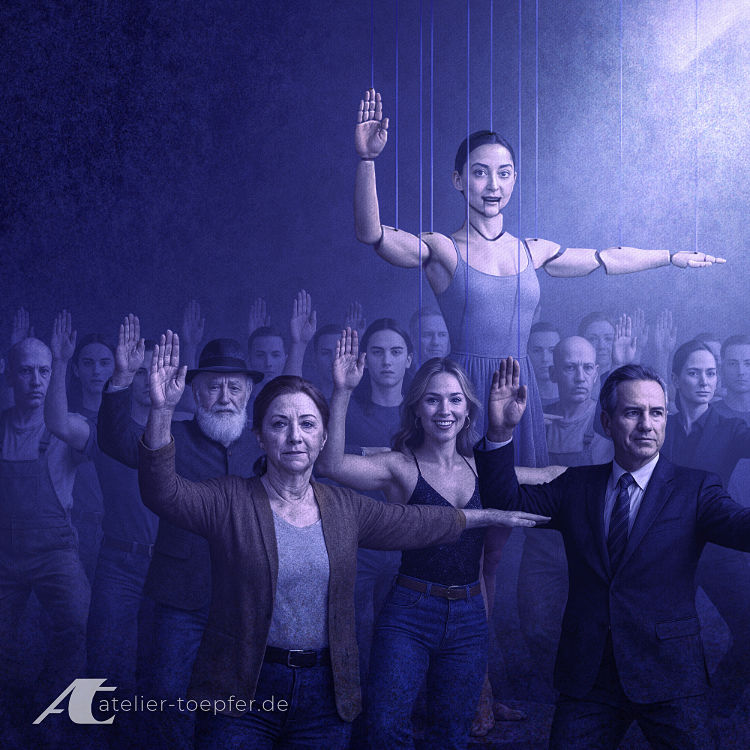
People as puppets? How Marx and Engels suppressed the real psyche in their teaching, Part 6: Strange beings and „social laws of nature“

by Andreas Peglau


Download the entire text as a PDF file.


Strange beings

In 1843, Marx wrote that „money“ had „deprived the whole world, humanity as well as nature, of its peculiar value,“ „this alien being dominates him, and he worships it.“[1]

In 1844, he attested that labour „produces itself and the worker as a commodity.“[2] In Capital, we then learned that „commodity“ „loves money,“[3] is „a very complicated thing […], full of metaphysical subtleties and theological quirks“ as well as internal communication possibilities. The commodity „canvas,“ for example, reveals „as soon as it comes into contact with another commodity, the skirt,“ „its thoughts in the language familiar only to it, the language of commodities.“[4] We hear that „value“ becomes „the subject [!] of a process, in which it […] changes its own size, […] exploits itself. […] It gives birth to living young or at least lays golden eggs,“ transforming itself into an „automatic subject.“[5]

Marx endowed the relations of production with the same power and vitality as capital by equating the two: „capital is“ a „relation of production belonging to a particular historical formation of society“.[6] He proceeded in the same way with the means of production („Capital is the means of production transformed into capital“)[7] and money: „Every new capital enters the stage for the first time […] still as money.“[8] Weiterlesen

People as puppets? How Marx and Engels suppressed the real psyche in their teaching, Part 7: Doubtful pre- and review, wishful thinking

by Andreas Peglau


Download the entire text as a PDF file.


Questionable foresight

Wikipedia tells us that there is no „precise, uniform and conclusive definition of the term“ natural law and that this word is used „in natural sciences and scientific theory to describe the regularity of natural phenomena that is independent of place and time and based on natural constants“. Because of the latter characteristics, natural laws allowed „observable events to be explained and predicted“.[1] However, many of the predictions made by Marx and Engels did not come true, especially with regard to political upheavals. Weiterlesen

People as puppets? How Marx and Engels suppressed the real psyche in their teaching, Part 8: From Immanuel Kant to child labour

by Andreas Peglau


Download the entire text as a PDF file.


Manufactured immaturity

In 1784, the 60-year-old philosopher Immanuel Kant published his essay Answering the Question: What is Enlightenment? Kant begins with a bang:

Enlightenment is man’s emergence from his self-imposed immaturity. Immaturity is the inability to use one’s understanding without the guidance of another . This immaturity is self-imposed when its cause lies not in a lack of understanding, but in a lack of resolve and courage to use it without the guidance of another. Sapere aude! Have the courage to use your own understanding! is therefore the motto of enlightenment.“[1]

Weiterlesen

People as puppets? How Marx and Engels suppressed the real psyche in their teaching, Part 9: Vulgar psychology, half-hearted mitigations and conclusion

by Andreas Peglau


Download the entire text as a PDF file.


Vulgar psychology

In his 1933 book Massenpsychologie des Faschismus, Wilhelm Reich dealt with „vulgar Marxism“ – which he understood as the opposite of the teachings of Marx and Engels. According to Reich, vulgar Marxists „schematically separated social, mostly economic existence from existence itself,“[1] claimed that ideology and consciousness were „determined solely and directly by economic existence,“[2] and dismissed the study of drives, needs and mental processes as idealistic.

However, these accusations could also have been levelled at Marx and Engels in a milder form. They contradicted the idea that ideological processes were solely and directly determined by economics, albeit rarely. Although they viewed social existence in the context of „existence in general,“ they gave undue priority to economic existence. They did not deny the existence of psychological processes, but rather their real significance and momentum. Weiterlesen

People as puppets? How Marx and Engels suppressed the real psyche in their teaching, Part 10: Alternative ways of thinking

by Andreas Peglau


Download the entire text as a PDF file.


PART 2:

Alternative ways of thinking –

a suggestion for discussion


It is impossible to reconstruct what would have happened if Marx and Engels had set a different course around 1844, if they had taken the psyche into account in an appropriate manner. But I would at least like to run through some of their assumptions and see what happens when I confront them with what I consider to be sufficiently reliable knowledge today.
As I said at the beginning, I assume that we are born with the potential to be social, lovable, capable of love and in need of love, sociable, inquisitive and creative beings. This is not wishful thinking on my part, but has now been scientifically proven many times over.[1]
Perhaps others will pick up my threads and spin them further, in their own way, individually and self-confidently, in the spirit of Max Stirner and Kant’s motto: „Have the courage to use your own understanding!“ Weiterlesen

Wir sind keine geborenen Krieger. Zu psychosozialen Voraussetzungen von Friedfertigkeit und „Kriegstüchtigkeit“. Kostenloser Download des Hörbuchs


Hörbuch von Andreas Peglau

Gelesen von Felix Würgler und Saskia Rutner.
Klavier: Christina Schütz.
Produktion und Regie: Andreas Peglau.
Ton und Schnitt: Berthold Heiland.
Produziert im Juni 2025 im Hörbuch-Tonstudio Berlin.
Cover: Jan Petzold.
Dauer: ca. 55 Minuten.
Veröffentlichung: 22. Juni 2025, vierundachtzigster Jahrestag des Überfalls Hitler-Deutschlands auf die Sowjetunion.
Weiterlesen

Marxismus – eine „seelenlose“ Lehre? Tarek Al-Ubaidi im Gespräch mit Andreas Peglau. 

Sendung auf CROPfm vom 30. Mai 2025
(126 Minuten, Gesprächsbeginn nach ca. 8 Minuten).

https://cropfm.at/images/Menschen-als-Marionetten-750.jpg

Illustration: Matthias Töpfer >> atelier-toepfer.de


Karl Marx legte mit „Das Kapital“ einen Grundstein für die Entwicklung der kommunistischen Ideologie sowie sozialistischer und kommunistischer Staatsformen im frühen 20. Jahrhundert. Doch kam die von Marx vorhergesagte „Revolution“ viel später als angenommen und konnte auch die hohen in sie gesetzten Erwartungen nicht erfüllen. Andreas Peglau hat sich intensiv mit dem Marxismus – der Lehre, die „den Menschen“ befreien soll, deren Vertreter aber zumeist gar nicht wissen wollen, was Menschen sind – auseinander gesetzt und ist live zu Gast, um darüber zu reflektieren, wie „Marx und Engels die reale Psyche in ihrer Lehre verdrängten“.

Wir sind keine geborenen Krieger. Zu psychosozialen Voraussetzungen von Friedfertigkeit und „Kriegstüchtigkeit“

von Andreas Peglau[1]


Download als pdf

Übersetzungen in zwanzig Sprachen

Hörbuch-Download


Seit die Menschen existieren …

„Als Krieg wird ein organisierter und unter Einsatz erheblicher Mittel mit Waffen und Gewalt ausgetragener Konflikt bezeichnet, an dem planmäßig vorgehende Kollektive beteiligt sind. Ziel der beteiligten Kollektive ist es, ihre Interessen durchzusetzen. […] Die dazu stattfindenden Gewalthandlungen greifen gezielt die körperliche Unversehrtheit gegnerischer Individuen an und führen so zu Tod und Verletzung.“ Wikipedia[2]

Von dem antiken griechischen Philosophen Heraklit (circa 520 v.u.Z. – 460 v.u.Z.) ist der Satz überliefert: „Der Krieg ist der Vater von allen.“[3] 1642 schrieb der englische Philosoph Thomas Hobbes vom „Krieg aller gegen alle“ als ursprünglichen, als Naturzustand.[4] Knapp 300 Jahre später knüpfte Sigmund Freud an einen anderen Ausspruch von Hobbes an und behauptete: „Der Mensch ist des Menschen Wolf“, eine „wilde Bestie, der die Schonung der eigenen Art fremd ist“, beruhend auf einer „primären“ – also vorgegebenen, angelegten – „Feindseligkeit der Menschen gegeneinander“.[5]

Wäre es so, müssten wir uns keine Gedanken darüber machen, wie es zu Kriegen kommt oder wessen Interessen in Kriegen umgesetzt werden: Es liegt uns halt irgendwie in den Genen … Das hieße zudem: Kriege wären auf Dauer kaum zu vermeiden. Und wenn überhaupt, dann nur um den Preis, unsere wahre Natur, unsere „Anlagen“ zu unterdrücken.
Weiterlesen

Wir sind keine geborenen Krieger. Übersetzungen


Download des deutschen Textes als pdf

Text auf meiner Webseite lesen

Kostenloser Hörbuch-Download


Da mir dieser Text sehr wichtig ist, habe ich ihn von DeepL in zwanzig Sprachen übersetzen lassen.
Diese Übersetzungen konnte ich nicht überprüfen. Die daher mit Sicherheit entstandenen Fehler oder Ungenauigkeiten bitte ich zu entschuldigen.  Weiterlesen

We are not born warriors. On the psychosocial prerequisites for peacefulness and “warlike“ behavior

by Andreas Peglau[1]


(This is an partially unchecked translation by DeepL. Please excuse any errors that sure have occurred.
Here you can download this text as pdf.)


Since humans have existed …

“War is defined as an organized conflict involving the use of weapons and violence, carried out by groups acting in a planned manner. The goal of the groups involved is to assert their interests. … The acts of violence that occur in this context are aimed at the physical integrity of opposing individuals and thus lead to death and injury.” (Wikipedia)[2]

The proposition “War is the father of all” has been handed down from the ancient Greek philosopher Heraclitus (approx. 520 BCE – 460 BCE).”[3] In 1642, the English philosopher Thomas Hobbes wrote of the “war of all against all” as the original, natural state.[4] Almost three hundred years later Sigmund Freud picked up another saying, quoted by Hobbes from the Roman playwright Plautus, and maintained that “Man is a wolf to man,” a “savage beast to whom consideration towards his own kind is something alien,” based on a “primary” — that is, a given, inherent — “mutual hostility of human beings.”[5]

Were this so, we wouldn’t have to mull over how wars come about or whose interests are transacted in wars: it is just in our genes somehow …. This would also mean that wars could hardly be avoided in the long run. And if they could be avoided at all, then that would be only at the cost of suppressing our true nature, our ‘natural disposition.’ Weiterlesen